
Read this guide in
FROZEN DESSERT GUIDE
Natural Sweetener Blends for Ice Cream and Frozen Desserts
Sweetener blends for reduced-sugar ice cream and frozen desserts: monk fruit, stevia and allulose systems for freezing, overrun and melting.
Ice cream and frozen desserts are not simple sweetener swaps. Sugar affects sweetness, freezing point, solids, body, iciness, meltdown, flavor release and scoopability.
This guide is for dairy ice cream, plant-based frozen dessert, gelato, sorbet, frozen yogurt, frozen novelty and private-label buyers comparing monk fruit, stevia, allulose or erythritol-free sweetener systems.
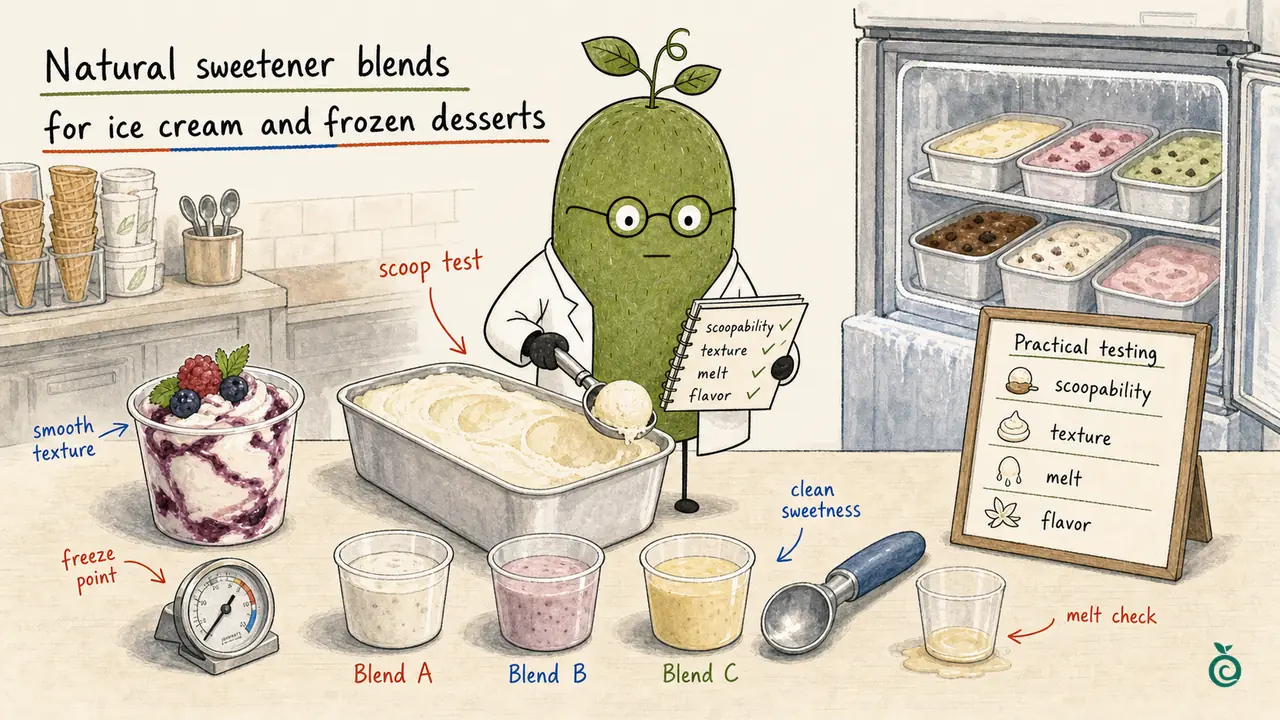
Judge the frozen product at its serving condition
Compare scoopability, texture, melting and flavor after the intended freezing and hardening process. The drawn Blend A/B/C cups, tick marks and dial illustrate checks to plan, not tested formulas, a ranking or a measured freezing point. The scoops and cabinet do not establish a recipe, production capability or shelf life.
Define the frozen dessert format
A dairy ice cream, high-protein pint, plant-based dessert, sorbet, gelato, frozen bar and soft-serve mix each needs a different balance of sweetness, solids, fat, protein, stabilizer and freezing behavior.
Separate sweetness from texture
Monk fruit and stevia can provide sweetness at low use levels, but they do not replace sugar's physical role in freezing point control or body. A Wageningen model study linked hardness and melting time mainly to ice content, while serum-phase viscosity was more important for delaying melting onset. The model is useful for planning measurements, not for predicting a finished commercial product. Source: https://edepot.wur.nl/696739
Use allulose only where the market allows it
Allulose can be useful in permitted markets because it may support body and sugar-like taste while affecting freezing behavior. U.S. label treatment, EU novel-food status and Australia/New Zealand production-route rules are not interchangeable. Confirm the target market, finished food category, ingredient identity and label plan before using an allulose-supported sample direction.
Watch crystallization and aftertaste
Erythritol can bring a cooling effect and crystallization risk in some frozen systems, while stevia and monk fruit can show linger or bitterness if the flavor base is weak. A 2026 Wageningen model found that smaller ice crystals could form a harder, more connected structure in its simplified system, so ice crystal size should not be treated as a single quality score. Check sweetness onset, aftertaste, iciness, scoopability and storage texture together. Source: https://edepot.wur.nl/705184
Start with the frozen dessert and the problem
Tell Hengliyuan the frozen dessert format, final sales market and the sweetness, iciness, hardness or melting issue you want to resolve. Share the known base, ingredient restrictions, process and package; if these are still being developed, describe the intended product and reference. A final formula or order quantity is not required to begin. Before a comparison, identify the material and formula version, fat and protein sources, total solids, stabilizer/emulsifier system, aeration, freezing and hardening route, package and serving condition. After the sample direction is useful, confirm the specification, receiving pack, trial or repeat quantity, requested documents and delivery terms. This is a sweetener ingredient or blend discussion; identify a finished frozen dessert manufacturing request separately so supply fit can be confirmed.
Keep the comparison basis with each result
A softer scoop can result from several changes in the complete product. Record the formula and process differences before deciding which observation should guide the next trial.
| Check | Record alongside the result | Decision it supports |
|---|---|---|
| Sweetness and finish | Full material identity, actual addition, base, tasting procedure and serving temperature | Does the hardened product meet the taste target? |
| Solids and water | Complete formula by mass; water and solids brought by syrups or other ingredients | Which physical functions still need support? |
| Scoopability or hardness | Defined method, hardening and storage history, sample temperature and time before testing | Is the result suitable for the intended serving condition? |
| Overrun / aeration | Defined same-volume method, net weights and the corresponding mix reference | Is a texture change being confused with a change in air incorporation? |
| Melting behavior | Sample amount and geometry, ambient condition, setup, first drip and subsequent melt observations | Does the melt profile suit the product, without assuming slower is always better? |
| Storage response | Final package, temperature history and agreed checkpoints; texture and ice sensation separately | What changes need another trial or the full validation plan? |
Set the checkpoint schedule for the actual product and intended life. A short frozen sample comparison can guide development; it does not establish commercial shelf life. The existing controlled-trial guide explains the overrun calculation and its limits.
What the latest ice cream study adds
A 2025 International Dairy Journal study compared 15% and 30% sucrose replacement with trehalose, erythritol and isomalt in Fiordilatte ice cream. Overrun, melting, emulsification stability and sensory results changed with the ingredient and level. It supports a control-plus-candidates sample matrix, not a fixed replacement formula. Source: https://doi.org/10.1016/j.idairyj.2025.106339
A published example keeps the replacement mass visible
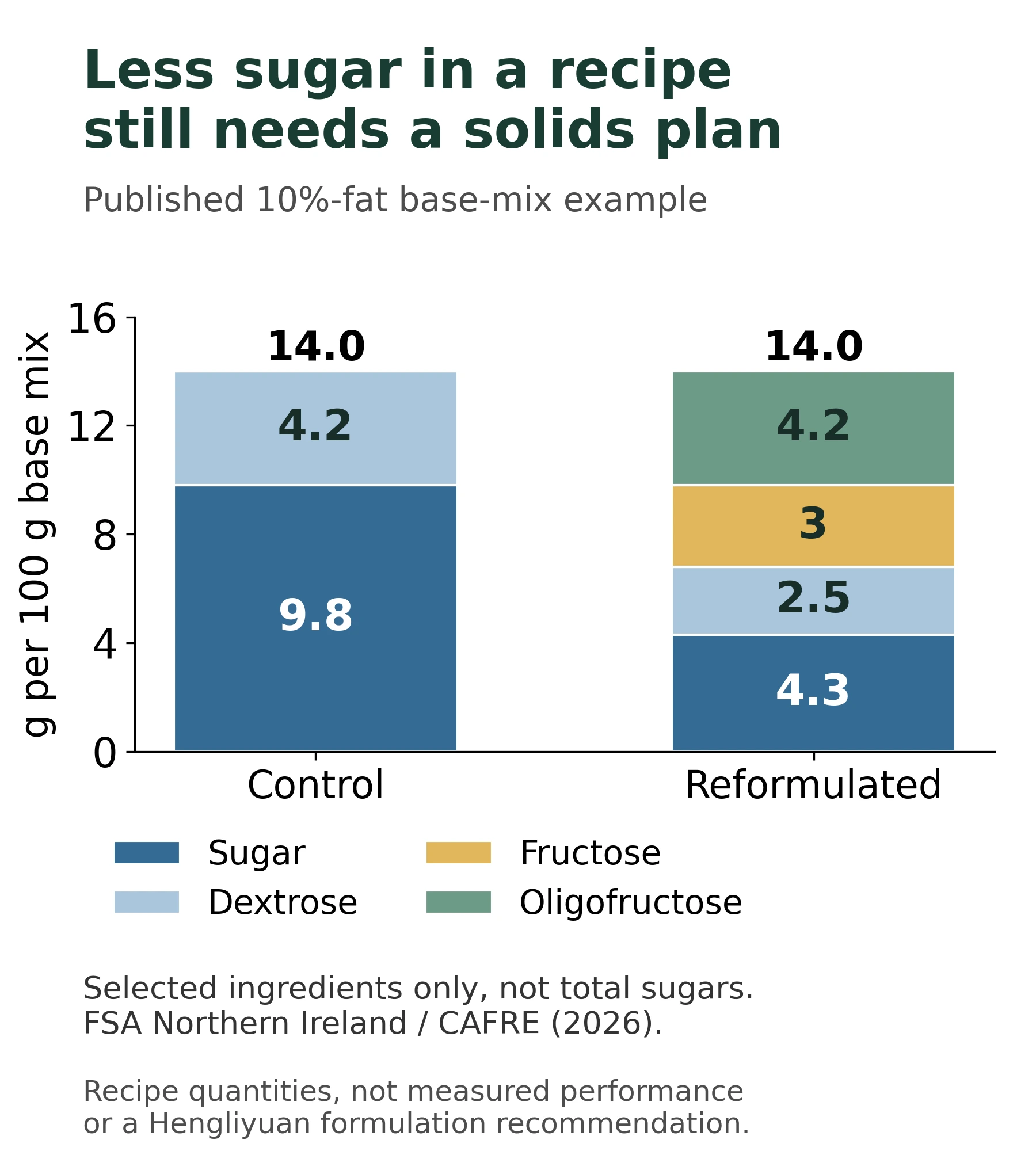
The FSA Northern Ireland / CAFRE suggested 10%-fat base-mix example changes several ingredients together. It illustrates a system change, not an isolated sweetener comparison.
| Selected recipe ingredient | Control (g/100 g mix) | Reformulated (g/100 g mix) |
|---|---|---|
| Sugar | 9.80 | 4.30 |
| Dextrose | 4.20 | 2.50 |
| Fructose | Not listed (dash) | 3.00 |
| Oligofructose | Not listed (dash) | 4.20 |
Technical references and boundary
The FSA Northern Ireland / CAFRE guidance was published in June 2026 and applies to Northern Ireland; its suggested recipes do not authorise a different product or market. The IFST sugar reformulation brief discusses the technical roles that need attention when changing sugars. Use these references to plan comparisons, then review the actual formula, label and intended market separately.
Compare allulose candidates at a defined serving condition
For a frozen dessert comparison, document the allulose form, full formula, preparation method, freezing conditions and intended serving temperature. Account for water and solids when comparing syrup with powder. Decide whether the first trial holds the formula conditions fixed or adjusts sweetness with another ingredient, and record that choice; otherwise a change in sweetness can become confused with several simultaneous formulation changes. Compare hardness or scoopability at the same defined serving condition, taste using a consistent procedure, and observe melt behaviour with the same sample quantity and setup. Record each result separately against the desired product profile. A slower melt is not automatically a better product, and a preferred taste does not prove storage performance. Use the results to choose the next controlled trial rather than inferring the required allulose level from one observation.
Common questions
Can monk fruit or stevia replace sugar in ice cream?
They can supply sweetness at low use levels, while the complete formula still needs to address body, solids, water and freezing behavior. Compare the actual extract or blend in the hardened product against your reference; matching the sweetness of a liquid mix does not establish the same frozen texture.
Discuss the frozen-dessert sample directionWhy can two equally sweet frozen desserts scoop differently?
They may differ in their full composition, water and solids balance, aeration, process or temperature history. Record those conditions with the hardness or scoopability result rather than assigning the difference to the sweetener name alone.
Discuss the frozen-dessert sample directionDoes the recipe chart prove a sugar-free product or a better blend?
No. It reproduces selected ingredient quantities from a published example, with other recipe context identified. It is not a total-sugars analysis, a performance trial or a finished-pack claim assessment, and it does not rank Hengliyuan blends.
Discuss the frozen-dessert sample directionShould I choose the candidate with the slowest melt?
Use the melt profile that fits the intended product and serving situation. Keep the setup and sample basis consistent and record first drip separately from later melting. Judge those results alongside taste, scoopability and storage texture.
Discuss the frozen-dessert sample directionCan the sample direction be allulose-based or erythritol-free?
State the intended market, ingredient restriction and frozen format. An allulose direction needs the actual ingredient and use route reviewed for that market. Excluding erythritol still leaves sweetness, solids and texture to resolve in the full formula; it does not establish a label claim.
Discuss the frozen-dessert sample directionWhat can I send before the formula and quantity are final?
Begin with the frozen dessert type, final sales market and the problem or product target. Add known base, process, ingredient and package details. We can clarify a sample direction before finalising the specification, quantity and quotation details.
Discuss the frozen-dessert sample direction