
Read this guide in
SAMPLE TESTING WORKFLOW
How to Choose a Monk Fruit Sweetener: A Sample-Testing Workflow for Product Developers
How to choose a monk fruit sweetener: a sample-testing workflow for beverages, powders and bakery, from test goal to quotation.
Choose a sample by defining the product goal, fixing a control, comparing coded trials, reviewing process and storage results, and agreeing a specification before quotation. This page covers the workflow; the companion sensory scorecard supplies the comparison record.
Evaluate a monk fruit sweetener sample in the product you plan to make. Keep preparation and serving conditions consistent with the current sweetener or control, then record the differences that matter to that application.
The workflow separates three decisions: what the sample is, what the real product test shows, and what documents or commercial details need confirmation. A sample result does not replace a batch COA or guarantee finished-product performance.
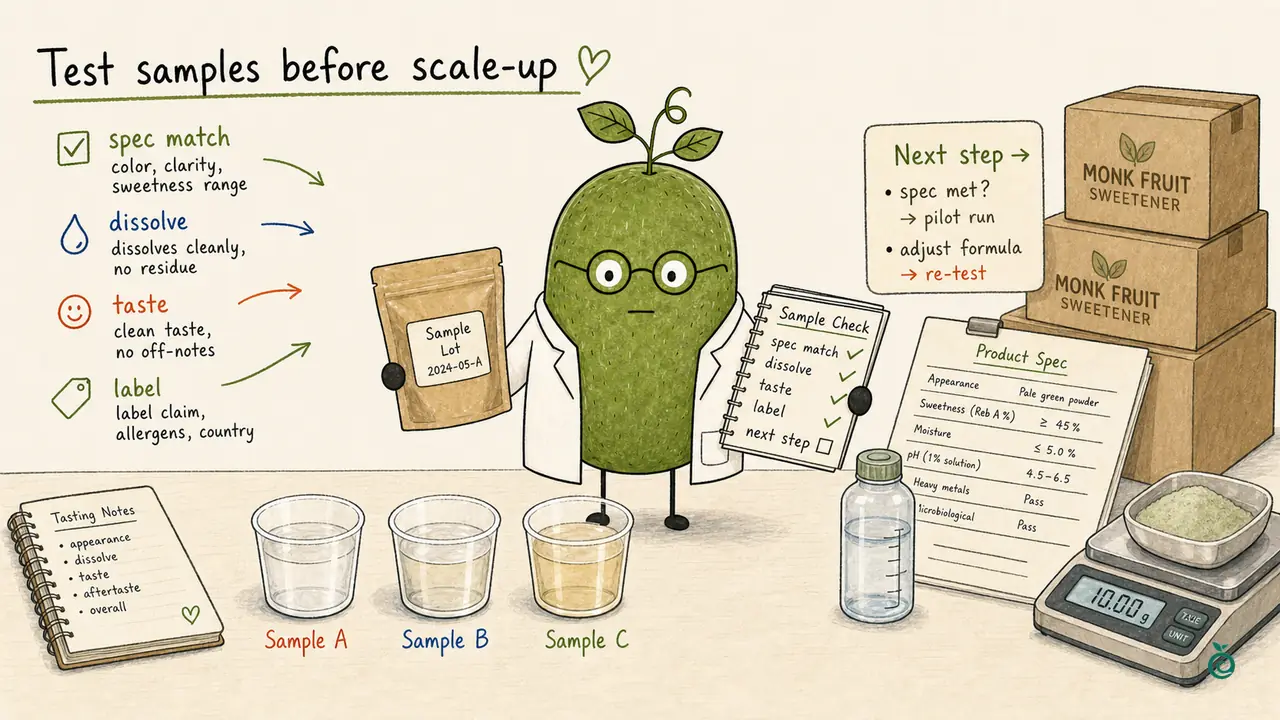
The Doctor illustration depicts coded samples and a review before pilot work. Its sample date, material description, Reb A entry, numerical limits, scale reading and pass marks are fictional, not monk fruit specifications or test records. Use product-specific documents and your recorded trial conditions for the actual decision.
Define the test objective
Identify whether the sample is for a beverage, coffee, tea, electrolyte powder, bakery product, tabletop sweetener sachet, jar, pouch, syrup or bulk ingredient blend. Match the test method to the intended use. Write the question and the decision criteria before tasting. Name which change matters most and which other properties must remain acceptable; use criteria for the actual product rather than a universal score for all applications.
Five decisions in the sample workflow
First define the decision. A drink with a lingering finish, a powder with lumps and a baking blend that changes spread need different comparisons. Write one main defect or target, the complete product type and the serving condition. Keep the current formula or an agreed sucrose benchmark as the control so the improvement has a reference. Second choose the materials. Request the exact product identity, grade, carrier, ingredient statement and sample batch documents. Identify what each candidate is expected to change. Avoid comparing an extract, a retail blend and a syrup by equal weight and treating the result as an ingredient ranking. Set the intended sweetness and document the actual dose and solids in each sample. Third prepare coded trials using one written method. Record weights, water, process, package and tasting conditions. If a sample is difficult to dose accurately, document its premix or stock rather than estimating with a spoon. Separate an initial water screen from a test in the actual product; only the latter addresses the application question. Fourth score the outcome and repeat the promising direction. Use the sensory scorecard to record sweetness, finish, body and relevant physical behavior. Add the actual process and storage checkpoints. A strong first-day tasting is a reason for the next test, not evidence of shelf life. If an outcome is unclear, repeat it before changing several variables. Fifth connect the accepted sample to a purchasing specification. Preserve the formula version, sample lot, agreed acceptance criteria, packaging and document requirements. Review the destination-market use and final label with the full formula. Ask for a quotation that matches those items so a low price for another grade or pack does not become the basis for ordering.
| Step | Evidence to keep | Next decision |
|---|---|---|
| Define | One question and current control | What must improve |
| Select | Identity, composition, specification and batch | Which candidates answer it |
| Prepare | Weights, process and coded sample record | Whether comparison is fair |
| Evaluate | Sensory scorecard and storage observations | Accept, revise or repeat |
| Specify | Approved version, market, packaging and files | Comparable quotation |
An incomplete preparation record is a reason to repeat the comparison, not to rank the ingredients. A useful sensory direction still leaves processing, storage, product documents and the selected purchasing specification to be checked. Keep those open questions next to the result instead of marking the whole project passed.
Prepare a simple comparison set
Compare the monk fruit sample with sugar, current sweetener, target competitor product or a control formula. Keep serving size, water volume, recipe, temperature and mixing method consistent. State whether you are comparing a fixed ingredient amount or aiming for matched sweetness. Record the actual commercial material added and any carrier, stock or replacement ingredients. If water, solids or another ingredient changes as well, identify that full recipe version rather than attributing every difference to monk fruit. A prepared stock record needs both the stock amount and the commercial material it contains.
Check taste in stages
Evaluate sweetness onset, middle taste, aftertaste, bitterness, cooling effect, mouthfeel and aroma interaction. For beverages, also test acidity and flavor balance. For bakery, test taste after baking and cooling. Use the same description or scale meaning across coded samples. Keep intensity, liking and a specific defect separate; a stronger sweetness score is not automatically a better product. Keep the preparation code with each repeat and avoid treating a single tasting as a stable ranking.
Review handling and processing
Check solubility, powder flow, clumping, sediment, color, odor, heat process, cold-water behavior, filling performance and storage behavior. These practical checks often decide whether the sample can scale. Record sample preparation, actual process conditions, the observation time and evaluation temperature. Visible particles or a clear cup are observations under that method, not a quantitative solubility specification. Name any storage checkpoint, pack condition and handling before comparing it with another sample.
Record feedback the supplier can act on
Avoid vague feedback such as not sweet enough or bad aftertaste. Better notes include target sweetness level, where the aftertaste appears, what formula was tested, dosage, temperature, pH or packaging behavior.
| Record | What to identify |
|---|---|
| Material | Sample reference, specification revision, analyte and carrier declaration. |
| Application | Real product base, process, serving condition and comparison control. |
| Observations | Dose, sweetness, finish, dispersion and handling under the same test conditions. |
| Next decision | Questions still open, changes for the next trial and required documents. |
Give feedback that can be acted on
Keep separate notes for taste and physical behavior. “Too sweet at the start, acceptable middle, lingering finish” gives a different instruction from “not sweet enough.” For dissolution, report temperature, addition order, mixing and the time when particles appear. For texture, report the method and stage: after cooling, after hardening or after a defined storage interval. Give each revision a new code and retain the earlier record. State which variable was changed and which stayed fixed. If the supplier changes the grade, carrier or material form, repeat the checks affected by that change rather than carrying forward an approval based only on a similar name. Ask for the updated specification when a candidate is selected. This workflow is a practical way to organize development evidence. It does not replace a product-specific safety, process or shelf-life assessment. Use those separate reviews to close the launch decision once the sample direction is technically useful.
Move from sample to quotation
When the sample gives a useful direction, separate the next steps: confirm product identity and batch documents, then discuss packaging, estimated quantity, documents, delivery timing and whether more samples are needed for a quotation. Use the extract inquiry for a concentrated ingredient, or the blend inquiry when the full composition is part of the brief. You can raise a trial problem before quantity and packaging are settled. Start with the actual product, sample code, control, tested dose and the observed difference; add the record or available notes. A useful response can be a clearer next comparison even when the current sample is not accepted.
Common questions
Is a water test enough to choose a monk fruit sweetener?
It can screen a candidate, but it does not answer the full application question. Compare it in the actual product under recorded preparation and serving conditions. Keep the water screen separate from the finished-product result.
Should all samples use the same weight of sweetener?
Decide the comparison goal first. Fixed ingredient amount and matched target sweetness answer different questions. Record the actual commercial ingredient, carrier or stock and complete recipe in each version; equal weight of an extract, blend and syrup is not a general measure of equivalent performance.
What if I cannot repeat the result?
Check the material identity, preparation code, weighing or stock record, mixing and evaluation conditions before ranking candidates. Keep the individual results and identify what changed. Repeat the unclear comparison rather than silently changing several variables.
Does a higher sensory score mean a better sample?
Only in relation to the stated scale and decision. Sweetness intensity, liking, aftertaste and a particular defect are different observations. Define the desired direction and product criteria before the comparison, and keep physical or process checks separate.
Does a good first-day sample establish shelf life or production readiness?
No. It identifies a direction for further work. Check the actual process, packaging and recorded storage checkpoints, then complete the product-specific safety and shelf-life reviews that the launch requires. A sensory result does not replace those assessments or a shipment batch COA.
What should I send when the sample did not work?
Send the sample and formula references, control, actual dose or stock basis, preparation conditions and the specific difference observed. Separate taste from physical behaviour, and identify when the defect appeared. Keep earlier versions so a change of material or recipe can be traced.
Can I ask for another sample before deciding the final order quantity?
Yes. Start with the product, current sample, comparison record and the question for the next trial. Add the target market and document needs when known. Packaging and quantity can be confirmed as the direction moves toward a matching quotation.
