
Read this guide in
DAIRY AND PLANT-BASED GUIDE
Monk fruit sweetener for dairy and plant-based products
Compare monk fruit in dairy drinks, yogurt, frozen desserts and plant bases. Separate sweetness, texture and process checks; investigate chilled milk-tea grit.
At Hengliyuan, we choose a monk fruit sweetener direction around the finished product: a dairy drink, yogurt, frozen dessert or a specific plant base. Sweetness is one part of the decision. Reducing sugar also changes the formula, so we review taste and the product's physical behaviour separately.
Start with the actual ingredient form, base and process, then compare with the current formula. The milk-tea grit investigation below is one application of that approach; it does not replace the checks needed for fermentation, frozen structure or a different plant base.
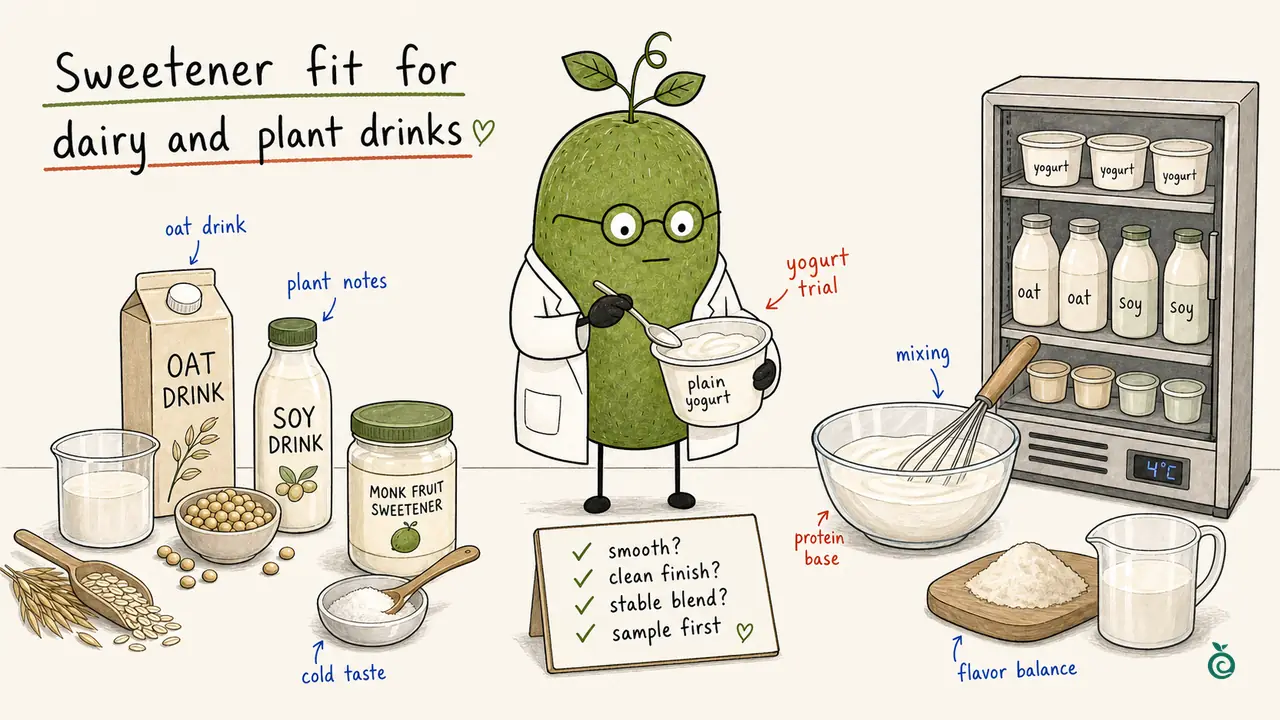
The Doctor illustration shows dairy, oat and soy samples, yogurt and mixing checks. Its ticks and drawn 4°C display are illustrative prompts, not test results or a storage specification for your product.
Choose the product and ingredient form first
A monk fruit extract supplies concentrated sweetness; a bulk sweetener blend also brings the other ingredients in that blend. Record the supplied material, carrier where present, actual addition and the mass basis. Do not exchange extract and a bulk blend gram for gram simply because both are sold as monk fruit sweeteners. Decide which finished-product question the next trial must answer. Keep the control, formula version, process and evaluation checkpoint identifiable; when you deliberately change solids or processing, record that as a separate formulation trial.
| Product route | Keep with the sample code | Evaluate separately from sweetness |
|---|---|---|
| Dairy or milk-tea drink | Complete base, addition order, heat/cooling history and serving condition | Grittiness, sediment or separation at the stated checkpoint |
| Yogurt or cultured plant base | Composition, addition stage, culture, fermentation endpoint and chilled storage | Acidity, gel/viscosity and water release using a defined method |
| Ice cream or frozen dessert | Complete formula, solids, processing, hardening and serving condition | Hardness, iciness, body and melt of the hardened product |
| Oat, soy, almond or coconut drink | Specific base/product code, full ingredients and intended process | Base flavour, mouthfeel and physical changes in that actual recipe |
Protein and fat can change taste perception
Milk or plant proteins, fat level and stabilizer systems can affect sweetness and aftertaste. Review the sample in the final flavor system and serving condition; a texture change should be logged separately from the taste score.
Plant-based bases need their own trials
Oat, soy, almond and coconut bases bring different flavor and solids. Test each intended base for sweetness, aftertaste, mouthfeel, sediment and process fit rather than carrying a dairy result across.
Yogurt: fermentation, acidity and water release
For yogurt or a cultured plant base, record the base composition, sweetener addition point, culture and fermentation endpoint. Compare sweetness and acidity at the same serving temperature, while measuring or observing viscosity and water release separately. If fruit preparation is included, evaluate the base and fruit portion separately before testing the combined product. Keep a current formulation as the control and record the actual solids change when sugar is reduced. The same sweetness does not prove equal fermentation behavior, gel strength or syneresis. Repeat after the intended chilled-storage checkpoint and use the yogurt scorecards for the observation record.
For yogurt trials, the existing two-sheet sensory workbook records the control and candidate, addition stage, acidity, storage and individual sensory observations. Keep intensity and liking on their own scales and leave unmeasured fields blank. Download it without an email address; use the linked guide for the recording method.
Ice cream: assess the hardened product
For frozen desserts, retain the same dairy or plant base, process and hardening conditions while comparing the sweetener direction. Record actual sweetener and total solids, then evaluate serving hardness, iciness, body and melt after hardening. A milk-tea grit observation is not an ice-cream texture result. Use the intended serving temperature and the same time outside the freezer for coded samples. Record relevant storage and temperature handling separately. If the blend changes, preserve the formula version and recheck the complete product rather than carrying over approval based only on the ingredient name.
If chilled milk tea becomes gritty, start with the base
List the ingredients that make up the milk-tea base, including milk, cream, whey, milk powder, non-dairy creamer, stabilizers and the sweetener system where known. Note product or lot details, batch size and the order of addition if available. If the recipe is proprietary, keep the record internally and share only the detail needed for a supplier discussion.
Rebuild the heating and cooling timeline
Write down the actual heating conditions you used, when each ingredient was added, how the batch was cooled, the container or fill condition, when it entered cold storage and how long it was held before the texture changed. Use measured values where available; do not substitute a generic time or temperature for your process record.
Describe when and where the grit appears
Record whether the texture change is visible or only felt, when you first notice it, whether it is uniform or localized, and how it changes after storage. A dated photo can help compare samples, but appearance alone cannot identify the particles or their cause.
| Observation | Record before changing the sample | What remains unresolved |
|---|---|---|
| Grit felt while tasting | Sample code, serving temperature and time after preparation | Particle identity and the physical cause |
| Visible particles or a bottom deposit | Undisturbed appearance, location and a dated photo at a stated checkpoint | Composition; a photo alone cannot identify lactose crystals |
| Change after re-mixing | Mixing operation and how the appearance or sensation changes | Whether the material dissolved, dispersed or only moved |
| Difference between control and candidate | Base, process, actual addition and any other formula changes | Causation if more than one factor changed |
Keep sweetener observations separate
Record sweetness, aftertaste and the gritty texture as separate observations. If you compare a sweetener direction, use a matched control with the same base and process where practical, and change one factor at a time. This can show whether the sweetener change tracks with the result; it cannot diagnose the physical cause on its own.
Treat lactose crystallization as a hypothesis
Grit after chilling does not confirm lactose crystals or show that a sweetener caused the change. Smykov et al. studied sweetened concentrated milk supplemented with whey and reported that cooling conditions affected lactose-crystal characteristics in that system. That result is a reference for controlled observation, not a diagnosis of milk tea.
Bring the product and the next question into a sample discussion
Start with the product type, the dairy or plant base you use, the ingredient or sample code and the result you want to change. Send the comparison conditions you know. You can keep a proprietary formula internally and share only the details needed to discuss the next trial. For a milk-tea grit question, include when it appears and the heat, cooling and storage history. For yogurt, identify the addition stage and fermentation endpoint; for a frozen dessert, describe hardening and serving conditions. Packaging, quantity, market and required documents can follow as the sample direction moves toward quotation.
Common questions
Can I use the same monk fruit sweetener in dairy and plant-based products?
You can compare the same candidate, but evaluate it in each intended base and process. A result in dairy milk does not establish taste, mouthfeel or physical performance in an oat or soy formula. Keep each base and formula version identifiable.
Discuss this product trialCan monk fruit extract replace the removed sugar by weight?
Do not use an equal-mass substitution as a starting rule. Extract and a bulk blend are different supplied materials, and sweetness does not replace all of sugar’s formula functions. Record the actual ingredient, addition and solids change, then evaluate the complete product.
Discuss this product trialDoes a good yogurt taste result settle the fermentation and texture checks?
No. Record when the sweetener was added, the culture and fermentation endpoint, then assess acidity and physical properties separately. Taste at the same serving condition and repeat at the planned chilled-storage checkpoint. The sensory workbook keeps these records separate.
Discuss this product trialWhen should I judge a frozen-dessert sample?
Evaluate the hardened product under the intended serving conditions, including the same time outside the freezer for a matched comparison. A sweet liquid mix alone does not establish hardness, iciness or melt behaviour after processing and hardening.
Discuss this product trialDoes grit after chilling confirm lactose crystals?
No. A gritty sensation or photo cannot identify the particles. The cited study concerns sweetened concentrated milk with whey powder, not your milk-tea formula. If particle identity is needed for the next product decision, use a qualified laboratory or technical team.
Discuss this product trialWhat should I record before blaming the sweetener for a texture change?
Keep the full base, addition order, actual sweetener material and amount, heating/cooling timeline and storage checkpoint with the sample code. Compare against a matched control and log sweetness separately from the physical finding. More than one changed factor leaves the cause unresolved.
Discuss this product trialDo I need a complete private recipe and packaging order to ask about a sample?
No. Start with the finished product, the base you can identify and the specific taste or texture question. Share process and comparison notes when available. The selected ingredient, market, packaging, quantity and document requirements can be confirmed for quotation as the project develops.
Discuss this product trial