
Read this guide in
IMPORT DOCUMENTS
Monk Fruit Sweetener Import Guide: Indonesia & SE Asia Buyer Brief
Prepare a monk fruit import request: match the formula, supplier files, batch documents and packaging to the destination and bulk or retail sales route.
Prepare the import brief around one destination country and one product configuration. Ask the importer which local records are needed, then match the supplier specification, formula and packaging information to that request.
This guide helps Southeast Asia importers coordinate a Hengliyuan purchase. It covers the information handoff for bulk ingredients and retail packs; it is not a country-by-country list of legal requirements.
Our approach is to agree on the product identity and importing route before finalizing packaging. A certificate for one company or product cannot fill a gap in the documents for a different formula, pack or shipment.
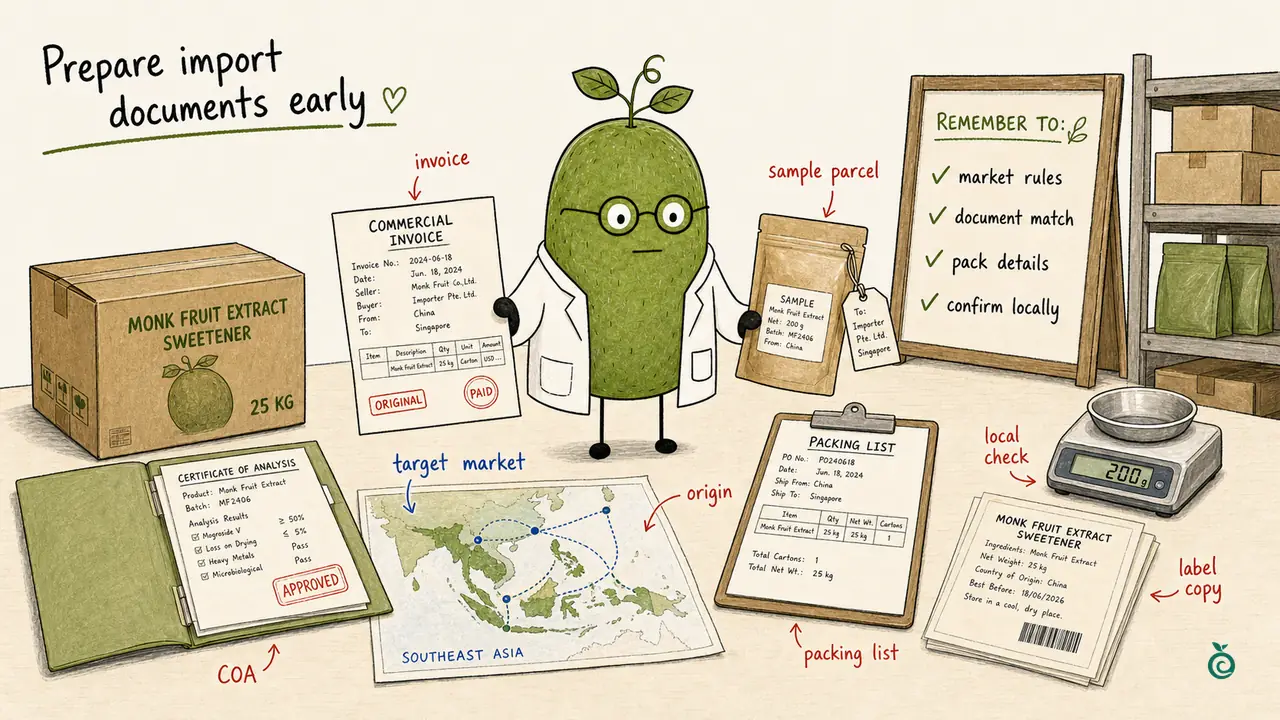
The Doctor illustration shows the files to compare: specification and COA, invoice, packing list and label. Its company names, dates, quantities, analysis values, stamps and shipping route are fictional examples, not Hengliyuan records or approval evidence. Match the actual files to your selected product, batch and destination before dispatch.
Identify the destination and sales route
Name the country, importer and intended use: ingredient supply to manufacturers, repacking, retail distribution or a private-label product. Ask the local importing team to identify the documents and label questions for that configuration before approving artwork.
Keep one product identity across the working file
Use the same agreed product name, formula revision and pack reference in the specification, sample notes, quotation and artwork discussion. Record any change of formula or pack so earlier reports and labels can be checked again. Distinguish the seller, actual manufacturer, importer, brand owner and certificate holder. If their names differ, request the relationship and the scope of each file rather than assuming every company must have the same name.
Match each document to the question it can answer
Use this as a working-file comparison, not a claim that every item is mandatory or available for every order. Ask the supplier which files can be provided for the chosen product, and ask the importing team which form and scope its destination requires.
| File to review | Match it to | Question to resolve before using it |
|---|---|---|
| Specification and composition information | Selected extract grade or complete blend and revision | Does the name describe the full material, including carriers or other sweeteners? |
| COA or laboratory report | Actual product and identified batch or test sample | Is this the proposed shipment batch, a reference batch or a separately submitted sample? |
| Company or product certificate | Named holder, site, product scope and relevant validity | Does the scope cover this material and use, and what relationship needs clarification? |
| Commercial invoice and packing list | Agreed order, seller/buyer, pack configuration and shipment | Do product descriptions, quantities, net/gross weights and batch references agree where applicable? |
| Label and packaging artwork | Exact formula, unit/outer pack and target sales route | Has the importer checked the destination wording and required local details for this version? |
| Origin or other destination-requested files | Exact requirement and relevant product or shipment | Who issues the file, what must it cover and can it be supplied before the required deadline? |
A reference COA can support early product review, but it is not automatically the COA for the shipment you later receive. Keep specifications, limits and measured results distinct; use the supplier-document guide for detailed checks instead of treating a document title or a stamp as the conclusion.
Distinguish bulk ingredient and retail pack requests
For bulk extract or blends, share the receiving pack size, downstream use and repacking plan. For retail products, add the individual and outer pack, label language and brand owner. Hengliyuan catalog references include 100 g, 454 g and 150 g containing thirty 5 g packets; confirm the chosen formula as well as the weight. For a blend, identify the complete formulation rather than declaring only the monk fruit component. A different pack weight does not, by itself, identify a different formula; a matching weight does not prove two formulas are the same.
Close the open points before artwork and dispatch
During product selection, collect the specification or available reference documents and list any unresolved identity or composition questions. Before artwork approval, confirm the exact formula and pack version with the importer and brand owner. Before dispatch, reconcile the actual shipment documents and any required batch or origin files with that agreed version. Agree who resolves each missing item and the date it is needed. If the supplier cannot provide a requested file, make that gap explicit before committing to a route that depends on it. Changing the formula, manufacturer, importer or pack after review means checking which documents and label decisions need to be revisited.
Use the destination authority for the importing route
For Singapore, SFA states that the relevant licence or registration depends on food classification, and that an import permit is needed for each consignment through TradeNet. These are importer steps in addition to checking the product requirements; a supplier COA does not replace them. Use that distinction when preparing any Southeast Asia project: confirm both the importing procedure and whether the exact material and intended use meet the destination rules. The Singapore example does not establish that a particular monk fruit extract or blend is permitted, or that the same procedure applies in Indonesia or another country.
Use Indonesia news for the market context it documents
Our news archive contains Indonesia launch and retail-cooperation coverage. It gives a prospective partner background on that activity. It does not establish product authorization or distribution rights in another country; review the separate product and partner files for your project.
Settle brand ownership before packaging work
For private label, identify your brand and the artwork status. For Hengliyuan brand distribution, describe your country, channels and products of interest. Distribution rights, quantities and other commercial terms are discussed for the specific project.
Start with the product and the document question
Send the destination country, extract or blend name, bulk or retail plan, and the document or packaging question you need to settle. Include an existing specification, document reference or importer request if available. You can begin the discussion while quantity and packaging details are still being decided. For a quotation, confirm the selected product, packaging specification, estimated quantity, requested files and sample needs as the project develops. Keep the document review tied to that same product version.
Common questions
Which documents should I ask for before importing monk fruit sweetener?
Start with the selected product specification and composition, available COA or test report, and relevant certificate scope. Agree the shipment invoice, packing list, label and any destination-requested origin or other files with the supplier and importer. The exact set depends on the product, destination and route; confirm availability and requirements rather than assuming one universal list.
Discuss import documentsIs a supplier COA enough to confirm import permission?
No. It reports the identified product or batch against its stated items; it does not replace destination product requirements, importer registration, permits or label review. Check the actual composition and intended use with the importing team before relying on the file.
Discuss import documentsCan I reuse the documents for a different monk fruit blend?
Recheck their scope. A change in carriers, other sweeteners, grade, manufacturer or formula revision can change what a specification, report, certificate or label actually covers. Keep the old and new product versions identifiable and request the missing relationship or replacement file.
Discuss import documentsWhat changes between bulk ingredients and retail packs?
Identify the complete material, receiving pack and downstream use for bulk supply. For retail packs, also identify the brand owner, exact formula, unit and outer packaging, artwork and local label details. A pack size alone does not define the formula or establish the importing route.
Discuss import documentsDoes export-compliant packaging mean the product is cleared for sale?
No. Agree the food-contact pack, moisture protection, seal, markings and destination label requirements for the actual product with the importer. Packaging suitability and document consistency do not by themselves establish product permission, completed clearance or retail authorization.
Discuss import documentsWhen should I raise a missing document or inconsistent company name?
Raise it before the decision that depends on it, such as artwork approval or dispatch. Identify the seller, manufacturer, importer, brand owner and certificate holder and ask how the named file applies. If a requested file cannot be supplied, resolve that gap with the importing team before proceeding.
Discuss import documentsCan Indonesia launch news establish a new distributor appointment?
No. It provides background on the reported activity. The territory, products and commercial rights of a new distributor need their own agreement, and product or shipment requirements need their own review. Start with the country and cooperation route you want to discuss.
Discuss import documents