
Read this guide in
PRIVATE-LABEL OEM
Private Label Monk Fruit Sweetener Packets: OEM Packaging & Export Documents
Plan private-label monk fruit packets: formula screening, packaging quantities, net-weight calculations and export documents for your market.
Plan private-label monk fruit sweetener packets by aligning the formula, serving mass, packaging layers and export documents with the destination market.
No sweetener package is automatically export compliant. Readiness depends on the destination market, the finished formula, the food-contact material and intended use, unit and outer-pack details, mandatory label information, importer review, and the documents tied to the exact product version.
Hengliyuan can help turn those variables into one workable project brief. We can discuss the sweetener direction, screen several formula candidates in our sensory lab, send selected samples for the buyer's second-round test, and prepare the supplier-side product and packaging information after the formula and pack are confirmed. The buyer and importer still need to complete the market-specific and finished-product review required for their sales channel.

Keep the product and its packaging version together
Review the blend, consumer unit and outer pack together before approving artwork. The pictured jars, pouches, sachets and labels are conceptual formats, not confirmed sizes, finished artwork or certifications.
Quote each pack size separately
For a project with two retail sizes, list the net weight and number of finished units for each size, not only the combined order weight. State who supplies and prints the pouches, and whether each size needs separate artwork. Packaging purchase minimums and finished-product minimums may use different units; confirm the basis for each SKU. An approved formula does not by itself confirm the filling fit, packaging cost or minimum order for a second size. A jar that looks partly filled does not by itself establish a shortage. Check the declared net mass using a suitable balance and the empty container's tare; bottle capacity and powder settling are different from net content.
Do not print final artwork before the formula is fixed
Packaging work should begin with the identity of the product inside it. A private-label project may involve a monk fruit blend, a stevia blend, an allulose-supported system, an erythritol-free direction, or another custom sweetener blend. These are development directions, not interchangeable label names. Before approving final artwork, confirm the complete ingredient list and formula version, target sweetness, serving or dosage information, product form, net weight, pack count, destination market, label language, ingredient restrictions and the sample reference the buyer accepted. If the formula changes, the ingredient declaration, product name, directions, nutrition work and supporting documents may also need to change. Reusing old artwork for a new formula can create a mismatch before production starts.
Let Hengliyuan complete the first sensory round
The buyer does not need to start by sourcing several individual sweeteners and building every comparison alone. Start with the application, destination market and pack idea. Add a known sugar or sweetener reference, target taste and ingredient restrictions as available. Our sensory lab can prepare and compare several suitable directions. Depending on the brief, the comparison may look at sweetness onset, peak sweetness, aftertaste, mouthfeel and the effect on the original flavor. We then send the selected candidate samples to the buyer. The buyer performs the second round in the real food, drink or tabletop use, under the intended process and serving conditions. That test should confirm more than sweetness. It may also need to cover dissolution, powder flow, filling behavior, heat response, color, texture or storage observations, depending on the application. This two-round process is usually more efficient than preparing final packaging around an unconfirmed formula. It also gives the formula, sample, specification, label and quotation a common reference. Sensory screening does not replace the buyer's finished-product validation, shelf-life work or local regulatory review.
Check four packaging layers, not only the retail container
An export packaging brief should show how the product moves from the filling line to the buyer's warehouse. Review each applicable layer separately.
| Packaging layer | What to define | Why it matters |
|---|---|---|
| Unit pack | Jar, pouch or sachet; fill weight; dimensions; opening; dosing or serving information | Must suit the product, filling process and consumer use |
| Retail or inner pack | Sachet count, total net weight, barcode area, label language and artwork version | The count and total weight must match the unit packs inside |
| Shipper carton | Units per carton, carton marks, gross/net weight and dimensions | Supports quotation, handling and shipment planning |
| Pallet or logistics configuration | Cartons per layer, layers per pallet, pallet limits and destination requirements | Must be confirmed for the actual order and transport route |
For example, if one outer pack contains 30 sachets of 5 g, the declared total net weight is 150 g. If the sachet weight or count changes, update the outer-pack statement, directions and quotation together.
Confirm food-contact material and actual use conditions
A material name alone does not prove that a package is suitable for every sweetener or market. The review should identify the component that contacts food, the intended temperature and duration of contact, the product form, and any moisture, oxygen or light barrier needed for the agreed shelf-life plan. Ask the packaging supplier for the declaration or test information applicable to the selected material and intended use. Match it to the actual jar, film, sachet, liner, lid or other component, not just to a general material family. The European Commission describes food-contact materials as materials intended to contact food and requires them not to transfer constituents at levels that endanger health or unacceptably change food. Destination-market requirements still need to be checked for the particular product and use.
Build the label around the target market and final product
There is no single export label that works everywhere. The final checklist depends on the country, product category, sales channel and claims. At a minimum, the project normally needs to resolve the product name, ingredient declaration, net quantity, responsible business details, lot/date information, storage or use instructions where required, and the applicable nutrition and allergen information. For the United States, use the FDA's current food-labeling resources to review the applicable requirements. For the European Union, check the European Commission's mandatory food-information rules. For Canada, use the Canadian Food Inspection Agency's checklist for core requirements, then review claims and product-specific rules separately. These sources help frame the review; they do not approve a specific Hengliyuan or customer label. The buyer, importer or a qualified local reviewer should approve the final market label. Hengliyuan can provide supplier-side product information and check whether the artwork matches the formula and packaging details agreed for production, but this is not a substitute for local legal review.
Packaging reference quantities: confirm the scope for your order
Our September 16, 2026 packaging notes recorded a 500-finished-unit starting reference when suitable packaging was already available. The customer could also supply completed packaging, subject to checking its fit with the selected product and process. That reference means defined retail units such as jars or bags, not kilograms; reconfirm the current production and packaging conditions for your project. For newly purchased custom packaging, distinguish the supplier’s packaging purchase quantity from the finished-goods batch. The following recorded references explain the different components; they are not a live supplier quotation.
| Custom packaging component | Recorded planning reference (September 16, 2026) | Confirm for the chosen component |
|---|---|---|
| Standard labels for jars | About 2,000 labels | Jars are ordered separately; jar minimum depends on the selected jar |
| Shrink-sleeve labels for jars | About 2,000 sleeves | Confirm against the actual jar and artwork |
| Packaging bags | About 20,000 bags | Packaging purchase quantity is not automatically the finished-product quantity |
| Inner individual sachets | About 200,000 sachets | Inner and outer packaging are calculated separately |
| Outer packs for sachets | About 20,000 outer packs | Check the pack count against the available inner sachets |
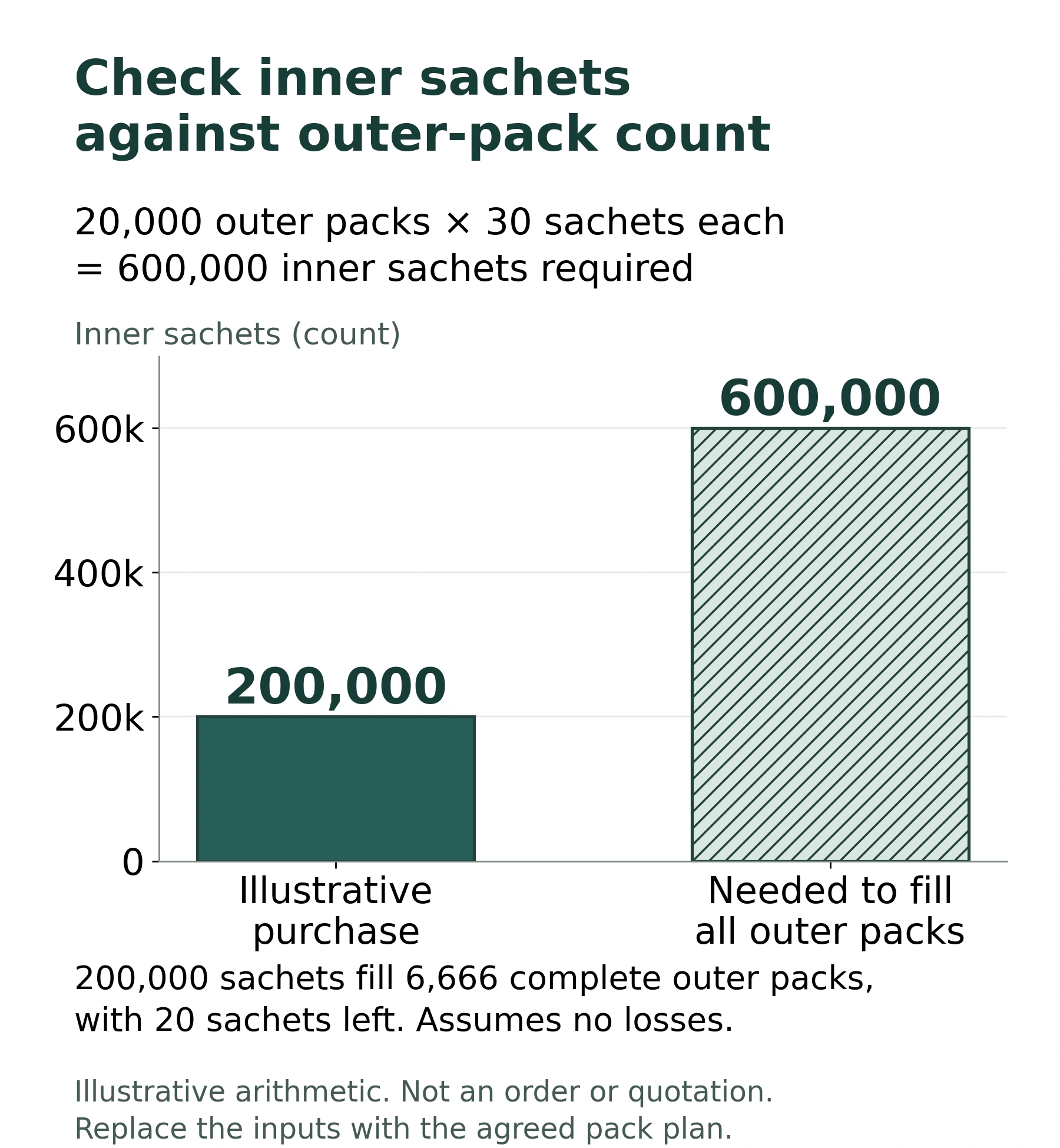
Keep the material, dimensions, artwork and packaging-supplier quotation with each component’s agreed quantity. The recorded references are not a universal finished-product MOQ. At 30 sachets per outer pack, 20,000 outer packs need 600,000 sachets. Buying 200,000 sachets and 20,000 outers therefore does not provide enough inner units to fill every outer pack.
Calculate the inner and outer quantities before ordering
This example uses 20,000 outer packs, 30 sachets per outer and an illustrative purchase of 200,000 inner sachets. It assumes no filling losses and does not represent an actual order, production yield or current supplier offer.
| Calculated item | Arithmetic | Illustrative result |
|---|---|---|
| Inner units to fill all outer packs | 20,000 outer packs × 30 sachets | 600,000 sachets |
| Complete outer packs possible from inner units | Whole packs in 200,000 ÷ 30 | 6,666 outer packs |
| Inner units left after those complete packs | 200,000 − (6,666 × 30) | 20 sachets |
| Outer packs still unfilled | 20,000 − 6,666 | 13,334 outer packs |
Download the free Excel planner to replace the example quantities with your agreed stocks or purchases, sachets per outer, first batch and sachet net mass. It calculates component shortages, remaining packaging and planned net content; no email is required and you do not need to complete it before contacting us.
Separate packaging purchases from finished-goods production
A buyer may not need all finished units at once. Custom packaging can be purchased according to the packaging supplier's minimum, while finished goods are produced in agreed batches. Unused custom packaging can stay at Hengliyuan's factory for later orders. For example, if 20,000 custom bags are ordered but only part of them are used in the first production, the balance can remain for subsequent orders. Storage and future use should still be tied to the same customer, artwork and compatible product specification. If the artwork, dimensions, material or formula-related information changes, review the remaining packaging before reuse. Packaging that requires printing plates also has a separate initial cost. The September 16, 2026 notes used about CNY 400 per color as a planning reference. Four colors would be about CNY 1,600 and six colors about CNY 2,400. This dated reference is for an initial discussion; final colors, plate requirements and charges are confirmed from the artwork and quotation. Unchanged and usable plates can be reused, while changed artwork may require new or modified plates.
Match every document to the agreed version
An export file should not be assembled from unrelated certificates and reports. After the sample, formula and packaging are confirmed, agree which supplier-side documents are needed and what each one covers. Depending on the product and buyer request, this may include the finished-product specification, ingredient statement, batch COA, packaging specification, artwork approval record, company certificate, applicable product test report or shipment documents. Check the company name, product name, formula or grade, batch or validity period, issuing body and scope. A company certificate does not automatically certify every product. A report for one ingredient or submitted sample does not automatically represent a different finished blend. A document set also does not by itself establish that the final retail product may be sold in the destination market.
Start with the market and pack concept
Send the destination market, intended use and the pack idea or question you want to resolve. Add a known formula, reference sample, ingredient restriction or estimated quantity if available. A complete formula, final artwork and full document brief are not required to begin. For a comparable final quotation, bring the accepted sample and blend version together with each SKU’s net weight, sachet count, component purchases, first production quantity, artwork and plate scope, sales market and required documents. Packaging costs, quantities, lead time and available files must correspond to that same project version.
Common questions
Is any sweetener package automatically export compliant?
The finished blend, food-contact components, label, pack layers and documents must be reviewed for the actual destination and use. A component specification or certificate does not approve every retail product or market.
Discuss this requestCan packaging development begin before the final formula is selected?
Explore formats, dimensions and costs early. Confirm the accepted sample, complete ingredients, name, net content and directions before approving final artwork or printed packaging. Review the affected label and document versions after a formula change.
Discuss this requestCan Hengliyuan customize 500 units?
The recorded September 16, 2026 planning reference was 500 finished retail units where suitable packaging already existed. It was not 500 kg or a minimum for every packaging component. Reconfirm the current product, filling fit and commercial scope for the actual project.
Discuss this requestDo 200,000 inner sachets match 20,000 outer packs?
Only the pack count can answer that. At an illustrative 30 sachets per outer, 20,000 outers need 600,000 sachets. With 200,000 sachets, only 6,666 complete outers can be filled before losses, leaving 20 inner units. The examples are calculations, not a current order requirement.
Discuss this requestMust all custom packaging be used in the first production run?
Packaging purchases and finished-goods batches can be planned separately. Agree the first batch, unused component quantities, ownership, storage and later-use conditions. Review remaining packaging if its artwork, material, dimensions or product information changes.
Discuss this requestWhat should the buyer provide before sample work?
Start with the market, application and pack concept. Add an existing reference, taste target or ingredient restrictions if available. Hengliyuan can clarify the first sensory comparison, then send selected candidates for the buyer’s real-product test and discuss the packaging and quantity details.
Discuss this requestWho approves the final market label?
The buyer, importer or qualified local reviewer checks it for the destination and product. We provide supplier-side product information and check that the production artwork corresponds to the agreed blend and pack. The linked official resources frame the review; they do not approve a particular customer label.
Discuss this request