
Read this guide in
NUT SPREAD FORMULATION
Low-Sugar Nut Spread Formulation: Oil Phase, Particles & Spreadability
Low-sugar nut spread guide: test peanut butter and cocoa-hazelnut spreads for oil separation, particle size, spreadability and storage.
A nut spread can reach the target sweetness and still fail the product brief. It may separate in the jar, feel gritty, spread poorly at the intended temperature or change during storage. Those are different questions, so a useful low-sugar nut spread formulation brief keeps sweetness, oil phase, particles and storage in separate columns.
This guide is for peanut butter, cocoa-hazelnut spread, pistachio spread, nut fillings and ingredient buyers preparing a sample or quotation discussion. It does not provide a universal replacement ratio or a no-separation guarantee.
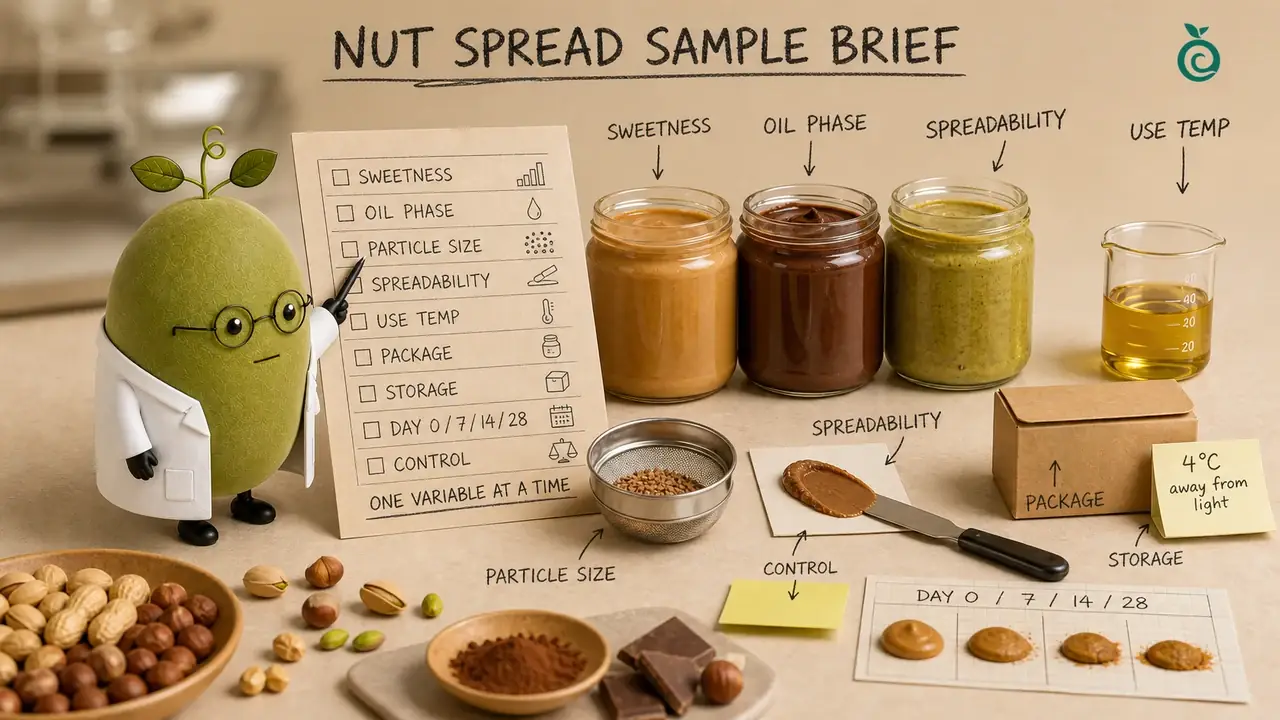
Separate the questions shown in the illustration
Taste, free oil, particle feel, spreadability and storage change need separate observations in the actual nut spread. The jars, beaker marks and sample dots are illustrative, not measured results or a ranking. The 4°C note and day 0/7/14/28 labels are example conditions to discuss, not universal storage instructions, a validation schedule or a shelf-life result.
Start with first principles: sweetness is only one job
Sugar or syrup in a spread may contribute sweetness, solids, particle packing, color, body and eating texture. Monk fruit or stevia can lift sweetness at low use levels, but they do not automatically replace those physical roles. Allulose, fibers, polyols or other carriers may be discussed where the target market allows them, but the finished spread still needs its own test matrix.
Name the oil phase before blaming the sweetener
Record the nut paste, added plant oil or solid fat, cocoa fat if present, emulsifier or structure direction, and the processing route. Nut spreads are oil-continuous suspensions with a particle network; roasting, grinding, particle size, fat level and storage temperature can all affect flow, mouthfeel and visible oil separation. A public ingredient label can show some of these layers, but it cannot reveal the full ratio or process.
Particle size changes more than smoothness
Particle size and distribution can change viscosity, yield stress, spreadability, grit and the way the oil phase is held. The 2025 pistachio spread study compared particle size, milk fat, sugar, rheology, texture and oil separation at 4°C and 25°C; its results support separating these variables, not copying its formulation or thresholds. Use D10, D50 or D90 only when the measurement method and product position are agreed.
Judge spreadability at the temperature people will use
A jar stored cold, a retail shelf at room temperature and a bakery filling line do not ask the same spreadability question. Record use temperature, conditioning time, hardness or adhesiveness, spatula spread, viscosity or yield stress when available, and mouthfeel after spreading. The 2024 cocoa-hazelnut model found that complete sugar replacement with an inulin-stevia mixture reduced spreadability in that formula, while an 80% replacement group was closer to the control on selected texture and fat-melting measures. That result is model-specific.
Keep storage and package in the same brief
Record jar or pouch format, headspace, seal, light exposure, storage temperature, humidity and opening frequency. Compare oil separation, visible layering, surface dryness, rancid or oxidized notes, color, spreadability and mouthfeel at agreed checkpoints such as day 0, 7, 14 and 28. A 2025 pistachio study observed more oil separation at 25°C than at 4°C in its tested system; that does not establish a universal shelf-life limit.
Build a small matrix that can explain the result
Keep the current or sucrose control. Then separate the first comparisons into a sweetness-only direction, a bulk or fiber-support direction, and an oil-phase or particle-processing direction. Change one main variable at a time where practical. If sweetness, oil, particle size and heat history all change together, the next sample will be difficult to interpret.
Keep the measurement method with each comparison
A visible oil layer, a centrifuged sample and a spreading test answer different questions. Identify the material and formula version, then retain the preparation and observation conditions with every result.
| Check | Keep in the record | Interpretation to keep separate |
|---|---|---|
| Material and formula | Ingredient identities/lots, actual additions, fat sources, processing and changes from the reference | A change in sweetener name alone |
| Oil separation | Undisturbed jar or accelerated/centrifuge method, sample basis, temperature and elapsed time | A percentage from a different method or storage history |
| Particle distribution | Which material/stage was measured, dispersion and instrument method, volume or other basis, and relevant D10/D50/D90 | A dry-ingredient value, the finished spread, or sensory grit treated as the same result |
| Spreadability and flow | Conditioning temperature/time and the defined spatula or instrumental method | Equal performance at cold, room and filling-line temperatures |
| Taste and particle feel | Actual serving condition, sweetness timing, finish, grit and the reference | A preferred sweetness result proving physical stability |
| Package and storage response | Pack, seal, temperature/light/opening history and agreed checkpoints; oil and texture observations separately | A fresh appearance or short trial proving commercial shelf life |
Use the result to select the next controlled comparison. If several formula or process factors changed, record them explicitly. Set the checkpoint schedule for the actual package and intended life rather than treating an example day list as a release standard.
A paste measurement needs its sample-preparation basis
The 2025 pistachio study reported the following volume-based particle values for large-particle paste (LP) and small-particle paste (SP). They describe the measured paste samples, not a universal target for finished nut spreads.
| Reported paste sample | D50 (µm) | D90 (µm) |
|---|---|---|
| LP — large-particle paste | 16.71 | 434.80 |
| SP — small-particle paste | 7.18 | 149.78 |
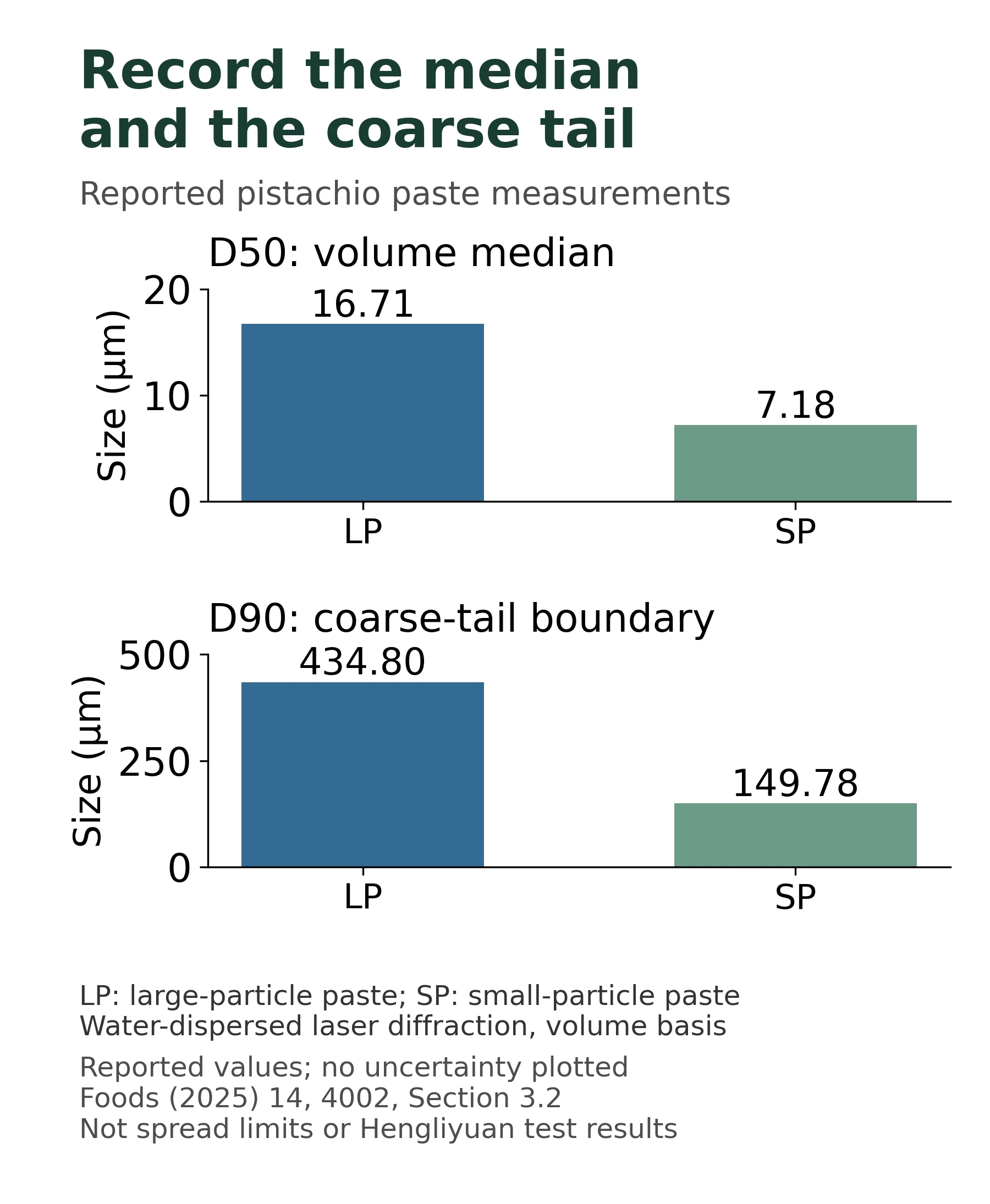
The source used a 1:10 (w/v) dilution in distilled water at room temperature, followed by shaking and vortex dispersion before laser diffraction. Keep this preparation context when discussing the numbers; do not silently transfer them to a dry powder, another dispersion method or the undispersed finished spread.
Technical references and boundaries
The pistachio study distinguishes paste particle measurements, formulation comparisons and its own storage tests. The cocoa-hazelnut study assessed an inulin-stevia system in a particular formula, with storage at 11°C for three months. Their results support choosing variables and comparison methods; they do not provide a Hengliyuan formula, universal D90 or viscosity target, no-separation guarantee, shelf life or market permission.
Start with the nut spread and the problem
Tell Hengliyuan the nut-spread format, final sales market and the sweetness, grit, free-oil or spreading issue. Add known nut base, fat sources, ingredient restrictions, process and package details; if these are still being developed, describe the intended product and reference. A final formula, particle target or order quantity is not required for first contact. After the sample direction is useful, connect the selected material and formula version to the specification, receiving pack, trial or repeat quantity, requested documents and delivery terms. This page concerns sweetener ingredients and blends; identify a finished spread manufacturing request separately so supply fit can be confirmed.
Common questions
Can monk fruit or stevia prevent oil separation?
They can supply sweetness, while oil separation depends on the complete nut, fat, particle, processing, package and storage system. Record the actual formula and method when interpreting free oil; a sweetener choice alone is not a no-separation guarantee.
Discuss the nut-spread sample directionIs D90 the largest particle in the sample?
No. For the volume-based measurements discussed here, D90 is the size below which 90% of particle volume falls. It does not give the maximum particle size or define a universal grit or acceptance threshold. Keep the basis and preparation method with it.
Discuss the nut-spread sample directionDoes a smaller particle number always mean the better spread?
Choose the texture and use behavior required for the actual product. Particle distribution interacts with the oil phase, solids, process and temperature; the reported paste values do not rank every finished spread or prove its storage response.
Discuss the nut-spread sample directionCan I compare centrifuge oil separation with an undisturbed jar percentage?
Keep the methods separate. Record the sample basis, preparation, temperature, force/time if used and storage history. A value from an accelerated or centrifuge method is not automatically the same observation as free oil in a stored retail jar.
Discuss the nut-spread sample directionCan the published 80% sugar-replacement result be copied?
It belongs to the cited cocoa-hazelnut formula and its inulin-stevia system, evaluated under the study's conditions. Use it to plan a controlled comparison, not as your commercial replacement ratio or evidence of the same texture in another nut spread.
Discuss the nut-spread sample directionDo day 0/7/14/28 checks establish shelf life?
They can be an initial screening example. Define the actual checkpoints and validation plan for the formula, process, package, distribution and intended life. Short physical or taste observations do not establish commercial shelf life.
Discuss the nut-spread sample directionWhat can I send before the formula and quantity are final?
Begin with the nut spread, final sales market and the problem or product target. Share known nut base, oil phase, process, ingredient restrictions and package information. The sample direction and later specification, quantity and quotation details can then be clarified.
Discuss the nut-spread sample direction