
Read this guide in
CHOCOLATE SPREAD GUIDE
Sugar-Free Chocolate Spreads: Sweetener Blend Guide for Brands and Manufacturers
Sweetener blends for sugar-free chocolate spreads, nut butters and cocoa fillings: texture, stability and formulation checks.
A sugar-free chocolate spread needs both a sweetness direction and a solids, fat and particle-size plan. Test the complete spread against a defined control; monk fruit or stevia alone cannot replace the physical mass and texture of removed sugar.
Chocolate spreads, nut butters and cocoa fillings are difficult sugar-reduction projects because sweetness, solids, particle size, fat phase, viscosity and flavor masking all interact.
This guide is for spread brands, wafer and bakery filling buyers, nut butter producers, private-label teams and ingredient buyers evaluating monk fruit, stevia, allulose, fiber or broader natural sweetener blends.
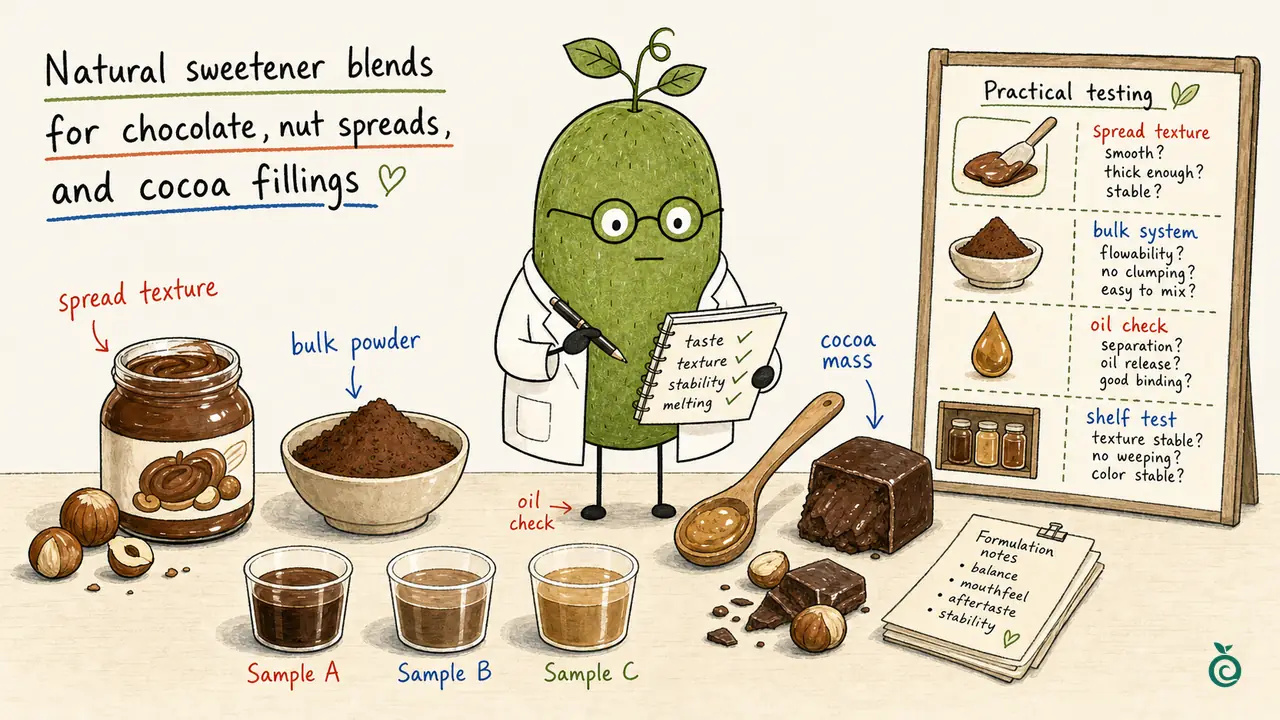
Read the illustration as development questions
Assess sweetness alongside the solids, oil phase, particle feel and intended use of the spread or filling. The sample A/B/C colors, notebook ticks and shelf-test jars illustrate comparisons to plan; they show no measured ranking, accepted formula or completed storage trial. The smooth spoonful is a drawing, not evidence that a particular sweetener blend gives that texture.
Start from the fat-based system
A hazelnut spread, peanut butter, cocoa filling, wafer cream, bakery filling and protein spread have different fat, nut solid, cocoa, milk powder, fiber and processing assumptions. The sweetener direction should match the matrix.
Sugar controls more than sweetness
Sugar contributes solids, particle feel, spreadability, flavor balance and cost structure. Monk fruit or stevia can raise sweetness, but they do not replace bulk or texture in a spread or filling by themselves.
Manage bitterness and flavor masking
Cocoa, roasted nuts and protein ingredients can amplify bitterness, while high-intensity sweeteners can add linger if the ratio is too aggressive. Pilot samples should be tasted after processing and storage, not only immediately after mixing.
Check texture, separation and shelf stability
Reduced-sugar spreads should be checked for viscosity, oil separation, graininess, crystallization, water activity, filling behavior, pumpability, heat stability and packaging compatibility.
Match blend direction to market rules
Allulose may be useful for some markets, while other launches may need stevia, monk fruit, fiber, erythritol-free carriers or polyol-based systems. Buyers should confirm target-market ingredient permissions and label claims before final quotation.
Matrix and sweetener roles for the first comparison
Identify whether the product is a peanut butter, cocoa-hazelnut spread, wafer cream or another filling. Record the fat system, nut and cocoa solids, moisture-bearing ingredients and refining route. These determine which physical functions need to be preserved when sugar changes. Equal sweetness does not establish equal solids or spreadability. Assign sweetness, bulk, texture and flavor balance separately. A high-intensity extract can address sweetness, while the rest of the solids and fat system still need design and validation. If a bulking or fiber direction is proposed, record its identity and actual dose, then compare viscosity, mouthfeel, oil separation and storage. Do not assume that an ingredient described as natural, fiber-based or erythritol-free will be compatible with every spread.
| Matrix | Sweetness role | Physical role to retain | First test |
|---|---|---|---|
| Peanut butter | Balance roast and sweetness | Nut solids, oil phase and particle feel | Oil separation and spreadability |
| Cocoa-hazelnut spread | Balance cocoa bitterness and finish | Fat, solids and refining behavior | Graininess, flow and storage |
| Wafer or bakery cream | Match sweetness and flavor | Filling consistency and handling | Depositing, leakage and texture |
| Protein spread | Address protein bitterness separately | Body and particle texture | Temporal taste and storage |
Control refining, temperature and storage separately
Keep the current formula as a coded control. Record the actual sweetener mass and the full solids change, then use a defined refining or mixing objective. The same process time does not prove that two formulas have reached the same fineness. Where possible, retain the measurement method used for particle size or consistency so the record can be compared during scale-up. Taste at the same serving temperature and record sweetness, bitterness, finish, waxiness and graininess separately. A colder sample may spread differently from a warm sample, and a fresh sample may hide oil separation that appears later. Photograph the package before remixing at each planned storage point. Record whether separation is reversible and whether the consumer method allows remixing. For a filling, add the actual depositing, pumping and finished-product test. A spread that tastes acceptable in a jar may behave differently between wafer layers or in a baked product. Define the storage condition and package that belong to the trial; the record does not prove shelf life outside those conditions. Before ordering, connect the selected formula version to its ingredient declaration, market permissions, specification, batch documents and packaging. “Sugar-free” and “no added sugar” are finished-product claims with different legal conditions, not interchangeable names for a sweetener blend. Use the destination-market review and the complete formula or test result for the artwork decision.
Define what the next sample needs to do
Choose the use condition before agreeing that a sample is acceptable: spreading from the jar, pumping or depositing, and performance in the filled food can require different checks. Write the reference product, formula and sample versions, actual preparation, measurement conditions and the observed difference together. Agree which properties must be retained and which trade-offs can be reviewed; a preferred taste alone does not close an unresolved processing or storage issue. Send Hengliyuan the product type, final sales market and the sweetness, texture or handling problem you want to resolve. Add the fat/base system, ingredient restrictions and process information you can share. If the formula is still being developed, a product description and comparison target are enough to begin the discussion. Final order quantity and packaging can follow the sample direction. This guide concerns sweetener ingredients and blends for your manufacturing process. If you need a finished spread or filling, identify that as a separate supply request so fit can be confirmed; an ingredient sample or price is not a finished-food offer. For a sweetener quotation, connect the accepted sample or formula version with its specification, receiving pack, trial or repeat quantity, requested documents and delivery terms.
Common questions
Can monk fruit or stevia replace the removed sugar by themselves?
They can provide sweetness, but the removed solids and their physical functions still need a formulation plan. Record the full solids change and compare the complete spread for particle feel, flow, oil behavior and its intended use. A sweetness match alone does not establish a physical replacement.
Discuss the blend sample directionIs oil separation automatically a rejected sample?
Record the amount and appearance using your agreed method, the storage and package conditions, and whether remixing restores the product. Acceptance depends on the product target and consumer instructions. A product expected to stay uniform and a product intended to be stirred need their own criteria; reversibility alone does not establish shelf life or safety.
Discuss the blend sample directionCan a spoon tasting approve a wafer or bakery filling?
It can inform the flavor comparison. Approval for a filling also needs the actual depositing or pumping condition and the assembled or baked food test. Record leakage, handling and texture at the agreed checkpoints rather than treating jar spreadability as proof of performance in another product.
Discuss the blend sample directionDoes a natural sweetener blend make the finished spread sugar-free?
The ingredient description does not establish a finished-product claim. Review the complete formula, applicable destination-market requirements and the evidence needed for the intended wording. Sugar-free and no added sugar have different conditions; neither follows automatically from selecting monk fruit, stevia or a blend.
Discuss the blend sample directionDoes a sweetener sample quotation include a finished jar of chocolate spread?
Confirm the requested deliverable. This guide links to sweetener ingredients and blends for your process. A finished spread or filling has a separate product specification and supply scope, which must be reviewed explicitly; do not treat an ingredient sample or price as a finished-food offer.
Discuss the blend sample directionMust I finish the formula before discussing a blend sample?
No. Start with the spread or filling, final sales market and the issue you want to resolve. Share known base, process and ingredient restrictions, or describe the intended product if those are still being developed. The sample direction, accepted specification and quotation details can then be clarified.
Discuss the blend sample direction