
Read this guide in
PROTEIN AFTERTASTE SCORECARD
Protein Powder Aftertaste Scorecard for Natural Sweetener Blends
Score protein powder aftertaste over time: sweetness onset, bitterness, metallic notes and lingering finish for blends.
Protein powder aftertaste is not one note. It can start as sweetness, turn bitter after ten seconds, become metallic late, or leave a chalky film that the sweetener seems to make louder.
This scorecard helps protein powder and sports nutrition buyers compare monk fruit, stevia, allulose-supported and natural sweetener blend routes without turning the test into a vague opinion meeting.
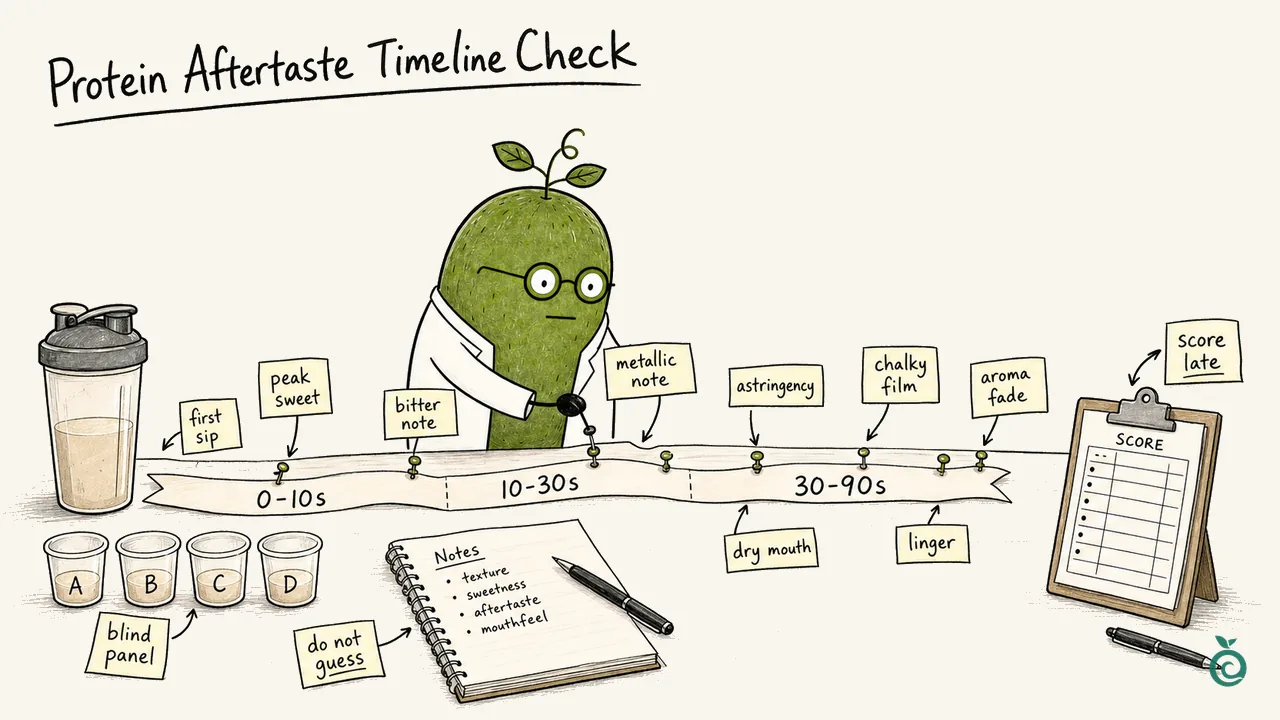
Use the timeline as a recording plan
Record the opening, middle and finish separately so a sweet first sip does not hide a later bitter, metallic or drying note. The illustrated 0–10, 10–30 and 30–90 second windows are proposed screening intervals, and the descriptor order is not a measured sequence shared by every protein powder. The A–D cups and blank score sheet illustrate coded comparisons, not a required sample count, real results or a Hengliyuan trial.
Download the blank aftertaste record
Use one copy per coded sample, assessor and preparation, with a new copy for the control, candidate or repeat. The free Excel record keeps preparation details and actual observation times beside eight descriptors and other notes. It opens without an email address or registration.
The sheet has 52 blank input cells, no preset trial results and no automatic score or ranking. Descriptive notes are the default; if you use intensity scores, agree the scale and anchors before comparing. It is optional for contacting us, and three checkpoint notes do not create a continuous time-intensity curve or a TCATA dataset.
Prepare the same drink before comparing the finish
Keep the protein grade and batch, sweetener grade and carrier, actual addition amount and mass basis with the sample code. Record the complete powder mass separately from the sweetener ingredient amount, then retain liquid identity and amount, mixing, standing time and preparation and tasting temperatures. Decide whether the purpose is a fixed-addition screen or a comparison at matched intended sweetness in the real base. If doses change to match sweetness, retain the actual amounts. Keep the serving amount, clock definition, sample order and between-product palate-cleansing procedure consistent across the comparison.
Score the first sip separately
Our opening screen looks at aroma, first sweetness, flavor match and early bitterness, with 5–10 seconds as a possible initial observation window. This catches whether the formula opens cleanly or starts with a protein, mineral, cocoa, vanilla or plant-base clash. Define whether time zero means intake or swallowing, and record the actual chosen time rather than only writing “first sip.”
Watch the middle of the curve
From 10–30 seconds, note peak or rising sweetness, creaminess or thinness, chalkiness, astringency and whether the main flavor still feels connected. We pay close attention to sweetness arriving after the main flavor has faded. Record that mismatch in the actual sample; do not assume every powder peaks in this window.
Measure the finish
At selected points within 30–90 seconds, record lingering sweetness, bitter finish, metallic or licorice-like notes, throat catch, dry mouth and powder film. Extend the observation if a relevant note remains. A recorded time of 90 seconds is not proof that the aftertaste ends there. Keep powder film and perceived dryness distinct from a measured moisture value or a diagnosis of the ingredient causing them. If a physical deposit or poor dispersion is also present, retain that preparation/appearance record separately from the taste notes.
Define the checkpoint before using the scorecard
These windows organize a first screen. The actual time, descriptor and observation task make the record comparable.
| Suggested window | What to observe | Keep with the result |
|---|---|---|
| Opening: a chosen point in the first 5–10 s | Aroma, first sweetness, flavor match and early bitterness | The start event, actual time, tasted amount and temperature |
| Middle: chosen points within 10–30 s | Sweetness rise or fade, flavor connection, mouthfeel and chalkiness | The same descriptors and record format across samples |
| Finish: chosen points within 30–90 s, or longer if needed | Lingering sweetness, bitter/metallic/licorice notes, dryness or film | The actual final observation time and any note still present |
Use separate records if you change preparation, assessor, sample version or intake stage. When examining build-up over a serving, retain the amount already consumed; it answers a different question from independent, freshly prepared first sips.
What a number on this sheet can mean
Agree the task before assigning numbers. A higher value can mean more of a sensation, more liking or closer to a target; those meanings must not be interchanged.
| Record type | Meaning | How to use it |
|---|---|---|
| Descriptive note | What the assessor noticed at the recorded time | Use specific descriptors; leave an unobserved checkpoint blank and explain any omission |
| Intensity rating | How strong one defined sensation seems on the agreed scale | Record anchors and direction; a valid zero on that scale is different from missing data |
| Liking or target fit | Preference or conformity to an agreed target | Keep it as a separate assessment, not a replacement for intensity or descriptor notes |
| TCATA / temporal penalty analysis | A structured time-based method with its own data and analysis requirements | Do not calculate citation frequencies, significance or liking penalties from three blank-form snapshots |
Retain individual records and repeats before summarizing. The workbook supplies no weighting, average, statistical test or pass threshold. Choose the next comparison from the specific unresolved note and the project requirements, rather than adding unlike scores into a single winner.
Keep label preference out of blind tasting
Natural sweetener positioning can matter to buyers and consumers, but the blind sample must still taste acceptable. Run the first panel without ingredient claims, then review label, cost, certificates and target-market fit after the sensory notes are clear. Keep the blind code separate from the formulation identity, then reconnect it for technical review. A positive response to a label concept does not establish a sensory result for the current powder.
Turn scores into sample decisions
Our preference is a next sample with one clear question: reduce a late metallic note, improve the sweetness/flavor connection, or separate poor dispersion from mouth-dryness. Narrow the changed variables where possible; if protein, flavor, carrier and mixing all change, identify the result as a new formula. Bring the control and candidate codes, preparation, chosen observation times and the specific remaining defect into the discussion. The full recipe and completed worksheet are not required for first contact. Begin with the product, market and existing observation; packaging, estimated quantity, documents and sample needs can be clarified as the supply and quotation scope become clear.
Technical references
Harwood and Drake (2021) linked temporal liking with TCATA observations in vanilla whey-isolate ready-to-mix beverages; their model associated some bitter, metallic, astringent and lingering notes with liking penalties, while blends mitigated some unwanted attributes. Parker, Lopetcharat and Drake (2018) studied matched-sweetness whey beverages using time intensity, TDS and TCATA; its model used 25 g protein with 360 mL water. These are specific beverage studies, not tests of every plant protein or a commercial mixing recommendation. They support retaining time and sensory task in the sample record. The simple checkpoint form here is our practical screening layout, not either paper’s complete protocol or proof of an aftertaste-free blend.
Common questions
Do all protein powders need the same 90-second test?
No. The suggested windows organize a first screen. Define the starting event, actual observation times, serving amount and temperature, and extend the finish observation when a relevant note remains. Do not record a universal end time from the diagram.
Does the Excel sheet require an email address or account?
No. The article link downloads it directly. Use one copy per sample, assessor and preparation. Completing the file is optional for contacting us.
Is an empty score the same as zero intensity?
No. Blank means not recorded. If the project uses an intensity scale, define its anchors and whether zero represents no detected sensation. Preserve missing observations and real zeros separately.
Can three checkpoint notes reproduce a TCATA or liking-penalty study?
No. They are a practical screen. Structured temporal methods require their own observation task, time-based individual records and analysis. Do not infer citation frequency, statistical significance or liking penalties from this blank form.
Can blending monk fruit and stevia remove all aftertaste?
A blend can mitigate particular notes in a specific base, as reported in the cited model, but that does not establish the result for another powder. Compare the actual protein, flavor, grade, carrier, dose and preparation against the control.
Does a chalky film prove the sweetener caused it?
No. Retain the complete powder portion, liquid, mixing, standing time and physical observations alongside the taste record. A film or dry-mouth note alone does not identify the ingredient or mechanism causing it.
What should I send to start troubleshooting?
Begin with the product type, market, protein base and the note you want to improve. Add the current sweetener and preparation or observations if available. We can clarify sample goals, specifications, packaging, quantities and documents together.
