
Read this guide in
PROTEIN POWDER BASE TEST
Sweetener for Protein Powder: Why Water Testing Is Not Enough
Compare sweetener-only water screens with reconstituted protein powders. Control serving preparation, sweetness matching and physical observations.
A sweetener that tastes balanced in water can still turn a protein powder into a sweet, chalky or slow-finishing shake. Protein changes flavor release, thickness, bitterness and the way sweetness fades.
This guide is for whey, collagen, meal replacement and plant protein powder buyers who need monk fruit, stevia, allulose-supported or custom natural sweetener blend samples for a real product, not a cup-water check.
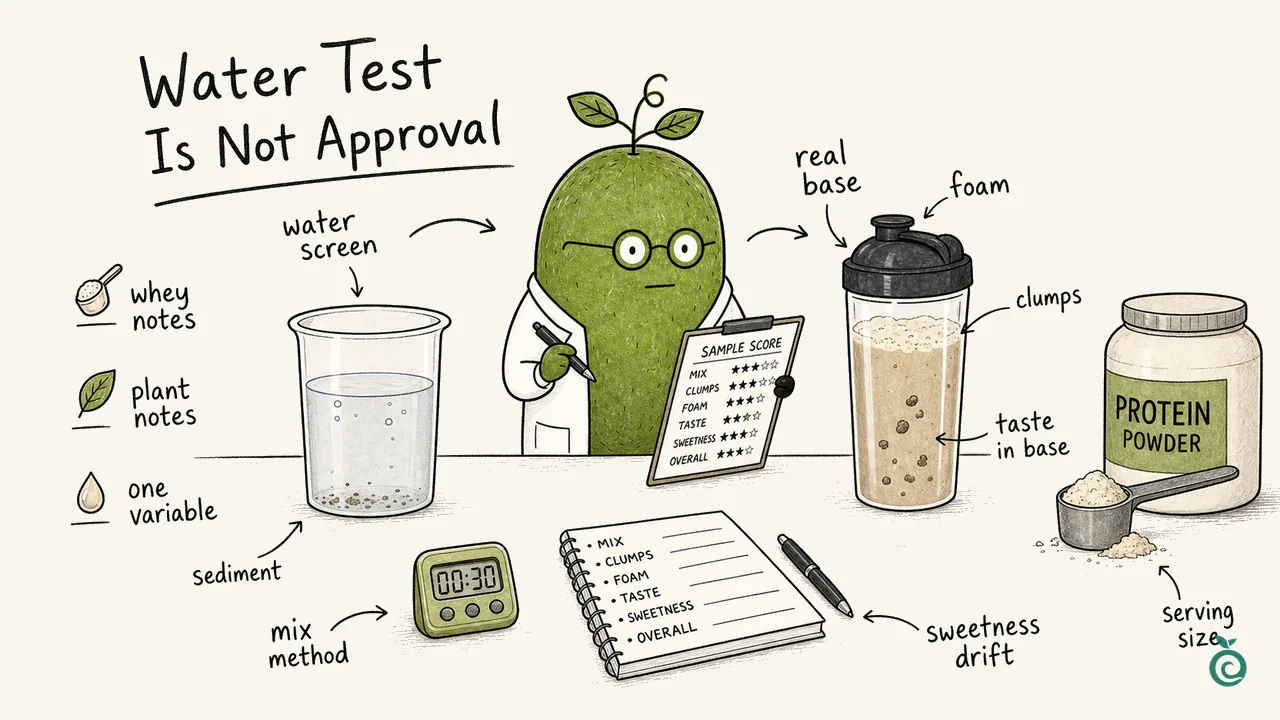
The complete powder is the real-base test
A sweetener-only water screen and a complete powder reconstituted in water answer different questions; the product comparison needs the actual protein base and preparation. The illustrated deposits, clumps, 00:30 timer and stars identify observation tasks, not measured results, a validated scale or a Hengliyuan trial. The water cup does not identify the cause of a deposit, and the package and scoop do not prescribe a formula or serving amount.
Start with the actual serving
A complete protein powder mixed with water is already a real-base test. The limited screen discussed here is the sweetener ingredient dissolved in water on its own. It can help identify an obvious ingredient note under the stated conditions, but it leaves out the full powder and how the customer prepares it. Set the product comparison around complete powder grams, water or milk identity and amount, vessel, addition order, shaker or blender operation, standing time and serving temperature. Record the sweetener ingredient amount and its basis separately. Equal grams of different sweetener ingredients do not establish equal sweetness.
Protein source changes the result
Whey isolate, whey concentrate, collagen, pea, soy, rice and mixed plant powders can bring different background notes and textures. Record the actual protein material, grade, batch and complete formula version. Do not treat a finding in one whey model as a result for every protein in that list. Keep flavor, minerals, acid system, fat, gums and fiber with the comparison. If a carrier, body system or protein base changes alongside the sweetener, identify the result as a changed formula instead of assigning it to the sweetener name alone.
Which comparison answers your question?
Use the stages that answer the current question; they are not a requirement to make four new formulas. Keep coded samples and a known reference where possible.
| Comparison | Useful question | What it cannot settle |
|---|---|---|
| Sweetener ingredient in water | Does this material show a note under the stated concentration and serving conditions? | Its full flavor, texture or sweetness behavior in the complete protein powder |
| Real base without the candidate, where available | Which background notes or physical behavior are already present? | A commercial conclusion if the base differs from the actual product |
| Current formula / control in actual preparation | What experience does the project currently deliver? | How a new candidate behaves without testing that candidate |
| Candidate in the same real base | Does the specified change improve the defined product question? | Which ingredient caused a change if several formula or preparation variables moved |
State whether the comparison keeps addition fixed or matches intended sweetness in the actual base. For a matched-sweetness comparison, retain the adjusted dose and any resulting formula changes. Keep sweetness level separate from finish, aroma, mouthfeel and overall liking.
Check texture before blaming sweetness
Our first step is to record clumps, foam, sediment, perceived thickness and chalkiness separately from the sweetness judgment. Inspect the undisturbed sample at the chosen time, then retain any defined re-mixing operation and what remains. A visual note does not measure particle size, viscosity or solubility, or identify which ingredient caused a deposit. If the next trial changes particle specification, lecithin or instantizing approach, gum/fiber support, powder handling or rest time, name that change and preserve the comparison. These are possible investigation variables, not automatic remedies to apply before the defect is understood.
Compare sweetener systems gently
Keep the current formula or another suitable reference. Compare a monk fruit, stevia/Reb-type or blend direction when it addresses the actual question, using the identified grade, carrier and dose. There is no fixed requirement to test every route in the first round. Treat allulose or other body-support ingredients as a separate formula decision when relevant to the product, market and label plan. If bulk solids, flavor, carrier or preparation change, document them alongside the sweetness decision.
Decide what the next sample must answer
Agree the relevant criteria and observation methods before comparing candidates. Record first sweetness, peak and finish, bitterness, metallic notes, astringency, body and aroma beside clumping, foam and settled material. A one-minute appearance check can be a chosen screen if its start point is defined; it is not a universal stability test.
| Finding | Useful next comparison | Keep separate |
|---|---|---|
| One candidate is sweeter at the fixed addition | Decide whether to calibrate intended sweetness before comparing taste quality | Dose and sweetness level from the character of the finish |
| Clumps, foam or deposit differ | Hold preparation constant and define the physical observation or measurement | Appearance from a chemical diagnosis or sensory approval |
| Protein, body and flavor all changed | Identify the new formula and narrow the next comparison where possible | A product preference from proof that one sweetener caused it |
A real-base screen can support a defined next step. Pilot processing, pack compatibility and storage work still have their own purpose; the screen is not a universal finished-product approval. Keep an unresolved physical or taste requirement visible instead of hiding it in an overall average.
Reuse the preparation record, then add timed notes if needed
The existing free preparation workbook has 28 paired control/candidate fields for material and dry-sample identity, addition basis, complete powder and liquid, mixing, standing, physical findings and taste notes. It requires no email or registration and has no automatic score. Use the same trial reference for the cups and any photos.
- Download the existing protein-powder preparation record (Excel)
- Use the separate aftertaste checkpoint scorecard for actual timed observations
For a detailed finish question, the linked aftertaste scorecard provides a separate record of actual observation times and descriptors. A preparation comparison and a time-based sensory record can share the same sample code; neither file is required to start a conversation.
Technical references
Parker, Lopetcharat and Drake (2018) compared matched-sweetness ready-to-mix whey beverages using time intensity, TDS and TCATA; the model used 25 g protein with 360 mL water. This is a model condition, not a recommended complete powder portion or mixing ratio. Wagoner et al. (2018) varied heating time to change whey-model texture without changing composition. They reported texture–sweetener interactions, with more viscous or semisolid models requiring more sweetener for matched sweetness. That does not mean every thick commercial shake needs a larger dose. Both papers support checking the real matrix and method; neither supplies a universal protein-powder formula.
Start with the product and the observed difference
Tell us the powder type, target market and what changed between the ingredient screen and the actual drink. Share any known protein base, flavor, sweetener, complete powder/liquid preparation and specific taste or physical observation. We can clarify the comparison and specification direction together. A full formula, completed workbook or final pack order is not required for first contact. Add known packaging, estimated quantity, document requirements and sample needs as the supplied product and quotation scope become clear.
Common questions
Does mixing the complete powder with water count as a real-base test?
Yes. The full formula is present, provided you use and record the intended preparation. The limited early screen is a sweetener ingredient in water on its own. Changing water to milk or a plant drink creates another preparation condition to record.
Can equal ingredient weight establish a fair sweetener taste comparison?
Not by itself. Identify the material grade and addition basis, then decide whether the purpose is fixed addition or matched intended sweetness in the actual base. Keep the doses used to reach that comparison.
Should a thick shake automatically receive more sweetener?
No. The cited whey-model study found texture–sweetener interactions under its conditions. Your formula, grade, serving preparation and intended sweetness still need comparison; the finding is not a universal dose rule.
Do clumps or a deposit prove that the sweetener is insoluble?
No. Record the complete powder, liquid, mixing and standing conditions and inspect before and after a defined remix. Appearance alone does not identify the material or quantify solubility.
Must the first round contain control, monk fruit, stevia and a blend?
No. These are possible comparison routes. Keep a suitable reference and select the candidates needed to answer the project question rather than treating four sample types as a required panel.
Can I download the preparation record without registering?
Yes. The existing workbook downloads directly without an email address. Its control/candidate fields are blank, with no automatic score. The separate linked aftertaste scorecard can hold timed notes if needed; neither is required to contact us.
What information helps start a sample discussion?
Start with the powder type, market and the observed issue. Add any known base, flavor, sweetener and preparation details. We can clarify sample goals, specifications, packaging, quantities and documents together.
