
Read this guide in
FROZEN DESSERT SCORECARD
Reduced-Sugar Ice Cream Sweetener Testing Scorecard
Scorecard for testing reduced-sugar ice cream sweetener blends: sweetness, solids, viscosity, overrun, hardness, ice crystals, melting and storage.
If a reduced-sugar ice cream sample tastes sweet enough but still feels hard, icy or thin, the sweetener is only part of the story. Sugar also affects freezing point, ice content, solids, unfrozen-phase viscosity, air structure and melting.
This scorecard is for product developers and ingredient buyers comparing monk fruit, stevia, allulose-supported, erythritol-free or broader natural sweetener systems in ice cream, gelato, sorbet, frozen yogurt, frozen bars and plant-based frozen desserts.
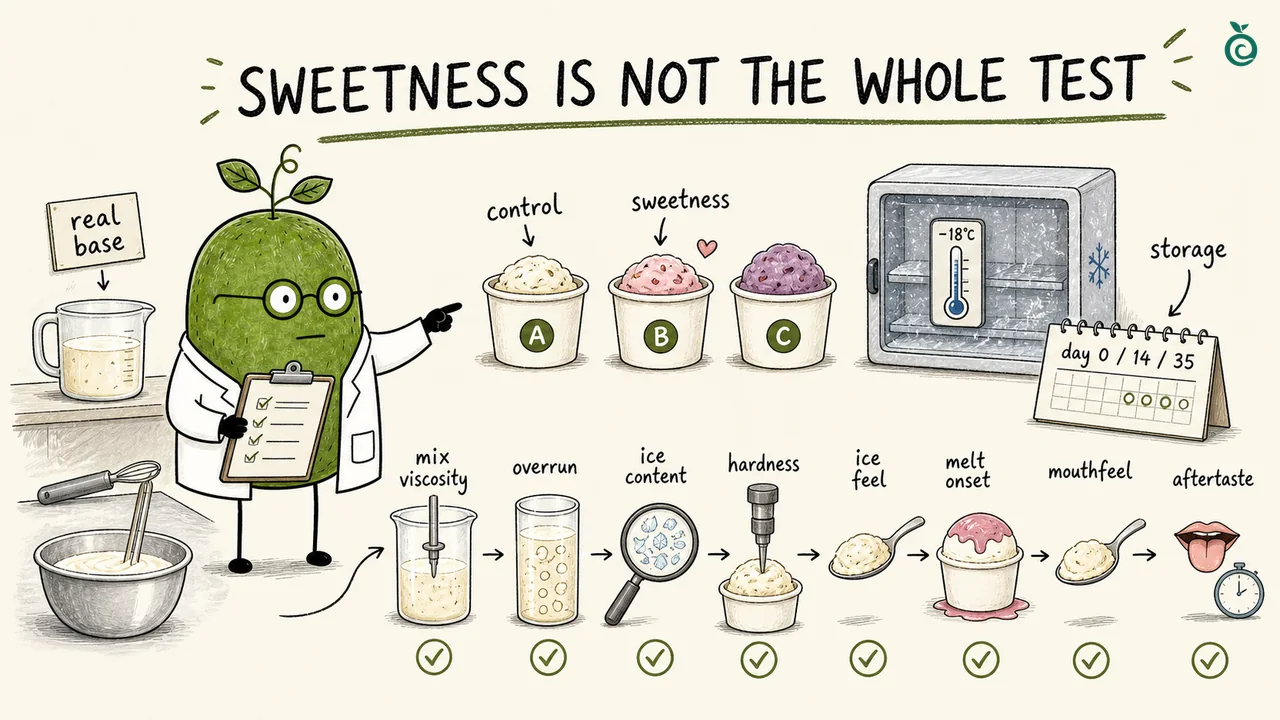
Keep a separate result for each part of the test
The illustration separates taste, air incorporation, ice observations, hardness and melting because a sweetness match cannot settle all those results. Its A/B/C labels, colors, heart and ticks represent comparison tasks, not approved recipes, rankings or measured performance. The -18°C display and day 0/14/35 calendar are scene examples, not a validated storage or serving protocol for your product.
Start with a real control
Keep the current formula or full-sugar control, the same base temperature, freezing route, hardening condition, package and serving temperature. Add a sweetness-only candidate and a system candidate that also addresses solids, body or viscosity. Without the control, a softer sample can look better simply because the process changed.
Compare routes that answer different questions
Keep each candidate tied to the same control and name every change. The routes below are options for the trial decision, not a requirement to make three production batches. State whether the addition was held fixed or sweetness was matched.
| Route | Question | Keep identifiable |
|---|---|---|
| Current or full-sugar control | What is the actual target for this product? | Formula, batch, base, process, pack and serving condition. |
| Sweetness-only candidate | Does the sweetening change match taste in the real base? | Removed/retained solids and actual addition; water screening cannot settle frozen performance. |
| System-adjusted candidate | Does the combined change address the physical problem? | Changes in solids, body, stabilizer/emulsifier and process; do not label this a single-ingredient comparison. |
Record the mix before freezing
Keep product type, fat/protein, solids and their measurement basis, acidity where relevant, ageing condition and stabilizer/emulsifier system with the sample code. Record apparent mix viscosity at its actual temperature and instrument/shear conditions. A liquid mix reading and the viscosity of an unfrozen serum phase are different measurements; do not infer one directly from the other. Dairy ice cream, sorbet and plant-based mixes need targets tied to their own structures.
Separate sweetness from frozen structure
Taste sweetness onset, peak, aftertaste, bitterness, cooling effect and flavour release separately from hardness, iciness, graininess, creaminess, scoopability and mouth-coating. A high-intensity sweetener may restore perceived sweetness without restoring the grams of solids removed with sugar.
Use a record that keeps method and condition visible
Choose the measurements needed for the project. Keep raw observations and unit identities before summarizing them, and mark unmeasured items as missing. Hardness, a spoon observation, ice sensation and a photograph each provide different information.
| Record | Method and condition to keep | What the result alone does not establish |
|---|---|---|
| Mix composition and viscosity | Analytical basis and unit; sample preparation, temperature, ageing, shear/probe and method revision. | A mix reading is not automatically a serum-phase viscosity or a complete frozen-structure prediction. |
| Overrun | Equal-volume mix and frozen portions, each formula's own mix mass, cup tare and sampling condition. | The same frozen weight across different mixes does not prove the same overrun. |
| Hardness or scoopability | Actual sample/core temperature, conditioning, geometry and instrument method/unit; separate spoon notes. | A softer sample is not automatically preferred or evidence of smaller crystals. |
| Ice fraction and crystal observations | Name the measurement: freezing curve/ice fraction, microscopy or sensory iciness; actual temperature and preparation. | An icy mouthfeel does not quantify crystal size or ice fraction. |
| Melting | Portion, initial temperature, mesh/collector, environment and time zero; first drip and collected mass at actual times. | A longer first-drip delay does not by itself establish the later melting rate. |
| Storage | Baseline after agreed hardening, actual elapsed time/temperature history, pack/seal and opening or tasting history. | Repeated handling of one pack is not unopened storage or independent sample replication. |
Keep the model research within its actual scope
Wang, Sala and Scholten's model work separated ice content and serum-phase viscosity: hardness was related to both, while melting duration and onset did not follow identical relationships. Their later simplified systems held serum-phase viscosity constant while varying crystal radius and found that smaller, more connected ice crystals could give a harder structure. These findings explain why the record needs separate measurements; they do not rank commercial sweeteners or predict a finished dairy, sorbet or plant-based recipe.
Measure overrun with the right reference mass
For the same filled volume, overrun (%) = (net mix mass / net frozen-sample mass - 1) × 100. Subtract the corresponding cup tare from each gross weight and use the actual mix for each candidate. Keep volumes, sampling and weighing comparable within the pair. Overrun describes volume increase relative to the mix; it is not the percentage of air in the finished product. University of Guelph's method uses equal-volume weights and warns that particulates affect package weight as well as air content. A fruit-, nut- or chocolate-piece product therefore needs an appropriate sampling method; the simple cup result should not be used to rank such products without that review. The existing controlled-trial guide gives worked examples, so they are not repeated here.
Download the comparison and overrun workbook
Download the Excel file directly without leaving an email address. It calculates the control and candidate separately from their own cup volumes, tare and gross weights, then provides 15 paired record fields for the base, process, hardness, ice observations, melting, sensory notes, storage and next decision. Use one copy for one comparison at one actual checkpoint. The yellow inputs start blank. Missing inputs leave the overrun result blank; unequal or nonpositive cup volumes prompt a volume check, and nonpositive net masses prompt a weight check. A correctly entered zero tare and a genuine 0% overrun remain valid. The workbook does not calculate an overall quality score or approve a formula.
Repeat the relevant checks after storage
Define the baseline after the agreed freezing/hardening sequence and select checkpoints for the product, package and project question. Record actual elapsed time, temperatures and any excursion or freeze-thaw history. Keep unopened units separate from those already opened, scooped or tasted; use separate matched units for destructive unopened checks. Repeat the relevant physical and sensory observations with the same definitions and serving conditions. A completed checkpoint is a result at those conditions, not a general shelf-life or food-safety decision.
Turn the result into a specific sample discussion
Start with the frozen-dessert type, final market and the main taste or texture problem. Add the base, control/candidate observations, process and conditions you already know. Clarify the next change to test before settling specifications, packaging, quantities and documents. You can contact Hengliyuan before the trial sheet or the purchasing brief is complete.
Common questions
Why can a sweet-enough sample still be hard or icy?
Sweetness and frozen structure need separate observations. Keep the actual solids, base, process and serving temperature with the result rather than treating the tasting of a liquid mix as approval of the hardened product.
Discuss this requestWhy does the overrun calculator ask for two cup volumes?
The weight-ratio method assumes equal filled volumes of mix and frozen sample within each column. The workbook checks that the recorded volumes are positive and equal before using their net weights.
Discuss this requestCan the control mix mass be used for every candidate?
Use each candidate's own mix reference. Changes in composition can change density, so the same frozen cup weight does not necessarily represent the same overrun across formulas.
Discuss this requestDo smaller ice crystals always mean a softer product?
No. The cited simplified model produced harder structures with smaller, more connected crystals under its defined conditions. Keep measured crystal information, sample temperature and hardness separate in the actual product.
Discuss this requestIs first drip the same as melting rate?
Record it as the onset observation under the defined protocol. Keep later collected mass and actual times separately, with the portion, initial temperature and reporting basis, before comparing a rate.
Discuss this requestMust the storage trial use the days printed in the illustration?
Choose checkpoints for the project and define its hardening baseline. The scene calendar and freezer display are examples, not a storage specification or evidence of shelf life.
Discuss this requestIs allulose always the best answer for frozen desserts?
The target market, proposed label, actual base, freezing behavior, taste and commercial requirements all affect the choice. An ingredient name or a cup calculation does not approve the final formula or its label.
Discuss this requestMust we complete the workbook before asking for a sample?
No. Send the product type, market and one problem to solve. Add observations and conditions as available; packaging, quantities and document requirements can be clarified as the sample direction develops.
Discuss this request