
Read this guide in
Hengliyuan application and selection
Steviol Glycoside Specifications: Total Content and Glycoside Composition
Read steviol glycoside specs: total content vs Reb A/Reb M composition, production route, COA checks and market rules.
Specifications for steviol glycosides may state total steviol glycosides and the contents of Reb A, Reb M, Reb D or stevioside. These are different measures and cannot substitute for one another. Confirm the production route, including enzymatic conversion or modification where relevant, because it forms part of product identity.
Total glycoside content states the sum of specified steviol glycosides. Glycoside composition identifies the individual glycosides within that total and their proportions. Two samples with the same total content may still differ in composition and sensory performance in the customer’s product.
A buyer does not need to research every glycoside before requesting a quotation. Provide the product application, requirements and intended result, and Hengliyuan can propose samples for evaluation in the real product.
What does total steviol glycoside content mean?
Total steviol glycosides is the sum defined by the applicable specification and analytical method. Read which glycosides are included and the reporting basis; the total does not tell you how much is Reb A, Reb M or another named glycoside. For example, the EU specification for E 960a requires at least 95% of 11 identified steviol glycosides on the dried basis, in any combination and ratio. That is a defined sum, not a requirement for 95% Reb A. It is also not a universal assay definition for every E 960 subtype. The consolidated specifications checked here are dated 18 August 2026.
- EU additive specifications: E 960a and the other steviol-glycoside entries
- View stevia specifications

Read two different assay rows in an actual RA98 COA
Shandong Haigen's RA98 batch 20260923 report lists a Reb A specification of at least 98.0% and a result of 98.29%, while the separate total-steviol-glycosides row lists at least 98.0% and a result of 99.41%. Both rows are reported on a dried basis. The total result does not mean 99.41% Reb A, and the specification limit is different from the measured result. This supplier-issued COA describes that batch, not a third-party certification, another grade or a future delivery. Match the selected sample and order to their own documents.
| COA assay row | Specification minimum | Reported batch result | Basis |
|---|---|---|---|
| Reb A | 98.0% | 98.29% | % wt/wt, dried basis |
| Total steviol glycosides | 98.0% | 99.41% | % wt/wt, dried basis |
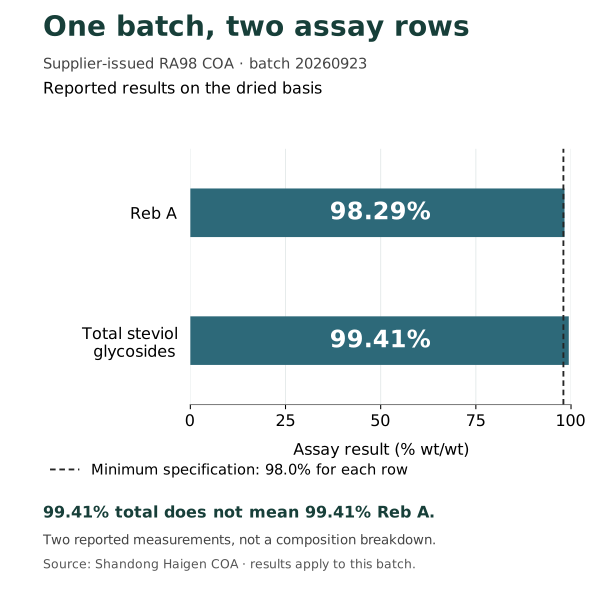
The method field on this COA is labelled JECFA2023. Read the selected batch document and method definition; do not assign the difference between two assay rows to specific unreported glycosides or use it to predict taste.
Why does glycoside composition affect sample selection?
The glycoside profile identifies the individual glycosides in the material. Check the actual specification and batch report rather than relying on the trade name. Two samples with the same total assay can have different profiles and different results in the same food. Our selection approach is to keep the ingredient brief and target sweetness fixed, then compare onset, bitter or herbal notes and the finish in the actual base. A higher proportion of one glycoside is not a universal ranking across juice, tea, coffee, dairy or powder mixes.
Confirm the production route as part of the identity
The name Reb M or steviol glycosides does not establish how the material was made. Review the production-route statement alongside composition and the documents for the intended market. Codex GSFA groups the following identities under steviol glycosides:
| INS number | Codex identity | What to confirm for the selected sample |
|---|---|---|
| 960a | Steviol glycosides from Stevia rebaudiana Bertoni | Leaf-extract identity, purification and actual glycoside composition |
| 960b | Steviol glycosides from fermentation | The documented fermentation route and resulting material identity |
| 960c | Enzymatically produced steviol glycosides | The specific enzyme-conversion route and final glycosides |
| 960d | Glucosylated steviol glycosides | Glucosylation process, final composition and the assay definition |
INS classifications are not a substitute for a destination-market specification. For example, the EU entries distinguish E 960a, E 960b(i), E 960c subtypes and E 960d, including particular production definitions. E 960c(ii) specifies at least 95% Reb M on the dried basis; E 960d specifies a different total, including glucosylated derivatives, on a dried, dextrin-free basis. The same percentage can therefore refer to different analytes and denominators. Enzymatic conversion to a named glycoside and glucosylation are not interchangeable product descriptions. A content result or the word enzyme alone does not establish that a material meets a permitted production definition. State a leaf-extraction, fermentation or non-enzymatic requirement before samples are chosen; we can then check the relevant identity and documents.
Common sample directions and the questions they raise
Use these directions to select comparisons. The actual composition, route, commercial dose and food base matter more than a broad category name.
- Tao and Cho (2020): Reb A, D and M sensory comparison
- Jung et al. (2021): the specific glycosyl Reb A and its mixtures
| Sample direction | Identity and route to document | Sensory comparison | Procurement check |
|---|---|---|---|
| A mixture of steviol glycosides | The included glycosides, defined total and actual leaf-extraction or other process statement | Evaluate sweetness, bitter or herbal notes and linger for the actual profile | Total assay, individual composition, basis and lot |
| Stevioside | Its individual content, accompanying glycosides and actual preparation route | Check bitterness, licorice-like notes and persistent sweetness at the target sweetness | Named-glycoside result and use in the selected base |
| Reb A | Reb A and total content; confirm the actual route and any further processing | Assess onset, bitterness, astringency and finish rather than assuming every Reb A grade tastes alike | Grade, complete composition, carrier and batch COA |
| Reb D | Actual content and documented leaf, enzyme-conversion or fermentation route, as applicable | Include it where a different sensory profile is needed; compare at a defined sweetness target | Sample identity, production statement and market documents |
| Reb M | Actual content, other glycosides and the documented production route | Compare the selected material in the food; a named glycoside does not guarantee a clean or short finish | Assay, route, label identity and specification match |
| A glucosylated preparation | Exact glucosylated identity and composition, not just the words enzyme modified | Check potency, onset, bitterness, astringency and sweet aftertaste for this preparation | Glucosylation statement, assay basis and market-specific documents |
Tao and Cho (2020) compared 0.1% Reb A, D and M with 14% w/v sucrose in water using 126 participants. The tested D and M profiles were closer to sucrose than Reb A, but lingering sweetness remained. This fixed-concentration aqueous comparison is a selection clue, not a dose or sensory guarantee for a food. Jung et al. (2021) studied a particular glycosyl Reb A with site-specific alpha-1,6 linkages at C19, using eight trained panelists for descriptive analysis. Compared with Reb A, that sample had lower bitterness and astringency and a faster onset, yet a stronger sweet aftertaste; its relative sweetness was also lower in the separate potency test. This does not establish the performance of every glucosylated product or Hengliyuan GSG grade. Trial the identified preparation in the real product.
How do requirements differ across countries and regions?
Match the exact material, production definition, finished-food category, intended level and label plan to the destination market. Check whether a limit is expressed as commercial material, named glycosides or steviol equivalents, and whether a combined-use rule applies. A purity percentage is not a permitted food-use level. Codex GSFA lists food categories and conditions, with relevant limits expressed as steviol equivalents. It provides an international reference; local permission still needs a market-specific check. These examples show why the scope matters:
- China NHC 2024 announcement: enzyme-produced identity and scope (page 37 onward)
- EU food-use permissions and conditions, consolidated 18 August 2026
- Australia–New Zealand Schedule 15 food-category conditions
| Market example | Scope to check |
|---|---|
| China | For the specific enzymatically produced material in the linked 2024 NHC announcement: formulated milk (01.01.03) 0.18 g/kg; flavoured fermented milk 0.2; ice cream and frozen ice products 0.5; gum-based confectionery 3.5; beverages 0.2. These are steviol equivalents, alone or combined with steviol glycosides. The beverage entry excludes packaged water, fruit/vegetable juice or pulp and their concentrates; it uses a ready-to-drink basis, with the stated dilution treatment for solid beverages. Confirm the defined production route and current applicable rules. |
| European Union | Match the exact E 960 subtype to Regulation 231/2012, then check the food category, maximum level, combined-use conditions and any energy-reduced or no-added-sugar restriction in Regulation 1333/2008. A fermentation or enzyme claim alone does not match every permitted production definition. |
| Australia and New Zealand | Check the Food Standards Code category and conditions. The Schedule 15 entry for steviol glycosides in food for special medical purposes excludes products formulated for infants; a medical-purpose use does not establish infant-formula permission. |
| United States | Review the legal basis for the exact ingredient and intended use. FDA GRN 638 concerns the notified material and conditions; its response is not a general approval for stevia, a Hengliyuan grade or a finished-food label. |
An ingredient used in an ordinary beverage is not automatically suitable for another food category, an infant product or another market. These examples are not a complete permissions list. Confirm the current rule and the selected product documents before fixing commercial use or labelling.
Read identity, total, named glycosides and use-level basis together
Keep these checks separate when comparing a sample, specification and quotation.
| Check | Question to answer |
|---|---|
| Product identity | Which glycoside preparation and production route does this sample represent? |
| Defined total assay | Which glycosides are included, by which method, and on which basis? |
| Named-glycoside content | What is reported for Reb A, Reb M, Reb D or another named glycoside? Is it a minimum or a batch result? |
| Finished-food use level | What units, category, steviol-equivalent factors and single/combined-use rules apply to the intended food? |
For example, FDA GRN 638 describes a notified Reb A material with a minimum Reb A content of 97%. That is a named-glycoside specification, not a statement that every total-steviol-glycoside assay means the same thing. The response concerns Hunan Huacheng's notified ingredient and intended uses; FDA stated it had no questions regarding the notifier's conclusion, while not making its own GRAS determination. It is not a document for an unrelated supplier or grade.
Why can’t we just choose products based on content and price?
The same total assay can hide different sensory profiles. Compare samples in the same food with the same sucrose or current-sweetener reference and a defined sweetness target. Record onset, peak, bitter notes, linger and liking separately. Price per kilogram is one input. Compare the actual commercial dose per finished serving, including carrier or bulk-replacement changes, on consistent currency, quantity, packaging and delivery terms. State the ingredient mass, units and final-product basis. If a stock is used, record concentration, dilution and added water. A sweetness multiplier does not establish the working dose or cost.
What should be checked in specifications and batch COA?
Check that the product name and grade match the quotation, sample and specification. Read the total assay definition, method, basis and limit; then the named-glycoside limits and reported batch results. Request the production-route statement separately where the COA does not establish it. Confirm that the batch number and relevant market documents correspond to the selected material. A document from another grade, another source of supply or an earlier batch does not replace the documents for the intended purchase. A supplier-issued COA also does not by itself establish independent certification, a finished-food label or market permission.
Is purified stevia extract the same as a blended tabletop sweetener?
No. Purified steviol glycosides are high-intensity ingredients; a tabletop blend may also contain erythritol, allulose or another carrier or bulking ingredient. Ask for the complete ingredient list and confirm whether the assay describes the extract ingredient or the finished blend. A total-glycoside percentage also does not mean the same percentage of Reb A or Reb M. Compare actual doses at the intended sweetness rather than transferring a powder weight between these product types.
Start with the application and ingredient requirements
You do not need to choose every glycoside or design the blend before contacting Hengliyuan. Start with the food, target market and result you need: full or partial sucrose replacement, a preferred sweetness reference, or a bitter or lingering note to resolve. State any leaf-extraction, non-enzymatic, single-ingredient or blend requirement. We can discuss samples around those constraints, actual composition and available documents. Trial the identified material in your own base and process, then report sweetness, finish, dispersion and the commercial dose used so the next comparison addresses the observed gap. A complete formula or test sheet is not required for the first contact. Add known packaging, quantity, document and sample needs as available; confirm the later specification, sample and quotation against the same material.
Common questions
Does 95% total steviol glycosides mean 95% Reb A?
No. The total is the sum defined by the applicable method and specification. Read the individual Reb A row and the reporting basis separately. A total result cannot substitute for the named-glycoside result.
Discuss stevia specifications and samplesWhat does the public RA98 batch COA actually show?
For batch 20260923, the supplier reports 98.29% Reb A and 99.41% total steviol glycosides, both on the dried basis, against separate minimum specifications of 98.0%. These are that batch's results, not values guaranteed for every RA98 delivery.
Discuss stevia specifications and samplesCan two total assays be compared without checking the basis?
No. Confirm the included analytes and whether the result is as supplied, dried basis, dextrin-free or another defined basis. A total for glucosylated derivatives is not automatically the same measurement as a total for unmodified glycosides.
Discuss stevia specifications and samplesDoes Reb M identify leaf extraction or an enzyme route?
No. Confirm the actual production statement and the market-specific product identity. The glycoside name alone does not establish leaf extraction, fermentation, enzyme conversion or compliance with a permitted process definition.
Discuss stevia specifications and samplesDoes enzyme processing guarantee no aftertaste?
No. Enzymatic conversion and glucosylation describe different processes and preparations. Compare the actual sample in the food at the intended sweetness. The cited glycosyl Reb A study found lower bitterness but a stronger sweet aftertaste for its particular sample.
Discuss stevia specifications and samplesIs a steviol-equivalent limit the same as a product dose?
No. First identify the applicable food category, units and conditions. Conversion depends on the actual glycoside composition and relevant factors, and a combined-use limit may apply. Do not copy a steviol-equivalent number as the mass of a commercial preparation.
Discuss stevia specifications and samplesDoes a GRAS response or supplier COA approve our finished product?
No. Read the exact ingredient, notifier and intended-use scope of the document. Match the selected preparation and destination-market requirements separately; a supplier batch result or response concerning another ingredient is not a finished-food label approval.
Discuss stevia specifications and samplesMust we know the final glycoside grade before asking for samples?
No. Tell us the food, market, ingredient constraints and result you want. Send the details you have; the glycoside direction, documents, sample quantity and quotation scope can be clarified from there.
Discuss stevia specifications and samples