
Read this guide in
REB A VS REB M BUYER BRIEF
Reb A vs Reb M Buyer Specification and Sample Brief
Prepare comparable Reb A and Reb M quotations: named glycoside, assay basis, production-route documents and real-base samples, with a free Excel record.
A Reb A versus Reb M buying decision cannot be reduced to one assay number or a claim such as clean taste. The comparable unit is the ingredient identity, the document set, the target market and the finished application.
Use this guide to prepare a supplier request that produces comparable samples and a clearer quotation discussion.
Compare the same ingredient identity first
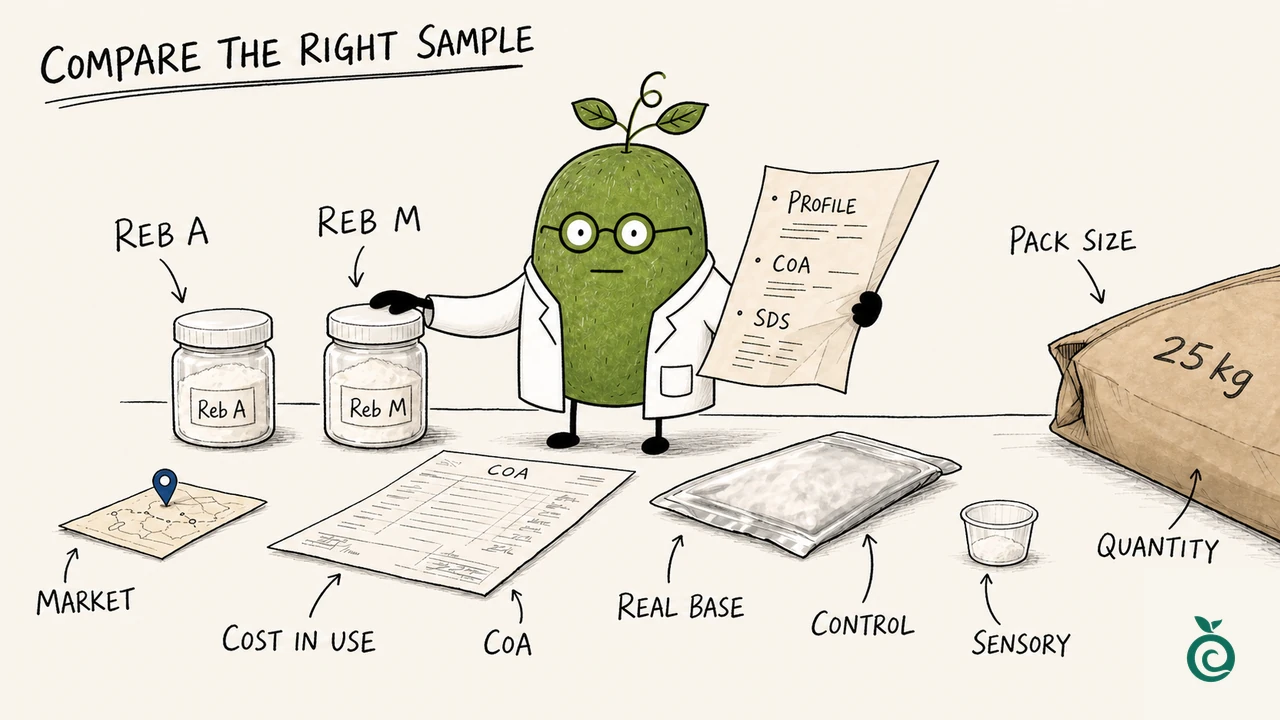
The illustration puts the sample, specification, control and buying conditions together because a Reb A or Reb M name alone does not make two offers comparable. Match the named glycoside, reporting basis and sample identity before comparing taste or price. The pictured pack and document props are a buying checklist, not a confirmed pack size, MOQ or certificate for a particular grade.
Identify the glycoside profile
State whether the project needs Reb A, Reb M, a steviol glycoside profile or a blend. Ask the supplier to identify the actual grade and provide the current product specification and COA. Do not compare a named glycoside on one side with an unspecified blend on the other. Keep the specification limit separate from the batch result. A total steviol-glycoside result cannot be relabelled as the Reb A or Reb M result.
- Compare our listed stevia grades
- Reb A 98% product and batch-document context
- Reb M 95% product and batch-document context
| Keep these fields separate | What to record for each offer |
|---|---|
| Ingredient identity | Named Reb A, Reb M, another glycoside profile or a declared blend; include the supplier product code. |
| Individual and total assays | Named glycoside result and total glycosides, with the method and dry/as-supplied basis. Mark a missing item as not provided. |
| Specification and batch | Specification version and acceptance limit beside the COA batch and measured result; do not turn one batch result into the grade minimum. |
| Sample and commercial material | Sample code/lot, producer or COA issuer and proposed commercial grade. Record any difference before treating the sample as representative. |
| Composition and route | Other constituents or carrier declaration, available production-route evidence and the market documents required for this project. |
Ask about the production route
The name Reb M does not, by itself, describe the production route or the full document question. Ask which production-route information is available for the proposed grade and what the target market requires. Keep any market conclusion conditional until the country, food category and current rule are checked.
Describe the real application
A supplier needs more than the phrase beverage or protein drink. Share the base, pH or acidity, soluble solids, protein or fat, flavor, target serving temperature, process heat, mixing order, viscosity and storage plan. These details determine whether the sample question is sweetness, bitterness, aroma, solubility, separation or shelf-life behavior.
Request the documents that match the grade
Start with product specification and COA, then list the documents needed for the project: SDS, allergen statement, origin, food-safety certificates, non-GMO or halal/kosher files where applicable, and target-market materials. Document availability must be confirmed for the actual grade and batch; a generic company certificate is not proof for every ingredient.
Compare cost in use, not headline purity
A higher assay number is not automatically the lower-cost solution. Compare the actual sample performance at the target sweetness, the amount needed in the finished base, carrier or bulk requirements, packaging and document work. Do not infer a competitor's formula or fixed ratio from a public label or supplier page. Keep a fixed-dose comparison separate from an equal-sweetness comparison. For cost in use, record each candidate's actual addition in the agreed base, with a clear mass or concentration unit, then apply a quotation with the same currency, price unit and trade-term basis. Missing freight, packaging or document costs remain open items rather than zero.
Set the control and scorecard
Use a current approved formula or a suitable sucrose reference beside the candidate grades. Agree whether the question is performance at the same addition or the addition needed to reach the same sweetness; these are different comparisons. Use the same finished base, preparation and serving conditions, and keep the sample code with every observation.
| Comparison question | Record with each candidate |
|---|---|
| Sweetness and finish | Dose with unit, agreed sweetness target, onset, peak and bitterness/lingering notes at the same selected times. If 30/90 seconds are used, use them for all candidates. |
| Preparation and physical result | Base/formula version, temperature, mixing order and time; note dissolution, haze or separation separately from taste. |
| Process and storage | Actual heat treatment, pack, storage conditions and observation time. An immediate tasting does not establish later stability. |
| Decision and remaining question | Which requirement was met, which was not assessed, and the next comparison needed. A preference alone does not resolve an unmatched specification. |
A neat sweetener in water can screen an ingredient question; it cannot stand in for a beverage or food formulation. If the product is a complete powder intended to be mixed with water, that full powder at its intended dilution is the actual base. Keep every component in that comparison rather than testing the sweetener alone.
Keep the regulatory note precise
The WHO/FAO JECFA Chemical 267 page includes a 2026 evaluation of steviol glycosides and purified Reb M preparations from two evaluated methods. That evaluation does not identify the production route of our offered grade or settle every market label and food-category question. Regulation (EU) 2021/1156 illustrates a process-specific EU specification for enzyme-modified Reb M, E 960c(i). For an EU project, match the actual grade and route to the applicable current specifications and permitted use; the historical regulation is not a complete current-market assessment.
Download a comparison record, or start with what you know
The free Excel has one column for your requirement and two for actual offers. Use Offer A and Offer B for the proposed Reb A and Reb M materials, and record their identities rather than assuming the columns represent interchangeable grades. Its 22 fields cover assay basis, composition, sample and specification references, documents, application conditions and quotation terms. There is no automatic ranking or recommended dose. The download needs no email, and completing it is not a condition for contacting us.
Send a useful sample or quotation brief
For a first discussion, send the application, target market and the main problem you want the sample to answer; include only the details you already know. As the project becomes specific, add candidate grades, the real base and control, target sweetness, process, storage plan, packaging, estimated quantity and any required documents. Confirm the agreed grade, sample scope and commercial terms before treating a quotation as comparable. You do not need a complete formula or finished paperwork to begin.
Common questions
Should buyers compare Reb A and Reb M by assay percentage only?
No. First identify which glycoside was measured, the reporting basis and whether the number is a specification limit or a batch result. Then compare the documented grade, route information and actual application performance.
Discuss this requestCan the same gram dose establish which grade costs less?
It can answer a fixed-dose question, but the candidates may reach different sweetness levels. A cost-in-use comparison needs the amount each candidate actually requires at the agreed sweetness in the same base, plus quotations on a comparable price and delivery basis.
Discuss this requestDoes a Reb M COA prove the production route or cold-drink performance?
Do not infer either from the product name or a general solubility entry. Request the route information and application details available for that grade, and verify the intended concentration, mixing and storage in the finished base.
Discuss this requestIs a water test always the wrong base?
No. A neat ingredient in water is an ingredient screen. A complete drink powder mixed with water at its intended dilution is the actual product base; keep the protein, flavors and other ingredients in that test.
Discuss this requestWhat if the supplier cannot provide one of the requested documents?
Record the missing document and what it is needed to establish. Confirm whether it is required for the actual grade, buyer or market before deciding the next step; do not substitute a generic company certificate for a batch COA or a product-specific requirement.
Discuss this requestDoes the spreadsheet decide the winner?
No. It is a blank purchasing record for your requirement and two actual offers. Keep the sample observations and source documents with it. An empty cell means not recorded, not zero cost, an accepted result or approval.
Discuss this requestCan we ask for help before the brief is complete?
Yes. Start with the intended product, market and the problem you want to solve. We can discuss which grade documents and sample conditions need checking as the brief develops.
Discuss this request