
Read this guide in
REB M BEVERAGE GUIDE
Stevia Reb M vs Monk Fruit in Beverages: Blend Roles and Aftertaste Guide
Choose a Reb M or monk fruit beverage trial by ingredient role, matched sweetness, cold dissolution and market conditions. Start with the drink and taste target.
Reb M stevia is getting more attention because beverage teams want cleaner sweetness with less stevia linger. That does not make it a direct sugar replacement.
This guide is for buyers comparing Reb M, monk fruit, allulose-supported options and erythritol-free beverage blends before asking for samples.
Start with the drink matrix
A flavored water, RTD tea, coffee drink, electrolyte powder and protein beverage can react very differently to the same sweetener blend. Check the acid level, flavor type, pH, processing, package format and serving temperature before judging whether Reb M or monk fruit is the right lead sweetener. A complete drink powder reconstituted as directed is the application base; a sweetener-only solution in water is an early screen. Record actual preparation and process conditions alongside the formula.
Give each sweetener one job
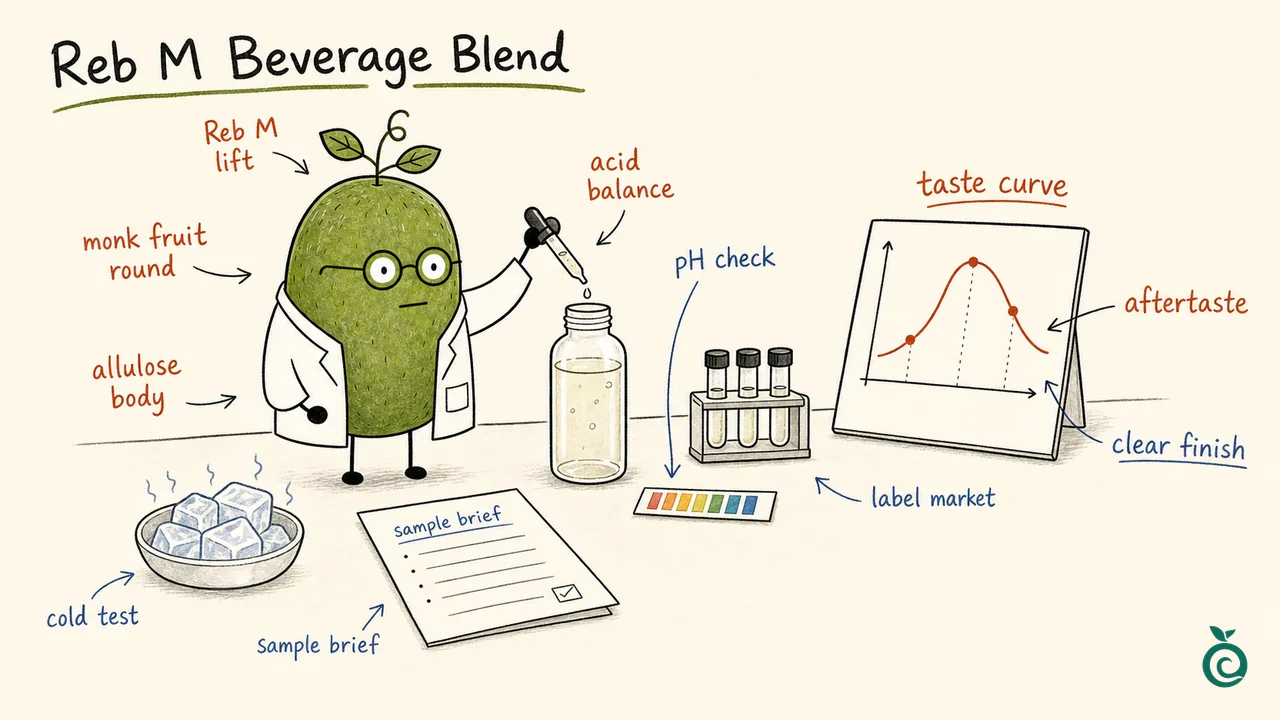
Reb M can provide a cleaner high-intensity lift than many older stevia directions. Monk fruit can round the sweetness curve in some beverages. Allulose may help body and sugar-like eating quality where the target market allows it. Carriers, fibers or other bulking ingredients may still be needed when the formula needs mouthfeel, powder flow or syrup behavior.
| Trial direction | Question it answers | Keep visible in the record |
|---|---|---|
| Reb M lead | Does this named grade meet the sweetness timing and finish target? | Material code, composition, actual addition and preparation; compare with the current drink. |
| Monk fruit lead | Does this extract fit the intended flavour and finish? | Named extract and Mogroside V basis where reported; actual dose, not a generic sweetness multiple. |
| Reb M plus monk fruit | Does the combination resolve a defined gap at the intended sweetness? | Each actual material and amount; a mass ratio does not state the sweetness contribution of each. |
| A direction with a bulking ingredient | What happens to body or solids when sugar mass changes? | Full changed recipe, permitted ingredient/use and method; do not attribute all differences to the high-intensity pair. |
These are trial directions, not four standard recipes. Compare actual commercial ingredients, not an assumed pure-glycoside ratio; adding a bulking material changes the formula as well as the sweetener system. A blend name alone does not establish synergy, improved liking or a smaller required dose.
Keep allulose market-dependent
For the United States, FDA's allulose guidance describes enforcement discretion for Total Sugars, Added Sugars and calorie declarations. This label guidance does not determine every product claim or another country's eligibility. EFSA's 2025 opinion could not establish safety for the submitted D-allulose novel-food dossier after data requests were not answered. That dossier conclusion is not a finding that every allulose source is harmful, nor a substitute for checking the current EU authorisation status of the proposed material and use. Australia and New Zealand gazetted A1247 through Amendment No. 233. The current Schedule 25 text lists food categories and conditions; its water-based flavoured-drink permission excludes electrolyte drinks and electrolyte drink bases, among other categories. Check the actual product classification, applicable limits, ingredient specifications and label requirements before choosing an allulose-supported route.
Taste the curve, not only the endpoint
Ask the tasting panel to record first sweetness, peak sweetness, acid bite, flavor release, bitterness and linger. A blend that reaches the right sweetness number can still feel late, thin or sharp if the curve is wrong for the drink. Choose whether the comparison uses a fixed addition or doses adjusted to matched sweetness, and write down how the target was matched. Record material codes, actual amounts, finished-drink quantity and any stock concentration and dilution. Use coded samples and the same preparation and serving conditions; keep sweetness or bitterness intensity separate from liking. Observations at stated checkpoints do not create a continuous time-intensity curve. Keep instrument readings and taste observations separate too. Measured pH, titratable acidity and perceived acid bite answer different questions; Brix in a mixed formulation is not automatically total sugars. State the method and units for each measurement instead of reading a drawn curve or a single endpoint as the whole result.
Ask for exact sample identity
Before sample testing, confirm whether the stevia direction is Reb M, Reb D, Reb A or a blended steviol glycoside system. Also confirm the monk fruit extract direction, Mogroside V target where relevant, carrier choice, allulose form and whether the blend is intended for liquid or powder use. Match the sample code to its specification and batch documents, including the full supplied composition and preparation instructions. Powder, liquid, a concentrated blend and a complete drink powder are different purchasing items; confirm which one is being discussed.
How should Reb M dissolution be checked in a cold drink?
Confirm the exact Reb M grade, full composition and preparation instructions first. Compare direct cold addition with any supplier-supported predissolution route at the actual use concentration. Record temperature, mixing, time and visible residue, then recheck after cooling and the planned chilled-storage interval. A clear warm solution does not establish the result in a cold concentrate or finished drink. Haigen's RM95 batch 20260920 COA reports compliance with its stated solubility specification, but it does not give a validated cold-drink concentration, mixing time or storage result. Request the matching material's application data and test the complete beverage.
Start a sample discussion with the drink and one target
Tell us the intended drink, market and the sweetness, aftertaste or body issue you want to change. Share the current formula direction, serving and process details you know; pH, final quantities, certificates and a completed comparison record can follow. Specify whether you want separate ingredients, a supplied blend or a different finished-product/packing project so the sample and quotation refer to the same scope. The offered material, documents, sample quantity, form and packing can be confirmed next.
Common questions
Should Reb M or monk fruit lead the beverage trial?
Start with the gap in the current drink: sweetness timing, bitterness or linger, flavour fit, or loss of body. Compare the named materials in the real base, then test a combination if it has a clear job. Neither name selects a universal ratio or dose.
Request a beverage blend sampleDoes combining Reb M and monk fruit guarantee a cleaner finish?
No. It is a direction to test in a defined formula. Record each actual material and amount, and compare at the intended sweetness; improved liking, less bitterness and lower dose are different outcomes.
Request a beverage blend sampleIs Reb M always better than Reb A?
No. Reb M can taste cleaner in some systems, but the actual grade, cost, documents and beverage matrix still matter. Compare the named samples in the same application before selecting one.
Request a beverage blend sampleCan these high-intensity ingredients replace the body of sugar?
They can supply sweetness at small additions, but that does not restore the removed sugar mass. Consider the full recipe and any bulking ingredient as a separate trial variable, subject to its market and use conditions.
Request a beverage blend sampleDoes an erythritol-free blend automatically fit every market?
No. Erythritol-free describes one compositional condition, not the eligibility of Reb M, monk fruit, allulose or the complete formulation. Confirm every offered ingredient, its identity and intended use for the destination market.
Request a beverage blend sampleDoes a compliant Reb M COA prove it will dissolve in my cold drink?
No. The RM95 batch example discussed above does not validate your concentration, temperature, mixing or storage. Follow the selected material's instructions and check the actual drink after preparation, cooling and the planned observation intervals.
Request a beverage blend sampleCan one pH or Brix reading explain the taste difference?
No. Keep the measurement method, units and formula context. Perceived acidity and measured pH differ, and Brix is not automatically total sugars in a mixed beverage; sweetness timing and linger need their own sensory observations.
Request a beverage blend sampleMust I know every measurement and quantity before asking for samples?
No. Start with the drink, intended market and the question the next sample should answer. Share what you know; the exact material, documents, sample quantity, form and quotation scope can be clarified next.
Request a beverage blend sample