
Read this guide in
STEVIA MONK FRUIT GUIDE
Stevia and Monk Fruit Blend Guide for Sweetener Buyers
Compare stevia and monk fruit blend identities, actual doses and sweetness targets. Plan real-product trials and request a sample without a fixed ratio.
Stevia and monk fruit are both high-intensity natural-origin sweeteners. Buyers often compare them as alternatives, but many commercial projects test them together because each can adjust a different part of the sweetness profile.
This guide is for beverage, tabletop, powder, supplement and private-label buyers who want a stevia monk fruit blend discussion without assuming allulose must be the main base.
Give each ingredient a job in the formula
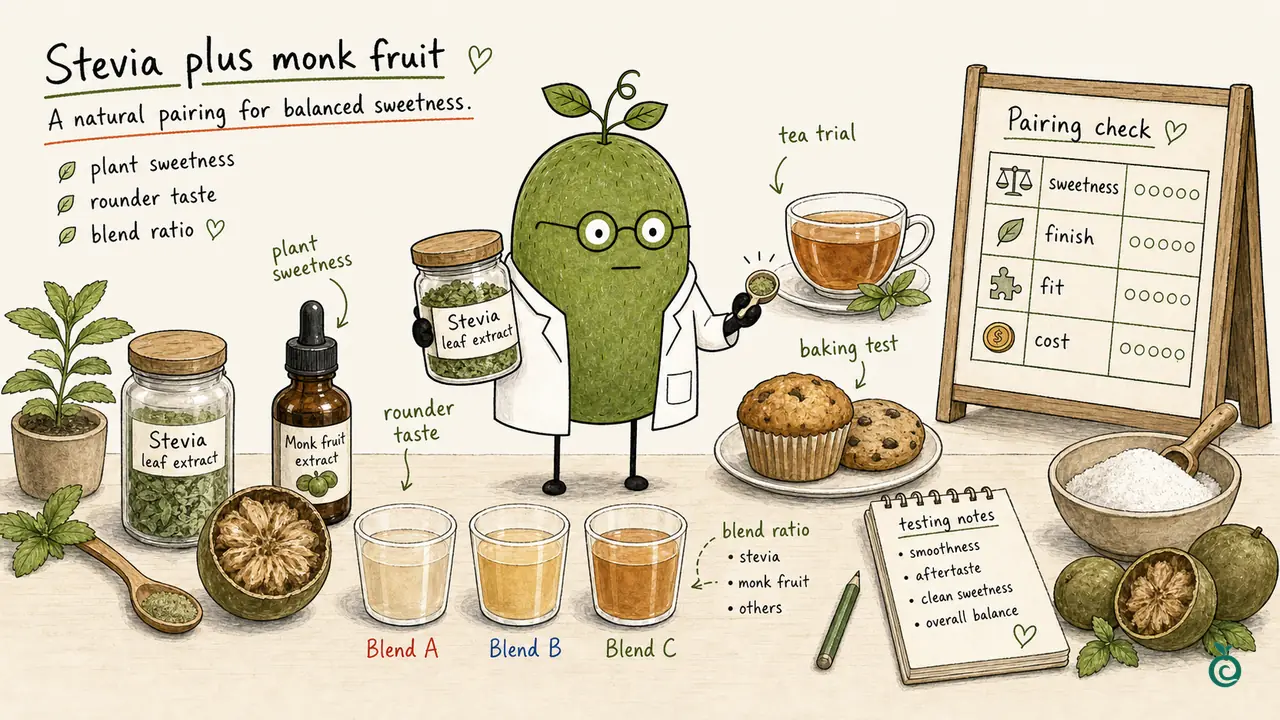
Stevia can provide a strong sweetness lift at low use levels. A monk fruit direction can be tested for the intended sweetness balance and finish. Define the improvement you want from the combination, then compare it in the product; two natural-origin ingredient names do not establish a rounded taste, lower dose or lower cost.
Compare the material you are actually buying
Stevia preparations differ by glycoside composition, assay basis, production route and other supplied ingredients. Keep total steviol glycosides and named Reb A or Reb M content separate. For monk fruit, retain the named Mogroside V specification, reporting basis, other components and form rather than treating the extract name as a complete identity.
| Supplied direction | Keep with the comparison | What the name does not establish |
|---|---|---|
| Separate stevia and monk fruit ingredients | Both product codes, grades, assay bases, actual masses and the complete base formula | A ratio of commercial materials is not automatically a ratio of pure glycosides or perceived sweetness. |
| A supplied high-intensity concentrate | Blend code and revision, full supplied composition, form and any carrier | The two headline sweeteners do not identify everything in the concentrate or supply the mass that sugar previously provided. |
| A finished tabletop or sachet blend | Full ingredient declaration, carrier or bulk system, serving mass and directions | Equal grams, equal measuring volume and equal perceived sweetness are different serving comparisons. |
| A revised grade or premix | New material or formula-version reference, corresponding documents and a new comparison in the intended base | A previous tasting result does not automatically transfer to a changed composition, form or serving. |
Separate sweetness tuning from a claim of synergy
Our practical question is whether the candidate gives the intended sweetness, finish and product fit at its actual addition. A blend can be worth evaluating without assuming that the pair must amplify sweetness beyond an additive expectation. The 2024 SWEET study used cell-based taste-receptor assays and did not observe sweetness synergy for its tested Reb M/mogroside V combination. That result does not measure a finished drink's aftertaste or preference, and it does not establish every commercial grade or application outcome. Judge the proposed blend in the actual product rather than treating a two-ingredient label as proof of synergy.
Choose the application and the missing sugar function
A high-intensity stevia–monk-fruit direction supplies sweetness at a small addition; it does not automatically replace sugar's physical mass, body or measuring volume. Identify which of those functions the intended product needs, then confirm the full formulation. A concentrate and a finished tabletop blend answer different purchasing questions. Clear drinks, flavored water, RTD tea, coffee mixes, electrolyte or beverage powders, tabletop products and other applications are trial directions rather than guaranteed best-fit results. For a drink, retain the full flavor, acid and solids system. For a powder or serving format, include actual preparation, dispersion, fill or handling requirements. Allulose need not be the main base; any proposed bulk or carrier system should have a defined job and fit the intended product and market.
Starting screening directions: compare grades and contributions
Compare a monk-fruit-led direction, a stevia-led direction and a balanced candidate against the current formula. These are screening labels, not fixed mass ratios. Mogroside V 25%, 50% or 95% specifications and Reb A or Reb M grades need their own identity and assay checks. A higher assay number alone does not establish the preferred taste or the required dose in your product. Request the exact grade, composition, carrier and current application guidance before weighing. For each candidate, record actual ingredient masses and total batch mass. Choose the starting levels with the application team and confirm equal sweetness in the complete base. A mass ratio cannot be reused as a perceived-sweetness ratio when materials have different potency or composition. If a supplier provides a premixed blend, keep its formula-version reference and full ingredient statement with the trial. After the first screen, adjust one contribution at a time. Describe the intended improvement: quicker onset, less bitterness, less lingering sweetness or better flavor balance. Keep the drink base, acidity, flavor and serving condition fixed. Repeat promising candidates after the intended process and storage checkpoint so the chosen grade is linked to the actual product result.
| Candidate | Grade / batch identity | Actual dose | Cost-in-use inputs | Result |
|---|---|---|---|---|
| Monk-fruit-led | Record monk fruit and stevia grades | Record both masses | Price basis, total dose and solids | Complete after tasting |
| Stevia-led | Record both grade specifications | Record both masses | Same quotation basis | Complete after tasting |
| Balanced screen | Record supplier version or weighed recipe | Record both masses | Same quotation basis | Complete after tasting |
Keep the comparison question with each sample
The three screening labels above do not define equal mass proportions or equal sweetness contributions. Include the current formula or an agreed control, then state whether the round compares fixed additions or matches a sweetness target. When matching sweetness, retain each actual addition and any other formula change; a good result at one addition does not supply a universal blend ratio. Record the exact material, formula revision, batch basis, preparation and serving condition. Use coded samples with an agreed tasting order and palate-cleansing method. Describe sweetness onset, peak, lingering sweetness, bitterness, flavor interaction and mouthfeel separately; intensity and preference are different observations. A stronger peak alone does not show a better finish or a preferred sample. A water screen can help identify an early difference. The decision belongs in the intended complete product; if that product is a beverage powder, its specified preparation in water is the relevant application. Check the actual pH or acid system, heat process, dispersion and planned storage observations where they matter. Receptor activity, a single cup and a powder-mixing description do not establish the finished result.
Tabletop sachets: carrier and dose checklist
For tabletop packets, define whether the serving is equal weight, equal volume or a sweetness amount per sachet. Record the fill mass, intended beverage or food and the consumer directions. A high-intensity blend may need a bulking or carrier system for reliable weighing and packing; confirm its actual identity rather than assuming the extract name describes the entire sachet. Compare powder flow, segregation, fill consistency, dust and seal-area contamination on the intended packaging route. Test the serving in the consumer’s hot or cold application as well as in the bulk powder. Keep any cooling sensation, residual particles and aftertaste in separate rows. Confirm the pack barrier and storage instructions for the agreed material. Calculate cost in use from the actual tested dose and a comparable quotation. Include carrier or bulk changes, packaging and processing where they differ. A lower price per kilogram does not guarantee a lower cost for the required sweetness or an accepted consumer serving. Once the sample direction passes, review the full ingredient list and destination-market claims before locking artwork.
Use the existing free sensory record for the next trial
The sensory workbook records one coded sample, one person and one checkpoint. Its 57 blank inputs cover context, six dimensions, three separate review gates and the next action. Keep both ingredient identities, the actual masses and recipe revision with that code; use a separately identified record for another candidate or checkpoint. The file has no formula, automatic total or winning-sample ranking. It is a feedback record, not a blend-ratio or cost calculator; retain the actual dose and comparable quotation separately when reviewing cost in use. Download it without an email address or account. Filling it in is optional before contacting us.
Start with the product, market and one improvement
Send the product you are making, intended sales market and the taste or handling issue the next sample should address. Share the current ingredients, desired sugar reduction, serving format and any route or ingredient-list restrictions you know. You do not need to choose a fixed ratio, complete the workbook or supply a full purchasing brief before the first discussion. As the direction becomes clearer, confirm the supplied composition, material or blend revision, specification and evaluated sample reference. Then align packaging, estimated quantity, documents, quotation scope and sample arrangements. Grade examples in this guide do not imply that every material is stocked or manufactured by Hengliyuan; the offered item and supply arrangement are confirmed for the selected request.
Common questions
Why consider a stevia and monk fruit blend?
Define the sweetness, finish, flavor or product-fit improvement you want, then compare the exact materials in the actual product. A useful blend result depends on composition, actual addition, base, preparation and the intended serving.
Request a stevia–monk-fruit blend sampleIs a balanced screen the same as a 50:50 mass ratio?
No. Monk-fruit-led, stevia-led and balanced are screening labels here, not fixed mass ratios or measured sweetness shares. Record both actual material masses and the comparison basis for the selected grades.
Request a stevia–monk-fruit blend sampleDoes this ingredient pair guarantee sweetness synergy?
No. The cited 2024 cell-based study did not observe synergy for its tested Reb M/mogroside V combination. That assay does not determine finished-product preference or aftertaste; evaluate the actual proposed material and product.
Request a stevia–monk-fruit blend sampleDoes a stevia–monk-fruit concentrate replace sugar's bulk?
Its sweetness contribution does not automatically supply sugar's physical mass, body or measuring volume. Confirm which functions the product needs and the complete supplied composition, including any carrier or bulk ingredients.
Request a stevia–monk-fruit blend sampleMust allulose be the main base?
No. Identify the intended product, missing formulation functions, ingredient-list direction and market. A bulk system, where needed, should answer that particular job rather than follow the two sweetener names.
Request a stevia–monk-fruit blend sampleCan I transfer a water-screening ratio directly to a drink or powder?
Treat it as an early screening result. Compare the complete intended base, actual addition and preparation, including process and serving conditions; a beverage powder prepared as specified in water is its actual application.
Request a stevia–monk-fruit blend sampleDoes the Excel file calculate the best ratio or total cost?
No. It records coded sample observations and separate review gates without a formula or automatic ranking. Keep actual ingredient masses, recipe revision and comparable quotation inputs with the sample record.
Request a stevia–monk-fruit blend sampleWhat is needed before the first sample discussion?
Start with the product, intended market and the main taste or handling issue. Share the ingredients and serving direction you know; ratio selection, specification, pack, quantity, documents and sample arrangements can follow.
Request a stevia–monk-fruit blend sample