
Read this guide in
SYRUP SAMPLE SCORECARD
Zero-Sugar Syrup Test Checklist: Brix, Flow & Storage
Zero-sugar syrup validation checklist: compare samples in hot, cold and diluted bases on Brix, viscosity, aftertaste and storage.
A syrup can taste acceptable from a spoon and still fail after dilution, hot coffee, carbonation or storage. The first useful test therefore keeps the comparison fair and follows the syrup into the drink where it will actually be used.
Use this checklist for coffee syrup, soda concentrate, milk-tea syrup, fruit drink base and similar projects involving monk fruit, stevia, allulose-supported or erythritol-free directions. It is a sample plan, not a fixed formula or shelf-life approval.
Write one decision at the top
State the decision in one sentence: can this syrup deliver the target sweetness and mouthfeel in the intended drink without an unacceptable finish? Add the market, product type, flavor, serving or dilution, package and current control. A clear question is more useful than a request for a generally better syrup.
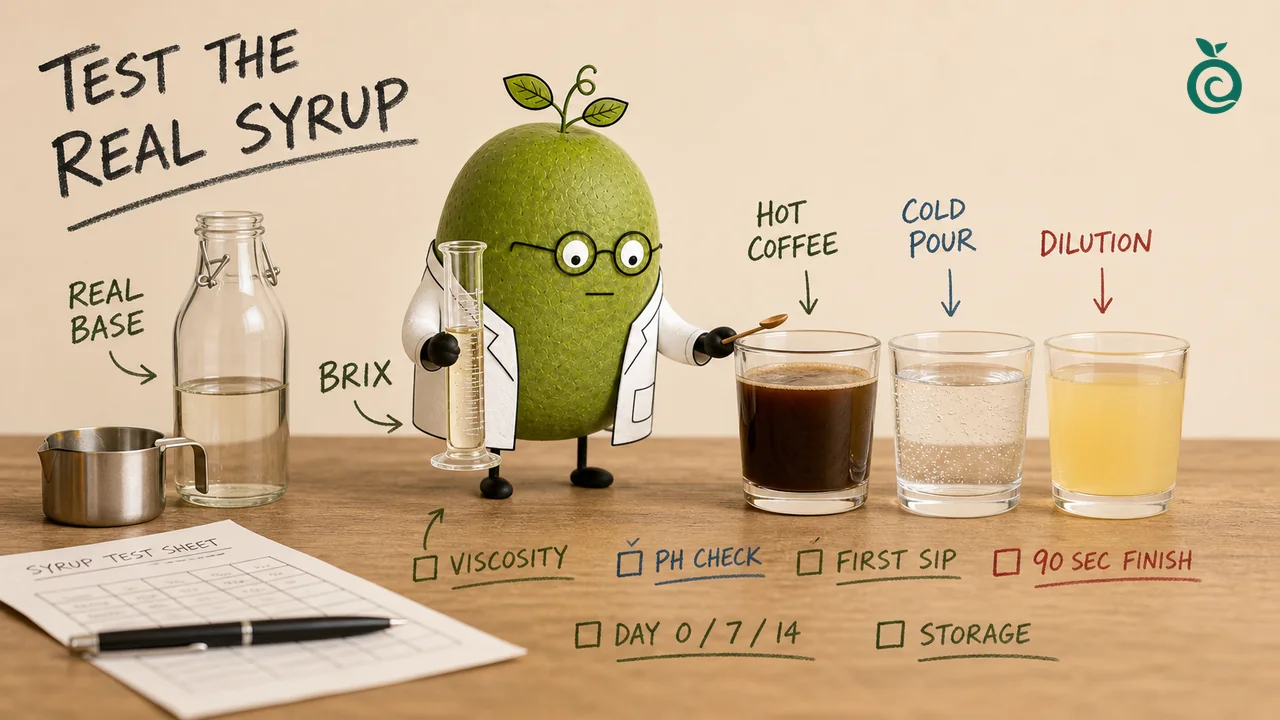
Keep the first samples comparable
A practical first matrix is the current or sucrose control, one candidate direction, a second direction and one blend or body-support direction designed to answer a specific trade-off. Keep the serving conditions and target sweetness clear. If a sample also changes solids or acidity, record that as part of the route rather than calling it a pure sweetener comparison. Identify the commercial ingredient grade, carrier, sample or formula version and actual amount, including any stock concentration and dilution. State whether inclusion is fixed or adjusted toward a matched sweetness target. Keep syrup-to-water and syrup-to-finished-drink ratios distinct, and state whether the ratio uses mass or volume; a pump count alone does not establish the delivered mass.
Test the real drink, not only water
Screening in water can find obvious problems, but final tasting should include the intended hot coffee, iced coffee, sparkling water, milk tea, fruit drink or other base. Record water and mineral profile, pH or acidity, flavor, protein or tea/coffee load, carbonation, mixing order, heat treatment, filling, serving temperature and storage conditions when relevant.
| Intended use | Hold or record | Question to answer |
|---|---|---|
| As-sold syrup or concentrate | Product version, preparation, temperature and the actual pump/pour setup. | Does the syrup handle and deliver the intended amount? |
| Hot coffee or tea, if sold for that use | Real base, dose, serving temperature and time before tasting. | Does the intended drink meet the sweetness and finish target? |
| Cold coffee, milk tea or fruit drink, if relevant | Real base, dilution basis, ice/preparation history and serving conditions. | What happens to taste, body and appearance after preparation? |
| Sparkling or carbonated drink, if relevant | Real carbonated base, added amount, mixing and serving conditions. | What happens to sweetness, foam and the finish in that format? |
Choose the formats the project actually intends to sell; this is not a requirement to test every drink listed. Keep a separate record for each base, sample version and checkpoint. Acceptance in one format does not establish the result in the others.
Record the physical syrup checks
Measure or describe Brix or total soluble solids, pH, viscosity, pump or pour behavior, dissolution, clarity, haze, sediment, separation, crystallization, color and foam where relevant. These fields describe the syrup's physical use; they do not prove food safety or shelf life. Use the buyer's method and units consistently across samples. Brix is a method-dependent reading in a multi-ingredient syrup, not a direct assay of total sugars, allulose concentration or sweetness. Keep pH, titratable acidity and perceived sourness separate. Record appearance before disturbing the relevant sample, then follow the agreed preparation method.
| Check | Keep with the observation | Avoid treating it as |
|---|---|---|
| Identity and dilution | Actual syrup/ingredient version, carrier, dose, mass or volume basis and prepared-drink amount. | A pump count or an undefined ratio. |
| Brix / soluble solids | Instrument or method, temperature, sample preparation and reading with units. | A direct total-sugars result or a sweetness score. |
| pH and acidity | pH; titratable acidity with method and units; separate sensory sourness notes. | Interchangeable measurements. |
| Flow, viscosity and pumping | The chosen method or pump/pour setup, temperature and actual delivered amount where measured. | A universal viscosity number or a guaranteed pump dose. |
| Mixing and dissolution | Order, mixing conditions, any stock dilution and the defined observation endpoint. | Visible dispersion proving complete dissolution. |
| Appearance and crystallization | Undisturbed clarity, haze, sediment, separation, crystals, foam and color at the stated checkpoint. | A demonstrated cause, ingredient purity or shelf-life result. |
| Process and packaged storage | Actual process, pack, storage conditions, date, checkpoint and relevant repeat observations. | Fresh-sample acceptance proving packaged stability or safety. |
Use a time-sensory record
At the same agreed serving temperature, record sweetness onset, peak, finish, bitterness, metallic or licorice-like notes, acid balance, aroma, body, thinness, coating and repeat-sip acceptability where relevant. Choose a clear time origin and checkpoints for the drink. The original 30- and 90-second observations are examples when useful, not universal requirements. Keep sensory intensity, liking and how well the sample meets a stated target as different questions. Retain individual coded-sample notes before discussing the group result. Mao et al. (2025) studied sucrose–citric-acid water models; Visalli and Galmarini (2024) reviewed temporal sensory methods. They explain the reason for recording time and method, not a commercial syrup ratio or a protocol for every drink.
Repeat the relevant process and storage checks
Compare the intended heat or cold process, package, light exposure and storage window. Day 0, 7, 14, 21 and 35 can be useful checkpoints when they match the project; they are not a universal shelf-life protocol. Recheck viscosity, clarity, separation, color, sweetness, aftertaste and package behavior under the conditions that matter to the finished product. Keep fresh, post-process and packaged-storage observations separate and use samples prepared for the planned sensory check with the required safety review. pH, an ingredient choice or hot filling alone does not establish microbiological safety or shelf life. Record the untested conditions and the next validation work.
Turn the score into the next brief
Write which route answered the question, which attribute improved, which trade-off remained and what must be retested. Share those notes with the final sales market, syrup use and main question; the record does not need to be complete before first contact. Add known packaging, quantity, required certificates/documents and sample needs as the discussion develops. A good scorecard makes the next sample more specific; it does not turn one result into a global performance claim.
Research and practical references
The studies cover model-system perception and temporal sensory methods. The related syrup guides explain dilution, physical checks and market review. Use them to define the project’s records; they do not establish a fixed syrup ratio, universal storage schedule or finished-product approval.
Common questions
Is a water test enough for a syrup project?
Water can screen obvious issues. Compare the intended real drinks with their own control, dilution, preparation and serving conditions; one base does not establish the result in another.
Discuss this requestDoes Brix show how much sugar or allulose is present?
A multi-ingredient syrup needs the appropriate analytical method for that question. Record how the Brix reading was obtained; it is not a direct total-sugars or allulose assay and is not a sweetness score.
Discuss this requestCan the same pump count compare two syrups?
Check the actual delivered amount under the chosen pump, syrup temperature and handling conditions. Keep the dilution basis and prepared-drink amount with the result; a pump count alone does not establish equal mass or sweetness.
Discuss this requestMust I use the listed seconds and storage days?
No. They are examples to consider when they match the project. Agree the tasting time origin, observation endpoints, process, packaging and storage checkpoints for the actual use.
Discuss this requestWhat does a fresh taste result establish?
It records that sensory comparison under its stated conditions. Processing, physical stability, microbiological safety, packaged shelf life and market claims need their own relevant checks.
Discuss this requestCan I use the existing beverage Excel record?
It can hold individual coded-sample feedback, agreed targets and next actions. Save separate records for samples, reviewers and checkpoints, and retain the detailed syrup measurements and methods alongside them.
Discuss this requestCan I ask for samples before the checklist is complete?
Yes. Begin with the final sales market, syrup use and the main taste, handling or process question. Known base, dilution, packaging, quantity and document requirements can be added as the discussion develops.
Discuss this request