
Read this guide in
Hengliyuan application and selection
Using Monk Fruit Sweetener in Electrolyte Drink Powder: Formula, Taste, and Stability
Choose monk fruit extract or a blend for electrolyte powders. Compare dose per bottle, mineral aftertaste, premixing and moisture checks before scale-up.
Monk fruit works in electrolyte drink powders, but selecting the sweetener is only the first decision. Our recommendation is to fix the water volume per stick, compare extract and blend options in the complete electrolyte base, then verify that the chosen sweetness is consistent from sachet to sachet.
A clean taste in water does not settle the formula. Sodium, potassium and magnesium salts, acids and flavors change what the consumer tastes. We assess mineral notes, sweetness and aftertaste together, then check premixing, filling and moisture protection before scaling up.
First choose the form: extract, existing blend or custom blend
Two samples labeled “monk fruit sweetener” can have very different compositions. Confirm the extract grade or full blend composition before comparing grams per serving or ingredient prices.
| Option | When we would start here | What to check |
|---|---|---|
| High-intensity monk fruit extract | You want control of the sweetener system and a small addition by weight. | Mogroside V specification, weighing accuracy, premixing and uniform distribution. |
| Hengliyuan natural blend series | You want an erythritol, monk fruit and stevia combination that is easier to weigh and contributes bulk. | Complete ingredients, cooling sensation, dissolution and the resulting sachet weight. |
| Custom sweetener blend | Existing samples miss your taste, pack-weight or ingredient targets. | Mineral salts, acidity, flavor, water per stick and cost at the tested dose. |
The extract mainly supplies sweetness. An erythritol-based blend also adds mass and can add cooling. Neither should be substituted gram for gram for the other. We recommend the form against the finished drink and packing process, not the ingredient name alone.
Fix the water volume before setting the dose
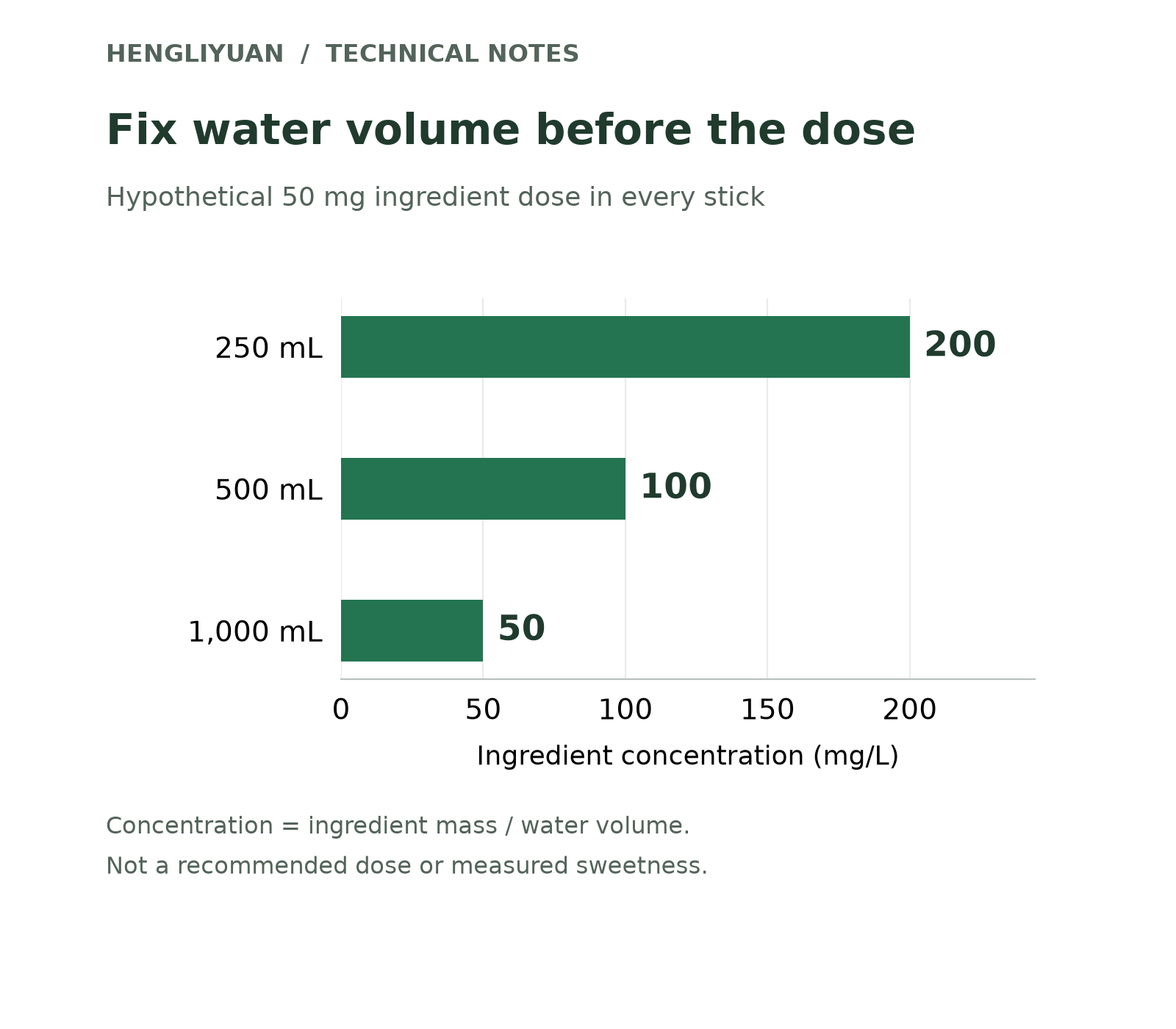
A stick intended for 250 mL is a different formulation task from one intended for 500 mL or 1 L. With the same powder dose, less water increases the concentration of the sweetener, salts and acids together. Specify the intended water volume on every sample record. Use this conversion for the sweetener ingredient: concentration in mg/L = ingredient mass in mg ÷ water volume in L. For example, 50 mg in 500 mL is 100 mg/L. The same 50 mg in 250 mL is 200 mg/L; in 1 L it is 50 mg/L. These are hypothetical arithmetic examples, not recommended monk fruit doses. They describe ingredient concentration, not a prediction of perceived sweetness. Once a dose is selected in the actual formula, calculate it on the same serving basis for scale-up. For example, 50 mg per stick across 10,000 sticks is 500 g before any validated process allowance. This calculation does not establish blend uniformity or account for manufacturing losses.
Balance the whole drink, not just sweetness
Different mineral salts can bring salty, bitter, metallic or astringent notes. Acidity and flavor also affect the balance. Increasing monk fruit until the first sip tastes sweeter can leave the underlying mineral note unresolved and the finish too sweet. Our preferred comparison is monk fruit alone against a monk fruit–stevia direction at a similar perceived sweetness. Keep the electrolyte base unchanged during that comparison. If both versions leave the same mineral problem, investigate the mineral and acid system instead of repeatedly increasing the sweetener. Recheck the blend when the salt form, acid level, flavor or water volume changes. Sugar reduction also changes body. A high-intensity extract can restore sweetness without replacing the mass and mouthfeel of sugar. Assess low-sugar and sugar-free versions separately; a winning sample in one is not automatically the best choice in the other.
Run a fair first-round sample comparison
Keep the electrolyte, acid and flavor quantities per prepared serving fixed, using the same ingredient lots where possible. Hold water volume, temperature and mixing method constant. Adjust each sweetener system toward the same target sweetness, then record its actual dose and the resulting total powder weight. Do not force an extract and a bulk blend to have the same addition weight.
| Sample | Sweetener direction | Decision to make |
|---|---|---|
| A — reference | Current formula or a sucrose reference. | Agree on the target sweetness, body and finish. |
| B — extract | Monk fruit extract at a recorded grade and dose. | Can it meet the target without an objectionable mineral note or lingering finish? |
| C — blend | Monk fruit with stevia, or an existing natural blend. | Does the finish improve, and are cooling and sachet weight acceptable? |
If pack weight is a hard constraint, record it before testing and develop within it. Any carrier added to equalize powder weight becomes another formulation change and must be recorded. Compare ingredient cost per serving at the selected dose, rather than price per kilogram alone.
Record the first sip, the finish and the whole serving
Test at the intended drinking temperature and include room-temperature water as a reference. Use the same preparation method for each sample and define what counts as complete dissolution. For a shake-and-drink stick, test the intended bottle and shaking method. We recommend tasting beyond the first sip. Record whether saltiness, bitterness, cooling or lingering sweetness becomes tiring as the serving is consumed. The fields below are a proposed trial record, not results from a Hengliyuan experiment.
| Record | Keep or write down | What the result tells you |
|---|---|---|
| Sample identity | Extract grade or blend code; lot; mg or g per serving; total powder weight. | Whether another person can reproduce the sample. |
| Preparation | Water volume and temperature; bottle or cup; mixing method and time. | Whether a difference comes from preparation rather than the sweetener. |
| First sip | Sweetness onset, acidity, saltiness, bitterness and metallic notes. | Whether the drink reaches its intended balance. |
| Finish | Lingering sweetness, bitterness and cooling after swallowing. | Which attribute needs adjustment in the next sample. |
| Half and full serving | Comfort of continued drinking and overall preference. | Whether a good first sip remains acceptable. |
| Physical observations | Dissolution time, residue, clarity, foam and sediment after standing. | Whether the powder works under the intended conditions. |
What the published evidence adds
These sources help us choose what to test. They are external studies and a patent example, not our factory trial results.
- Patil et al.: powder formulation and short-term stability
- Kitson et al.: sensory perception during exercise
- US10893690B2: sports drink formulation examples
| Source and conditions | Reported finding | How we use it |
|---|---|---|
| Patil et al., 2026: one monk fruit electrolyte powder; 40°C/75% RH for 28 days. | Moisture rose from 2.1% to 3.5% (a 1.4 percentage-point increase), with mild caking. Initial dissolution was 28 ± 2 seconds. | Check moisture and dissolution in the intended pack. This short study does not establish a commercial shelf life. |
| Kitson et al., 2021: 27 adults; 60 minutes of cycling at 35.3 ± 1.4°C; 20 mL tasting samples. | Liking of saltiness and perceived thirst-quenching ability increased for the oral rehydration solution. Sports drink and flavored water remained more liked at all time points. | Test the intended drinking context. The study measured liking, not increased salt concentration, and did not test monk fruit or a whole-serving taste protocol. |
| US10893690B2, Example 2: citrus drinks prepared to 473 mL. | The patent describes 5 g sugar, 100 mg stevia extract and 5 mg monk fruit extract, with reduced “magnesium taste” in those samples. | Include a blend comparison. The example contains sugar and is not a universal ratio or a validated zero-sugar recipe. |
Our development sequence remains practical: establish the taste direction in the complete base, assess continued drinking, then verify powder distribution and storage behavior. The whole-serving comparison above is our recommended trial approach, rather than a claim that the cited exercise study performed it.
Check powder uniformity and moisture protection separately
A successful cup test does not prove consistent sachets. At a low extract dose, weighing, sieving where appropriate, premixing, ingredient addition order and mixing time need a production trial. Sample across the blend and filling run; consistent fill weight alone does not prove consistent sweetener distribution. Use a sampling plan suited to the equipment and batch size. Compare prepared drinks from the selected locations or filling stages, and use appropriate analytical checks where required. Record the actual process so the chosen sample can be reproduced. For storage, track moisture, caking, flow, fill-weight variation, dissolution, residue, color and taste in the intended packaging. Include the seal and storage conditions, not just the film specification. For a multi-serve pack, include use after opening. Accelerated testing helps expose problems; the shelf-life decision needs a suitable validation plan for the finished product.
Which sample direction would we recommend?
For a light drink, start by avoiding excess sweetness and a long finish. For a mineral-heavy formula, compare the extract with a blend before committing to either. For a fixed-weight stick, evaluate pack weight and powder handling alongside taste. If erythritol cooling or bulk is unsuitable, that is a reason to review the blend, not simply reduce the whole dose until sweetness is lost. Hengliyuan supports monk fruit extract selection, blended sweetener development, taste comparisons, powder applications and stick-pack OEM/ODM projects. Start with your market, flavor, water volume per stick and the main taste or packing problem. If you already know the electrolyte levels, sugar target, pack weight or expected quantity, include them. You do not need a complete formulation to start the discussion.
Review note
Reviewed October 16, 2026. Factory recommendations, calculated examples and external research findings are identified separately.
Common questions
Can monk fruit extract be added directly to electrolyte powder?
Yes, it can be used in the powder formula. For production, validate weighing, premixing and distribution at the selected dose. Adding a small quantity to a large batch without a verified mixing process can give inconsistent sachets. A successful cup test is the starting point, not the uniformity check.
Discuss this requestCan monk fruit and stevia be used together?
Yes. We recommend comparing the combination with monk fruit alone in the actual electrolyte base. Match perceived sweetness and compare the finish, mineral notes and continued drinking. Choose the ratio for that formula, rather than copying a ratio from a different beverage.
Discuss this requestShould I choose an extract or a blended sweetener?
Start with an extract when you want control of the sweetener system and a small addition by weight. Consider a blend when easier weighing and added bulk are useful. Check its full composition, cooling, pack weight and market suitability before selecting it.
Discuss this requestHow much monk fruit sweetener should go in one stick?
The dose depends on the extract grade or blend composition, target sweetness, electrolyte base and water volume. State both ingredient mass per stick and water per stick. For the same ingredient mass, halving the water doubles concentration; it does not guarantee double the perceived sweetness. Send those details with a reference drink or taste target so we can review a sample direction.
Discuss this requestDoes passing a taste test make the product ready to sell?
No. Taste selects the sensory direction. The finished product also needs the relevant composition, microbiological, blend-uniformity, packaging and shelf-life checks. Verify electrolyte content and any required osmolarity or osmolality measurements against the intended product and claims.
Discuss this requestDoes monk fruit automatically make an electrolyte powder zero sugar or zero calories?
No. Review the complete formulation, including sweetener carriers and flavor ingredients, the finished-product nutrition data and the rules in the target market. The name of one sweetener does not establish a label claim.
Discuss this requestWhat should I send when requesting samples?
Start with your target market, flavor, water volume per stick and the main issue you want to solve. Existing electrolyte levels, a reference product, sugar target, pack weight and expected quantity help refine the request. Share what you already have; a complete formulation is not required for the first discussion.
Discuss this request