
Read this guide in
Hengliyuan Applications and Selection
How to Use Sucralose in Powdered Drink Mixes: Dosing, Premixing & Blend Uniformity
Dose sucralose in powdered drinks: direct use vs in-house premix vs blended sweetener, plus batch uniformity verification.
Because sucralose is highly sweet, its addition level in powdered beverage mixes is usually small. Beyond calculating the dose accurately, factories must manage weighing, addition, and uniform mixing of the full batch; otherwise, different packs from the same batch may differ in sweetness.
Depending on the factory’s formula and production conditions, three routes are available: use sucralose powder directly, prepare an in-house premix, or order a lower-intensity blended sweetener from Hengliyuan. There is no single answer. The key is to match the ingredient form to the factory’s weighing capability, mixing equipment, and finished-product sweetness.
One good cup does not establish batch uniformity
A laboratory cup can show that a formula is worth developing. It cannot establish that the same sweetness will reach every sachet after the powder has been mixed, discharged, transferred and packed. Sucralose makes up a small proportion of a powdered drink formula. The production task is to weigh that addition reliably and distribute it through the actual batch, then maintain the distribution during handling. Start the checks at weighing and follow the material through to the units the customer will use.
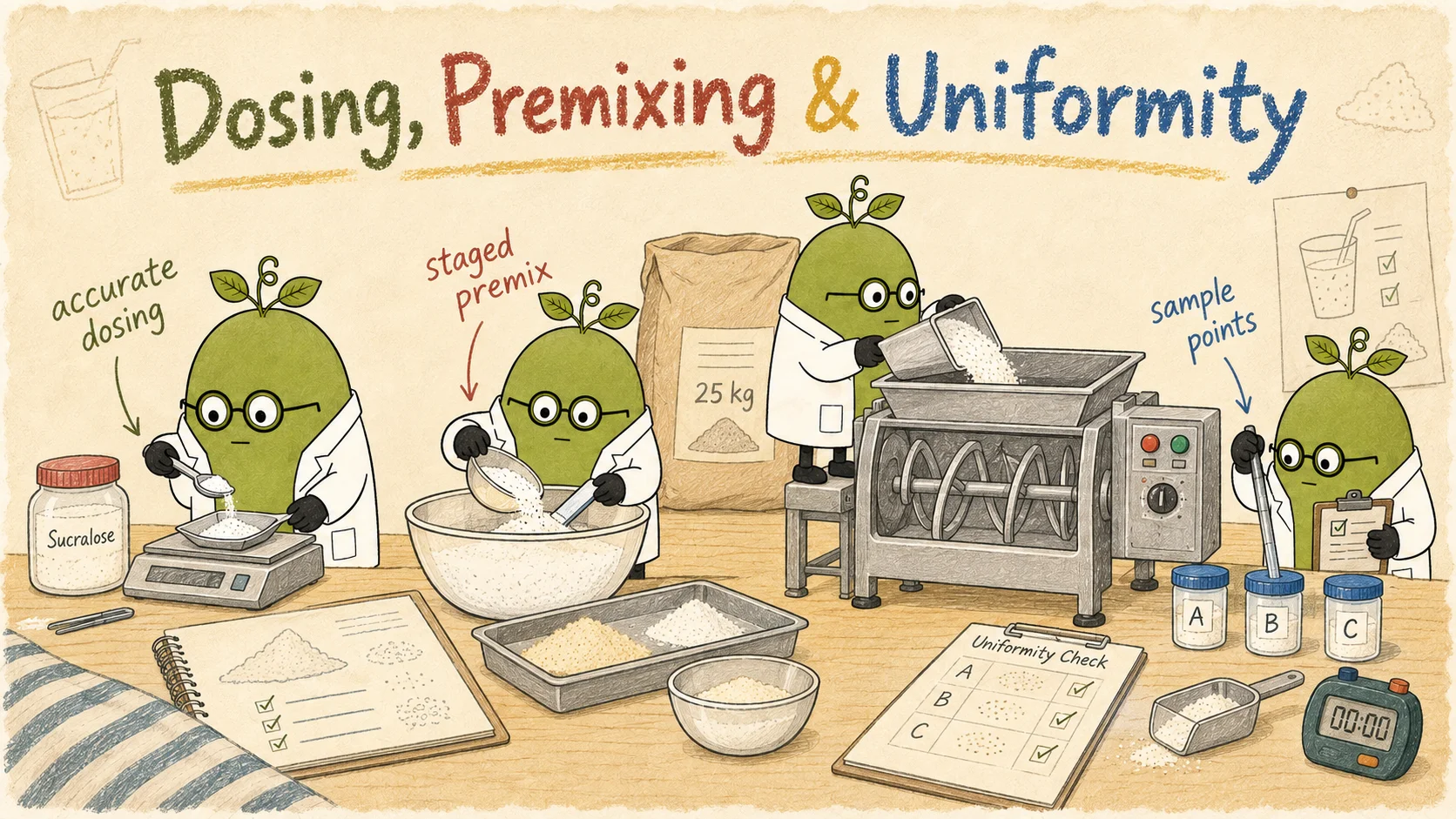
Choose between direct addition, an in-house premix and a blend
Choose the route around the actual addition mass and the equipment that will weigh, transfer and mix it.
| Route | When it fits | Checks before scale-up |
|---|---|---|
| Direct addition of sucralose powder | An established formula and a process that can handle its small addition reliably | Scale suitability at the required mass, repeatability, transfer losses and ingredient distribution after packing |
| An in-house premix | You control the carrier, proportion and staged addition within your own formula | Carrier identity, premix uniformity, recovered addition mass and distribution in the main batch |
| A lower-intensity blended sweetener | A larger addition mass would make routine weighing and feeding easier | Complete composition, target sweetness, actual dose, process uniformity, taste and cost in use |
Check the scale at the mass you will actually weigh. A large maximum capacity or a fine display increment alone does not establish a reliable small addition. A larger premix or blend addition may simplify handling, but it does not prove uniformity by itself.
Direct use: calculate the batch addition separately from bag size
Factories with an established in-house formula and the capability for small-dose addition can purchase sucralose powder directly. Hengliyuan currently offers one sucralose powder specification in 25 kg bags. The 25 kg figure is the ingredient's package net weight, not the addition amount for one production run. Calculate the actual sucralose addition from the confirmed formula and final batch mass on the same basis. Keep commercial ingredient mass, concentration units and finished serving or sachet mass explicit. Direct use gives the factory control over the ingredient addition. After the laboratory taste check, verify weighing, recovery and distribution on the actual production equipment. Equal finished-pack weights do not establish equal sucralose content.
An in-house premix needs its own uniformity check
An in-house premix disperses sucralose into a defined portion of powder before the main addition. Use a carrier already accepted in the complete formula, then account for that carrier in the final batch. Record the material identities, masses, addition order and mixing conditions. Check the premix itself before relying on it to distribute the ingredient in the main batch. Record the amounts charged and recovered, and inspect transfer containers and equipment for retained powder. Visible residue can reveal a handling problem, but its appearance or total mass does not establish how much sucralose was lost. There is no universal premix ratio or mixing time for this guide. Compare the intended sequence using the actual powder properties, mixer, fill level and batch size. A successful small premix remains a trial result until the scaled process and packing stages have been checked.
A lower-intensity blend can make the addition easier to handle
When a very small sucralose addition is inconvenient to weigh, Hengliyuan can discuss a blend at 5×, 10× or another target sweetness level. These are development directions to discuss for the project, rather than a guarantee that one standard product will suit every powdered drink. A lower-intensity blend increases the commercial ingredient mass needed for the target sweetness. Erythritol is one possible base, subject to the formula and application requirements. Compare the complete ingredients, actual dose and finished taste; reducing the sweetness multiple does not remove the need to verify distribution. Calculate cost at comparable finished-product sweetness, then update it with the dose established in the real base. The linked cost guide includes an Excel calculator that can be downloaded without an email address. Its example prices are calculation inputs, not a current quotation.
Keep quantitative distribution and prepared-drink taste separate
Agree the sampling locations, times, masses and acceptance criteria with the production, quality and laboratory teams. Follow the actual process rather than taking one convenient sample from the mixer.
| Check | What the result can establish |
|---|---|
| Defined positions after mixing | Differences among the sampled mixer locations, within the limits of the sampling method |
| Defined discharge and filling stages | Whether distribution changes through discharge, transfer, holding and packing |
| Individual sachets or servings | Content in the unit the customer uses; a pooled result can average out differences |
| Reconstitution under the intended instructions | Sweetness, flavour, clumping and sediment in the prepared drink, assessed separately from content distribution |
Use a quantitative method suitable for sucralose in the actual matrix when the question is ingredient distribution. State whether the reported result is per gram of dry powder, per sachet or in the reconstituted drink, with the dilution basis recorded. Repeat assays of one prepared sample do not replace independent samples across the process. If results differ, investigate weighing and addition first, then mixing, discharge, transfer and filling. Longer mixing is not an automatic remedy. Keep the observed result, process change and next comparison together; do not set a universal sample count, mixing time or pass limit from this article.
Start with the powder and the production constraint
For direct sucralose use, send the drink type, intended market, batch mass, planned addition, mixer and sachet or pack size where known. Hengliyuan can check the current material and discuss samples and a quotation for the identified specification and packaging. For an in-house premix or lower-intensity blend, describe the weighing or distribution problem, accepted ingredients, target sweetness and taste requirement. Discuss the complete blend direction, then verify the selected sample in the actual formula and production process. You can contact us before the full formula or test sheet is ready. Start with the application and the problem; add quantity, documents and sample requirements as they become clear.
Apply the premix plan to the actual protein powder
For a protein-powder project, include the protein source, flavour ingredients, intended serving mass and reconstitution method in the premix trial. A blend that appears uniform in a small cup may segregate during transfer or filling when particle properties differ. Retain samples across the mixing, discharge and packing stages, and agree an analytical method and acceptance criteria with the quality team. After reconstitution, compare sweetness and protein flavour separately from lumps or sediment; sensory tasting alone cannot establish sucralose distribution.
Common questions
Does one good-tasting cup prove the powder batch is uniform?
No. It supports that formula and preparation in the laboratory. Check independent samples across the actual mixing, discharge and packing process, including the sachet or serving that the customer will use.
Discuss powder and premix samplesIs a 25 kg bag the amount to add to one batch?
No. It is the ingredient package net weight. Calculate the commercial sucralose addition from the confirmed formula and final batch mass, with concentration units and serving mass stated separately.
Discuss powder and premix samplesIs an in-house premix always necessary?
No. Direct addition can suit a process that reliably weighs, transfers and distributes the required small mass. Compare a premix or lower-intensity blend when those operations are a constraint; verify the selected route at production scale.
Discuss powder and premix samplesDoes a 5× or 10× blend guarantee uniform sweetness?
No. The target multiple describes a blend direction, not a finished-product result. Confirm complete composition and actual dose, then test distribution through handling and packing and compare taste after preparation.
Discuss powder and premix samplesCan tasting replace a sucralose content test?
No. Taste answers a sensory question and is influenced by the base and preparation. Use a suitable quantitative method when assessing sucralose distribution, and report the sample identity, units and dry-powder or reconstitution basis.
Discuss powder and premix samplesDo we need a complete formula before requesting samples?
No. Start with the application, market and the weighing, uniformity or taste problem. Add the relevant ingredients, batch size, packaging, quantity and document needs where known so Hengliyuan can discuss a suitable sample direction.
Discuss powder and premix samples