
Read this guide in
GUMMY SAMPLE SCORECARD
Reduced-Sugar Gummy Texture and Stability Scorecard
Compare control and reduced-sugar gummy samples with separate texture, sensory, water and storage records. Includes a free Excel trial sheet.
A reduced-sugar gummy should be judged as a system. This scorecard keeps the sweetness comparison, gel structure, water control and storage record on the same page so a team can see which change helped and which trade-off remains.
Use it for monk fruit, stevia, allulose-supported, erythritol-free or other natural sweetener directions. It is a first-round test structure, not a universal formula or shelf-life approval.
Record the whole gummy
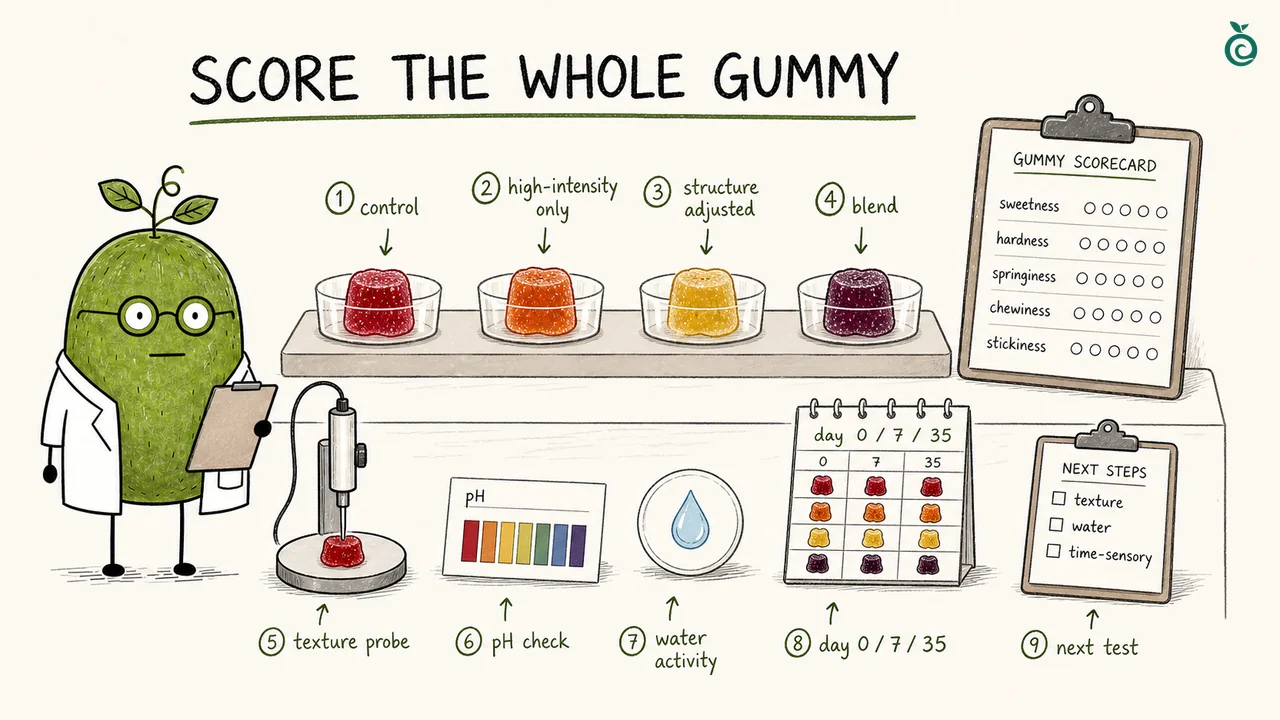
The illustration separates the control and candidate routes so sweetness, chew and water observations can be compared. Its sample colors, empty rating circles and day 0/7/35 calendar are illustrative, not measured results, a required scale or a validated storage schedule. The water-drop symbol is a reminder to record water activity separately; it is not an aw measurement or an instrument.
Write one decision before mixing
State the decision in one sentence: can this system meet the target sweetness and the agreed chew without unacceptable stickiness, bitterness or storage change? Add product type, target market, flavor, gel type, package and the current control.
Keep the comparison routes identifiable
Use the routes needed to answer your question. The four rows below describe different comparisons, not four mandatory production batches. Identify the actual addition and whether sweetness was matched or the amount held fixed.
| Route | What it helps compare | Keep explicit |
|---|---|---|
| Current or sucrose control | The existing sweetness, chew and storage target. | Actual formula, batch, process, package and baseline. |
| High-intensity-only change | What happens when concentrated sweetness is adjusted. | Which solids were removed or retained; a sweetness match does not restore their physical role. |
| Structure-adjusted direction | Whether the body or water-control change addresses the problem. | Every change in gel, solids, acid or process; this is no longer a sweetener-only comparison. |
| Optional blend | The combined result of the complete supplied composition. | Sweeteners, carriers or bulk ingredients and actual addition with unit. |
Gelatin, pectin and starch require different targets
A gelatin gummy, a pectin gummy and a starch-based confectionery do not share one reduced-sugar texture target. Define the gel system and the role of sugar or other solids before adjusting sweetness. For gelatin, record the setting and thermal history; for pectin, record the actual pectin type, acid and solids conditions; for starch, record cooking and structural development. Set Brix, water activity and chew acceptance for that complete system. A high-intensity sweetener can restore sweetness without restoring removed solids. Compare coded candidates against the same control and repeat after the agreed drying, packaging and storage conditions.
Record the process before tasting
Keep the gel identity, acid timing, heating/cooling, moulding, drying or curing, coating and packaging with each sample code. Record the method and actual condition for Brix, moisture, water activity and pH. A refractometer reports a reading under its calibration or reference relationship; in a mixed formulation, do not treat the same reading as proof of equal sucrose, dry solids, sweetness or aw. Retain the reporting basis instead of using Brix and total solids as interchangeable entries.
Keep physical readings and sensory observations separate
Choose the measurements relevant to the actual problem and available method. Keep individual observations with their sample identities before summarizing them. The same number from a different preparation, temperature or instrument setting may answer a different question.
| Record | Keep with the result | Avoid this shortcut |
|---|---|---|
| Instrumental texture | Named parameter and unit, sample geometry, probe, compression, speed and timing; method revision. | Calling a hardness number the complete eating-quality score. |
| Perceived texture and taste | Serving condition, panel/method, attribute definition, scale anchors and actual observation time. | Treating intensity as liking or comparing undefined score scales. |
| Water activity and moisture | Separate measured results, methods, temperature and moisture reporting basis. | Using water activity, moisture and Brix as the same measurement. |
| Surface stickiness or water release | Location, pack/opening history and checkpoint; collection method, unit and denominator if quantified. | Calling a wet surface proof of its cause or a measured syneresis percentage. |
| Decision against the target | Control/candidate result, agreed requirement and unresolved trade-off. | Assuming harder, softer or a higher rating is always better. |
Why hardness needs a sensory companion
McKenzie, Lee and Lee studied 20 model formulations made from four gel systems at five sucrose concentrations. Their instrumental and sensory results describe different aspects of texture. The figure selects two sensory attributes and five texture-profile parameters from the original correlation table; the readable values are also listed below.
| Instrumental parameter | r with perceived chewy | r with melt-in-mouth |
|---|---|---|
| Hardness | +0.43 | -0.18 |
| Fracturability | +0.71 | -0.54 |
| Gumminess | -0.48 | +0.65 |
| Adhesion | +0.58 | -0.68 |
| Cohesion | -0.76 | +0.77 |
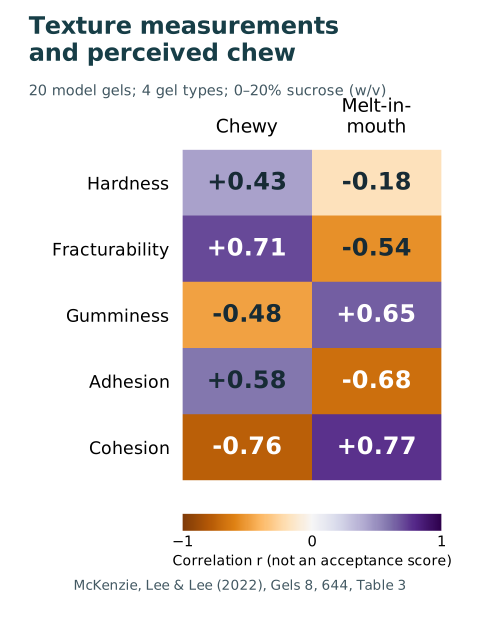
The study did not add another sweetener to match the sweetness of the lower-sugar samples. Its model gels do not establish the result in a finished flavored gummy, or supply a pectin/starch formulation or a commercial acceptance threshold. Use the comparison to select separate measurements, then assess your actual product.
Add a time-sensory record
At comparable serving conditions, record sweetness onset, peak and finish, unwanted taste, acid balance, aroma release and the perceived chew or adhesiveness. Define the attributes and actual observation times before comparing ratings. Keep a liking question separate from intensity. Use your panel and method consistently, rather than importing the illustration's empty circles as a validated scale.
Choose storage checkpoints for the actual product
Define a baseline after the agreed setting, drying or curing stage, then choose checkpoints for the question and intended storage window. Record actual elapsed time, temperature, package and handling. Keep unopened storage separate from units already opened, handled or tasted; use separate matched units where an unopened checkpoint requires destructive assessment. Repeated notes from one gummy or pack are not independent replicates. Repeat the relevant physical and sensory observations against the same target. Separate a planned checkpoint from a completed measurement, and identify missing observations as missing. This record does not assign food safety or a shelf-life claim.
Download the paired gummy trial record
Download the Excel sheet directly, without leaving an email address. It has 32 paired fields for the control and one candidate, including process, measurement methods, sensory notes, water observations and the decision at one actual checkpoint. Make a separate copy for another candidate or checkpoint and keep unit identities with the record. The yellow inputs are blank. It does not calculate a total score, prescribe a dose or fill in unmeasured results. You can use your own trial record and contact us before any sheet is complete.
Turn the result into the next sample request
Start with the gummy type, target market and the main chew, taste or storage problem. Add the gel system, actual control/candidate results and conditions you already know. Mark which change should be tested next and which trade-off remains. Packaging details, estimated quantities and required documents can follow as the ingredient or blend direction becomes clearer.
Common questions
Do we need all four sample routes?
Choose the routes needed for the decision. Keep a comparable control and identify every change in the candidate. Four conceptual routes do not require four commercial batches or one prescribed experimental design.
Discuss this requestDoes a higher hardness result mean a better gummy?
Judge it against the agreed chew target and the relevant sensory, surface and water results. Keep the instrumental method and unit with the value; a single hardness result cannot stand in for the complete eating experience.
Discuss this requestCan equal Brix replace moisture and water-activity testing?
Keep these as separate records with their own methods. A matching refractometer reading in a mixed formulation does not establish equal sucrose, moisture, dry solids, sweetness or water activity.
Discuss this requestMust every gummy be checked on days 0, 7 and 35?
Choose actual checkpoints for the product, process, package and project question. The calendar in the illustration is a scene example. Record the baseline and actual elapsed time rather than treating its days as a validated schedule or a shelf-life approval.
Discuss this requestAre the heatmap values ratings for Hengliyuan ingredients?
They are published correlations across 20 model gel formulations in a 2022 study. They do not compare our ingredients, establish causation or consumer liking, or recommend a replacement dose.
Discuss this requestCan we compare an erythritol-free candidate?
Record that constraint and the complete supplied composition. Compare sweetness, body, chew, water observations and storage under the actual process; removing an ingredient does not itself establish the final texture or label.
Discuss this requestDo we have to complete the Excel sheet before contacting you?
No. Send the gummy type, intended market and one problem first. Add existing observations and conditions as available; specifications, packaging, quantities and documents can be clarified during the sample discussion.
Discuss this request