
Read this guide in
GUMMY COATING SAMPLE GUIDE
Gummy Sugar Coating Test Guide: Adhesion, Moisture Pickup and Powder Loss
Find when gummy coating powder moves: before packing, after handling or during storage. Compare adhesion, surface tack and package residue with a matched control.
Our starting point for gummy coating complaints is simple: find when the powder moved. Powder already loose before packing, coating shed during handling and a surface that turns tacky in storage are different observations. Compare the candidate with an unchanged control at each step before choosing the next sweetener or coating trial.
This guide is for teams evaluating a real gummy base and outer coating. Keep the gel system, surface treatment, package and handling conditions visible in the record. We can discuss sweetener and blend directions from that brief; the trial must establish whether the proposed direction works in your finished product.
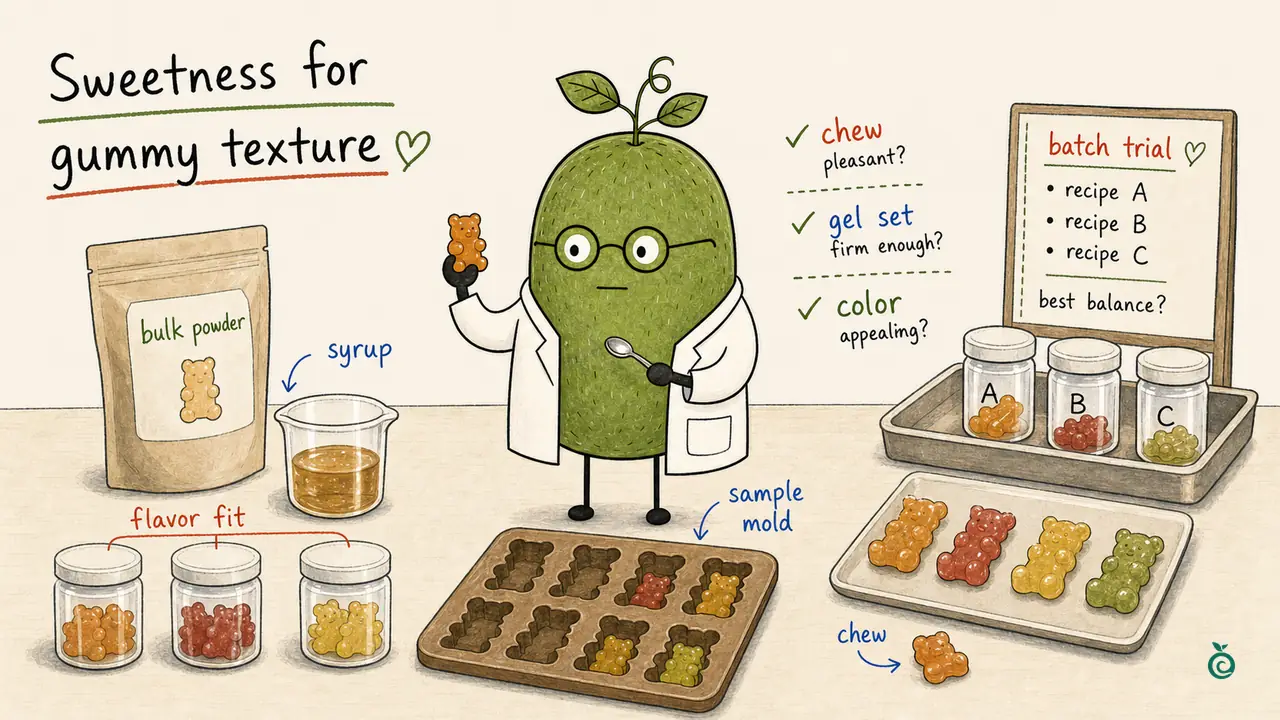
Define the gummy and the outer-coating context
Record the gel system, base recipe and batch, flavor/acid context, control and candidate sweetener forms, outer-coating composition, application stage and sample age. Include conditioning, actual package material and fill quantity. Identify what changed in the candidate. A sample coated today and a control conditioned for several days do not isolate the effect of a sweetener change.
Separate the observation from the suspected cause
Describe what you can see before assigning a cause. A tacky or wet-looking surface is an observation, not a measurement of moisture uptake. Keep measured moisture or water activity in separate fields with the method, sample and conditions. Likewise, loose powder in a pouch is not automatically the amount detached during transport.
| Observed result | Record first | Next comparison |
|---|---|---|
| Loose powder before packing | Initial loose powder, sample age and coating condition | Inspect the control and candidate before applying the handling step. |
| More residue after handling | Where residue appears, handling action and contact material | Compare before and after the same defined action. |
| Tacky, smeared or clumped surface | Time, storage conditions, package and visible change | Review storage observations separately from adhesion; measure moisture-related fields if needed. |
| Bare patches or uneven coverage | Location, coverage before handling and photo reference | Check whether the patch existed before packing or appeared afterwards. |
These rows help choose the next test. They do not identify the cause by appearance alone or assign a universal acceptable powder-loss percentage.
Record package contact and handling-related powder transfer
Take a baseline photo before the handling step, including the gummy surface and any loose powder in the package or tray. Record piece count or sample mass, contact material, package fill and closure, sample age and the movement being tested. Use the same defined action for the control and candidate, then record coverage and residue locations again. Keep the lighting and photo scale consistent. Choose an action that answers the actual packing or transport question rather than inventing a standard shake time or speed.
Turn the observations into a focused sample brief
A readable brief makes the control, candidate and one main change visible before the sample is judged. Use the table below to keep product identity, coating context, package contact, handling condition and powder transfer in separate fields. If a field is unknown, mark it for confirmation instead of filling it with a guessed process setting or threshold.
| Field | Record in the brief | Keep the comparison fair |
|---|---|---|
| Sample identity | Product format, gel system, sweetener form, control or candidate, batch/date | Do not compare an unknown sample with a named control. |
| Coating context | Outer coating or surface treatment, application stage, surface appearance | Keep the surface treatment explicit; do not assume every gummy uses the same route. |
| Adhesion | Where the coating remains attached or visibly detaches at the defined observation point | Record the observation, not a universal adhesion score. |
| Surface condition | Visible wetness, tackiness, smearing or clumping; time and conditions | Do not label a visual observation as measured moisture uptake. |
| Package contact | Contact material, position, contact window and visible residue or sticking | Use the actual package concept under review. |
| Handling condition | Movement or friction action, surface, package state and observer/timepoint | Choose a repeatable project action; do not borrow an unrelated lab setting. |
| Powder transfer | Baseline and post-handling residue location; photo or defined collection method | Initial loose powder and newly detached coating must not be silently combined. |
| Decision question | The one result needed before accepting, revising or requesting another sample | Change one main direction at a time. |
If you weigh collected powder, define what is collected, the collection surface, tare, balance resolution and the basis of any percentage. State whether the result includes initial loose powder or other fragments, and record material that could not be recovered. A collected-residue mass is not automatically a validated coating-loss rate. Do not compare percentages calculated from different denominators.
Choose the next trial from the failed step
If coverage is already uneven before packing, review that starting condition before investigating transport. If the difference appears only after handling, keep the coating and sample preparation unchanged while checking the relevant contact or handling variable. If tackiness appears during storage, preserve the baseline and review the recorded storage and package conditions. Change one planned variable at a time where practical, and record any unavoidable changes. Keep finished-product label review separate from this physical test.
Use the brief to start a Hengliyuan sample discussion
Send us the control/candidate comparison and the one step that failed: initial coverage, handling residue or stored surface condition. Add the actual gummy base, coating composition, sweetener form, intended market and package. Quantity, document needs and sample needs help define the commercial next step. The whole gummy and coating system needs testing; an extract sweetness specification alone does not establish powder retention.
What this test record can establish
A matched trial can show which sample differs under the recorded conditions and where further work is needed. This is our practical comparison method, not a universal coating standard. It does not supply a coating recipe, handling setting, powder-loss limit or shelf-life approval. Keep broader texture, safety and label decisions in their own project reviews.
Review note
Reviewed October 16, 2026. Existing sample-brief fields retained and refined; baseline residue, handling changes and visible surface condition are recorded separately. No experimental results or universal thresholds are presented.
Send these details for a focused gummy coating sample discussion
- Target market
- Product type
- Packaging specification
- Estimated quantity
- Required certificates/documents
- Whether samples are needed
- Gummy base, gel system and sweetener form
- One coating, moisture or powder-transfer question
Common questions
Does powder in a pouch prove the coating failed during transport?
Not by itself. Record loose powder before handling and compare the same package after the defined action. Otherwise initial loose powder can be mistaken for newly detached coating.
Discuss this requestDoes a sticky surface prove moisture uptake?
No. Record tackiness or visible wetness as an observation. A moisture-related measurement needs its own method, sample and conditions; appearance alone does not establish the cause.
Discuss this requestCan I report powder loss as a percentage?
Only with a defined measurement and reporting basis. Record what was collected, initial loose powder, tare, balance resolution and the denominator. Do not compare percentages with different collection methods or denominators.
Discuss this requestWhich conditions should stay matched in the comparison?
Keep the base, sample age, preparation, package fill, contact material and handling action matched wherever they are not the planned variable. Record the control and candidate before and after the same step.
Discuss this requestWill changing monk fruit extract fix coating adhesion?
An extract change needs evaluation in the full base and coating system. Send the composition, control result and failed step so we can discuss a useful sweetener trial; sweetness strength alone does not predict adhesion.
Discuss this requestWhat is the minimum useful sample brief?
Start with the gummy base, coating composition, control/candidate identity, package, handling or storage condition and the main observed difference. Add the target market and known quantity, document and sample needs. You can contact us before every field is complete.
Discuss this request