
Read this guide in
SUGAR-REDUCED GUMMY FORMULATION
Sugar-Free Gummies: Sweetener and Texture Formulation Guide
Why high-intensity sweeteners restore sweetness but not texture in sugar-free gummies, and how to rebuild the chew.
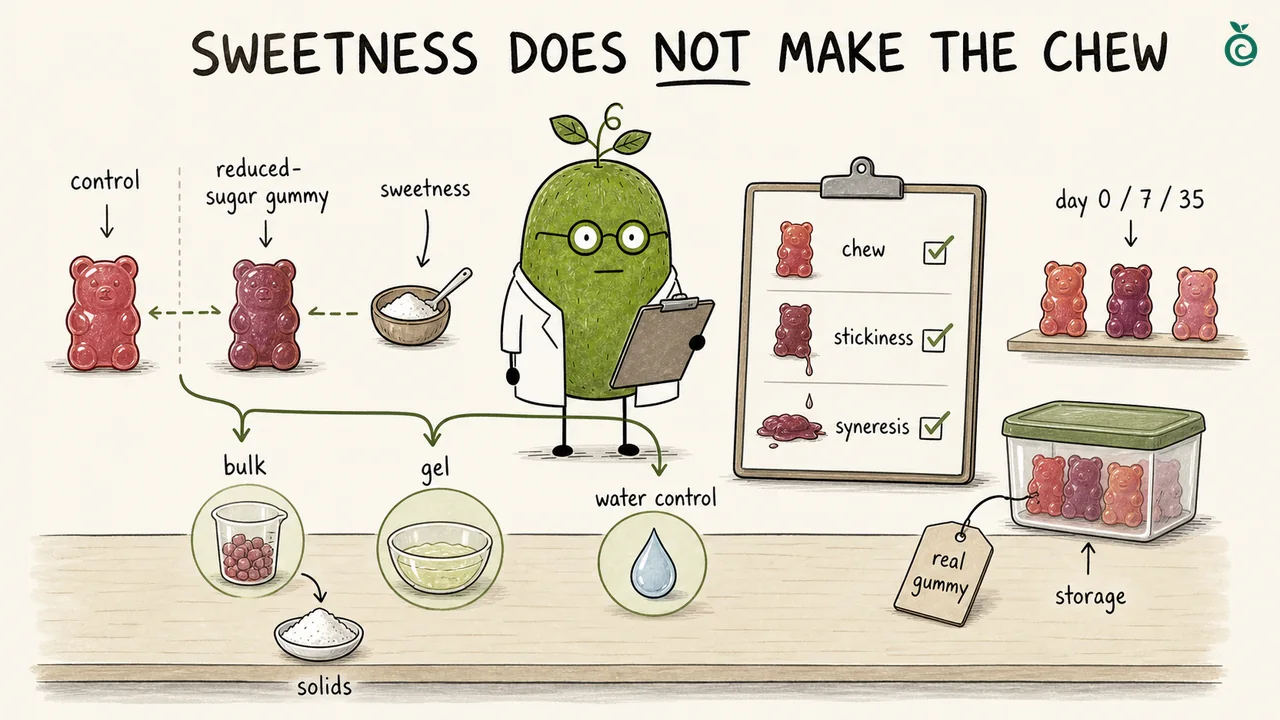
A high-intensity sweetener can restore sweet taste at a low use level. It cannot automatically replace the bulk, dissolved solids, water interactions and gel-supporting functions that leave with sugar. That is why a gummy can taste sweet yet feel thin, soft, sticky or short in the chew.
For a reduced-sugar gummy or jelly, treat sweetness and texture as related but separate questions. Keep a real control beside the new direction, then test the gel and water system in the finished product.
Sugar was doing more than making the gummy sweet
In a model confectionery gel study, sugar concentration changed taste, aftertaste and jiggly or chewy sensory attributes, while the authors also describe sugar's contribution to bulk, viscosity and preservation. Removing sugar therefore changes the physical system even when sweetness is restored. McKenzie, Lee and Lee (2022) is model-system evidence, not a commercial gummy formula. Our practical starting point is to separate the sweetness question from the missing mass, solids and water balance. A successful sweetness adjustment does not demonstrate that the original chew has been rebuilt.
The gel system still controls the bite
Gelatin, pectin, starch, carrageenan, konjac and blended systems do not create the same bite. A single hardness reading or supplier gel-strength grade cannot describe the full eating experience. Identify the gel system, acid, solids and process before changing the sweetness component. Keep the setting, drying or curing history with the sample. If the gel type, acid or process changes at the same time as the sweetener, record those changes; do not assign the whole texture result to one ingredient.
Published example: similar Brix did not mean the same hardness
Maringka and colleagues (2024) studied four high-methoxyl pectin jelly formulations. Treatments A–C used progressively higher FOS/xylitol substitutions, while all formulations retained sucrose and glucose syrup. Acid addition and other components also varied, so this was not an isolated single-ingredient comparison or proof of a sugar-free formula. The table and figure reproduce the reported refractometer and compression-hardness results. The paper reports three replications; its texture test used a flat plate at 1 mm/s at room temperature. These are study methods, not recommended client settings. The authors’ table gives the same significance group for all Brix values, while C has a lower-hardness group than the other formulations.
- Maringka et al. (2024): published paper DOI
- Read the original published paper in an open PDF copy
- See the existing instrument-and-sensory texture comparison
| Study formulation | Reported °Brix: mean ± SD | Hardness (N): mean ± SD |
|---|---|---|
| Control | 81.17 ± 1.04 | 7.88 ± 0.35 |
| A | 81.67 ± 0.58 | 8.16 ± 0.21 |
| B | 82.33 ± 0.58 | 7.82 ± 0.22 |
| C | 82.33 ± 0.58 | 4.40 ± 0.33 |
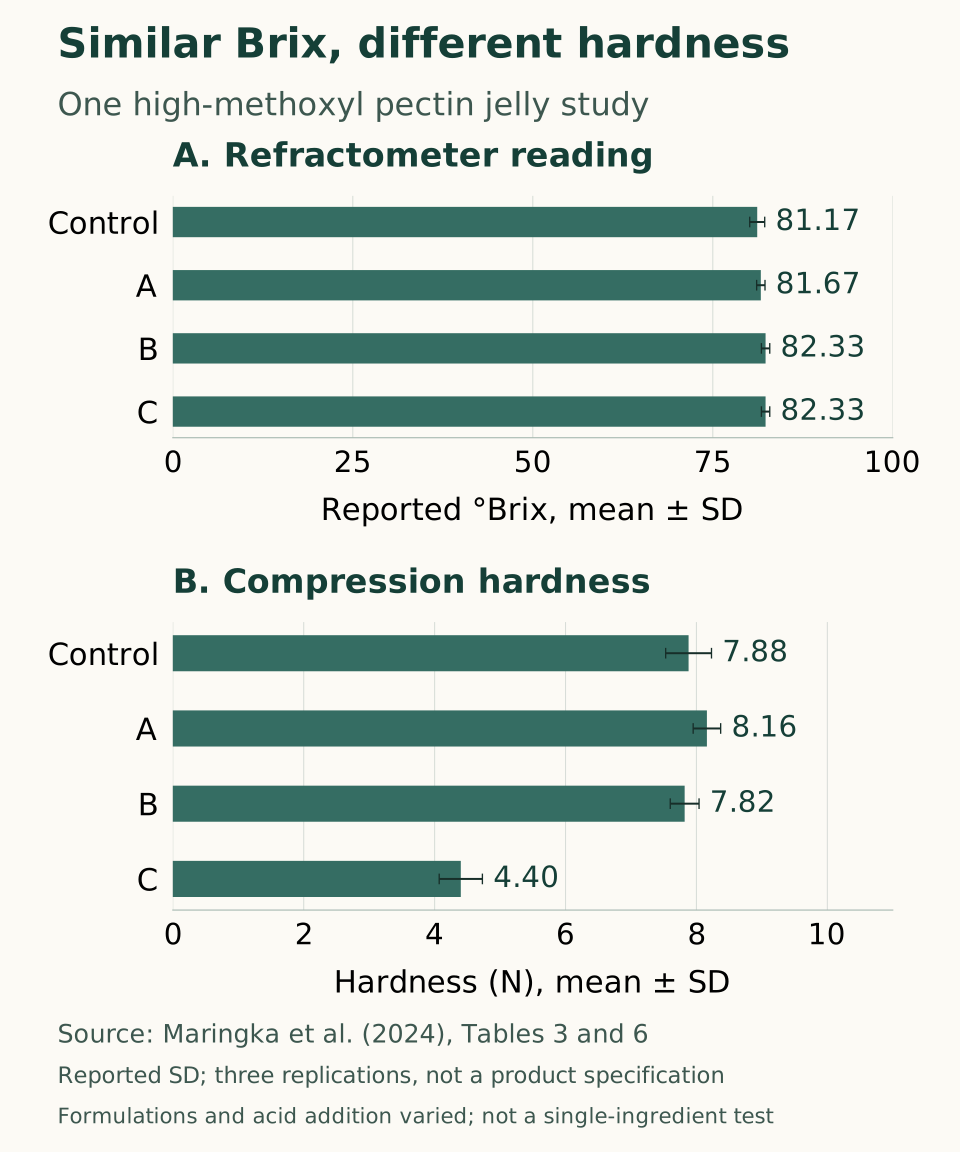
Brix and a compression reading answer different questions. Evaluate the target chew and sensory sweetness directly; neither Brix nor a softer piece establishes liking, shelf life or a label claim. The existing gummy scorecard also explains the distinction between instrumental and sensory texture with the verified McKenzie study data.
Give each ingredient a defined job
Monk fruit or stevia can provide a sweetness lift. Allulose, polyols, fibers, starches, hydrocolloids or other carriers may be considered for body or water management where the target market and product allow them. An erythritol-free project needs its own body and storage route. Do not describe one ingredient as restoring every function of sugar before the real matrix is tested. Monk fruit or stevia may supply the main sweetness as well as an additional lift, depending on the commercial material and formulation. Confirm the complete composition, including carriers; the development candidates named here are not a statement that Hengliyuan supplies every ingredient or manufactures the finished gummy.
Choose the first comparison for the texture question
Keep the current or sucrose formula as the control. The three directions below help separate the missing sweetness from the physical changes; they are options for planning, not a requirement to make three batches. Record actual commercial materials, masses and changes in solids or water, rather than assuming equal sweetness makes the samples physically equivalent.
| Direction | What the comparison needs to show |
|---|---|
| Current control | Identify formula version, material grades, finished mass, gel and acid, process and package. Record the actual texture and sweetness target. |
| Reduced-sugar direction with high-intensity sweetness | Identify the sweetener and use level, and document the remaining bulk, water and finished mass. This sample can reveal a texture gap even if sweetness is acceptable. |
| Structure-adjusted direction | Record the defined bulk, solids or gel adjustment and compare with the relevant control. Keep other conditions matched where possible; disclose changes in acid, process or package. |
An additional blend is useful only when it answers a defined trade-off. Choose the next change from the observed result; avoid changing several variables without retaining the formula and process versions.
Use the existing texture and storage record
Record sweetness separately from instrumental and sensory texture. Include the actual method and units for Brix or total solids, pH, water activity and moisture; these are not interchangeable measurements. Keep sample geometry, probe, compression, speed and timing with instrument results. Record chew, melt, tackiness, visible water, color and the sweetness finish against the agreed target. Define the baseline after the relevant setting or drying stage, then choose checkpoints for the product and storage question. Record actual elapsed time, temperature, packaging and opened or unopened history. Use separate matched units where tasting or testing destroys an unopened checkpoint; repeated notes on one pack are not independent replicates. The existing free Excel record has 32 paired fields for one control, one candidate and one actual checkpoint. It starts blank, has no automatic total score or dose recommendation, and can be copied for another candidate or checkpoint. Download it directly without leaving an email; you can use your own record and contact us before any sheet is complete.
Set trial gradients by the application test
No verified company formula range is published here. Define the gelatin, pectin or starch system and request application-specific starting guidance. Compare the current control with a lower, central and higher candidate around the agreed starting direction, recording the actual masses of gel, bulking ingredients, polyols or allulose where its use is permitted. These are trial labels, not fixed dose recommendations. Keep the gel process, drying and package comparable. Record set, chew, tackiness, water activity and storage separately from sweetness. Use the result to choose one next adjustment and preserve the formula version. A successful fresh sample does not validate production or shelf life. Use a gradient when a dose-response question needs it. It is not a mandatory set of samples for every first conversation; define the starting direction and the comparison needed before choosing the number of candidates.
Turn the texture problem into a useful sample brief
Start with the intended market, gummy or jelly format and the main problem: for example, a short chew, tackiness or visible water after storage. You can contact Hengliyuan before a full formula, complete diagnosis or finished spreadsheet is available. Add the known gel system, process and drying, ingredient restrictions, packaging, estimated quantity, required documents and whether samples are needed. For the selected material, check specification and supporting documents against its identity and intended market. Ingredient permission, product category and sugar-related claims need their own review; the cited trials do not approve a finished-product label or commercial shelf life. For allulose projects, use the existing market and label guide, including the current U.S. project-review information.
Technical references and scope
McKenzie, Youngsoo Lee and Soo-Yeun Lee (2022) studied 20 model gel conditions, not finished commercial gummies or a sweetness-matched monk fruit/stevia replacement trial. The existing scorecard contains its verified instrumental–sensory comparison; the formulation and methods remain part of the interpretation. Maringka, Lo and Indrawanto (2024), BIO Web of Conferences 98, 06002, supplies the pectin jelly data shown here. The original published PDF was read through the linked open copy and checked against its DOI and author details. Its results do not prescribe ingredient doses, prove an isolated sweetener mechanism or predict the performance of a Hengliyuan product.
Common questions
Can monk fruit or stevia make a gummy chewy by itself?
They can supply sweetness but do not automatically replace sugar’s mass, dissolved solids and water interactions. Chew depends on the complete gel, bulk, water and process system. Evaluate the commercial material in the actual gummy.
Discuss this requestDoes the pectin jelly study establish a sugar-free formula?
No. Its formulations retained sucrose and glucose syrup, and acid addition and other components also changed. The plotted results are published model-system data, not a Hengliyuan formula, product specification or single-ingredient effect.
Discuss this requestCan similar Brix confirm the same texture?
No. In the cited pectin model, Brix values belonged to the same reported significance group, while formulation C had lower compression hardness. Brix also does not establish sweetness, liking, water activity or a sugar-related label claim.
Discuss this requestIs a softer gummy always a failed gummy?
No. Compare it with the intended texture and sensory target. A compression-hardness result describes one measurement under particular conditions; it does not rank the whole eating experience.
Discuss this requestDo all projects need the same sample routes and storage days?
No. Choose the control, candidates and checkpoints that answer the question. Record actual elapsed time, process and package history, and keep opened or destructively tested units separate from unopened storage units. Screening dates are not validated shelf-life limits.
Discuss this requestDo we need a new Excel sheet or a completed record before contacting you?
No. The linked existing record is free to download without an email address and has blank paired fields for one control and candidate at one checkpoint. You can use your own record, copy it for another comparison or contact us before any sheet is complete.
Discuss this requestWhat should buyers send before asking for gummy sweetener samples?
Start with the market, gummy or jelly format and texture or taste problem. Add the known gel system, processing, restrictions, packaging, quantity, document needs and sample request. A complete formula or confirmed diagnosis is not required for the first conversation.
Discuss this request