
Read this guide in
GUM AND MINT SWEETENER TESTING
Sugar-Free Chewing Gum and Mints Sweetener Blend Guide
Sweetener blend testing guide for sugar-free gum, mints and tablets: timing, flavor release, storage and sample briefs.
Sugar-free gum and mints are not judged by first sweetness alone. Consumers notice how fast mint or fruit aroma appears, whether sweetness drops too early, whether bitterness lingers and how the piece changes during chewing or storage.
Use this guide when planning stevia, monk fruit, allulose-supported, polyol-based or erythritol-free sweetener blend directions for chewing gum, pressed mints, tablet candy and breath-freshening confectionery.
Define the format before the sweetener
Chewing gum, coated gum, compressed mints, tablet candy and chewable confectionery need different sweetener and flavor-release decisions. Start with gum base or tablet system, piece weight, coating, flavor type, cooling target, texture target and storage condition. A successful compressed mint does not establish performance in a gum base, and an uncoated gum result does not settle a coated product. Keep piece size and the base consistent when comparing sweetener candidates.
| Format | What the comparison must cover |
|---|---|
| Uncoated chewing gum | Sweetness, aroma and cooling through chewing; initial and chewed texture |
| Coated gum | Coating sweetness and cracking, followed by the flavour and texture of the gum centre |
| Pressed mints or tablet candy | Initial sweetness, dissolution and finish; compression behaviour, breakage and moisture pickup |
Track the early taste and the full eating period
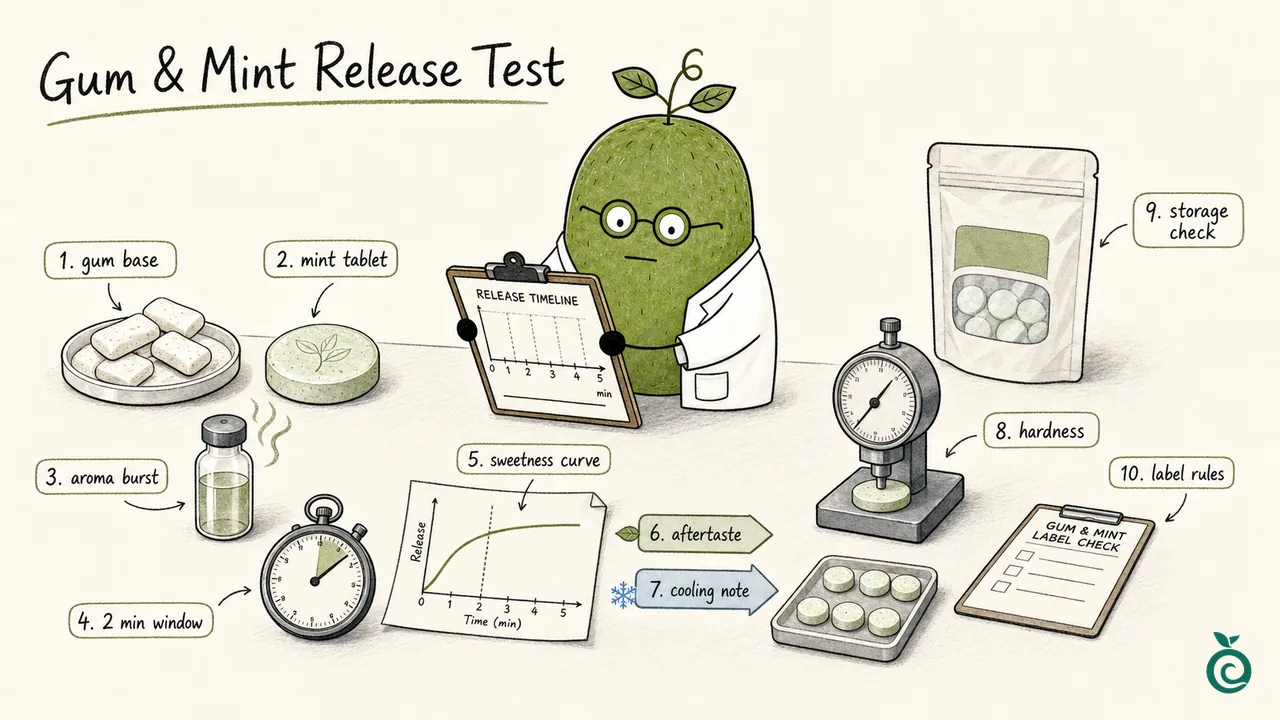
Record aroma burst, cooling, initial sweetness, peak sweetness, bitterness, lingering sweetness and how quickly flavour falls. A sample can taste strong at 20 seconds and still feel empty after two minutes; those times are an illustration, not a standard pass/fail protocol. Choose observation points that capture the intended chewing or dissolution period. Keep preparation, piece weight, serving conditions and the tasting method comparable, use coded samples and include a control. Record aroma and sweetness separately: an instrumental release measurement, perceived aroma and perceived sweetness answer different questions.
| Observation | What to record separately |
|---|---|
| Early eating window | Sweetness onset, aroma burst and cooling; note whether any bitterness appears |
| Later chewing or dissolution | Sweetness and aroma at the same recorded times; cooling and texture changes |
| After the piece is removed or dissolved | Duration and character of sweetness, bitterness or other aftertaste |
| Instrumental testing, if needed | The analyte, method, units and time points; do not label the reading as a sensory score |
Choose the sweetener role carefully
Stevia can support high-intensity sweetness, monk fruit may help round the finish in some systems, and allulose or carrier-supported directions may be considered where the target market and process allow them. Polyols or fibers may still be needed for bulk, hardness or cooling, depending on label goals. High-intensity sweetness alone does not replace the mass, cooling or structure supplied by the bulk system. An erythritol-free direction still needs those functions addressed in the finished piece. Compare identified commercial ingredients and their full blend composition rather than assuming equal powder weights will taste alike.
Verify storage in the intended pack
Gum and mints can lose freshness, aroma and perceived sweetness after warm or humid storage. Compare stored samples with the initial sample and the control, documenting the packaging, temperature, humidity and duration. Check gum texture and coating separately; for pressed mints, include cracking, sticking and moisture pickup as well as flavour. A short accelerated screen helps expose a weak direction. Set acceptance criteria for the actual product, then verify its intended storage and packaging before assigning shelf life. A different texture probe or sample state can change a hardness reading, so keep the method and whether the gum was chewed or unchewed in the record.
Prepare documents and label checks
Tell the supplier the target market early. Sweetener permission, polyol warning rules, ingredient naming, natural flavor position, allergen files, halal files, COA and export documents may affect whether a sample direction can become a commercial quote. Check the actual food category, ingredient specifications and planned claims in that market. A product catalogue or a published gum study does not establish permission for every country, mint or tablet format.
Start with the product and the taste problem
Start with the product format, intended market and what needs to change: a short sweet finish, weak lasting aroma, excess cooling, bitterness or a storage issue. You can contact Hengliyuan before a complete formula or test sheet is ready. Add the known base or tablet system, flavour, current sweetening approach, piece size and ingredient constraints, including whether polyols or erythritol are allowed. For sample planning, share the desired sweetness and cooling, process, packaging and intended storage. Existing sample observations help us discuss an ingredient or blend direction. For procurement, add estimated quantity, document needs and whether samples are required. Hengliyuan can discuss matching ingredient specifications and available supporting documents; confirm the selected material, sample requirements and purchase terms for the actual request.
What the aroma-release study actually measured
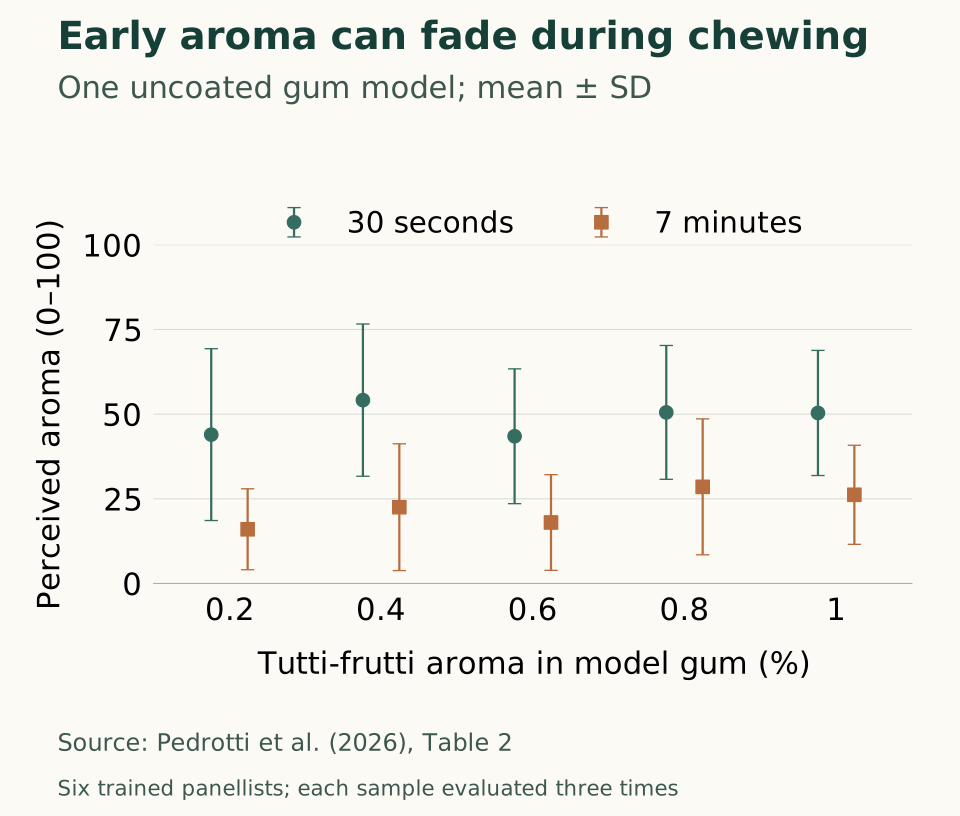
Pedrotti et al. (2026) compared five tutti-frutti aroma concentrations in an uncoated model gum. Six trained panellists rated aroma and sweetness at set times while nose-space analysis measured volatile release. The study found an effect of aroma concentration on perceived aroma, but no significant main effect on perceived sweetness. Adding aroma therefore should not be assumed to repair sweetness in another formulation. A separate chewing-simulator experiment measured the release of sorbitol, mannitol, xylitol, maltitol and aspartame. Its early burst and later release pattern was an instrumental result; the study did not test stevia, monk fruit or allulose release. Neither experiment establishes a universal gum or mint formula.
Published aroma scores show why later checks matter
These are selected 30-second and 420-second observations from Table 2 of the same 2026 study, not a reconstructed release curve. Panellists chewed at 60 chews per minute; each sample was evaluated three times by each of the six panellists. The 0–100 scores describe perceived aroma intensity, not aroma mass, sweetness or liking.
| Aroma in model gum (%) | 30 s: mean ± SD | 420 s: mean ± SD |
|---|---|---|
| 0.2 | 43.95 ± 25.38 | 16.00 ± 11.95 |
| 0.4 | 54.13 ± 22.48 | 22.52 ± 18.72 |
| 0.6 | 43.46 ± 19.91 | 18.00 ± 14.13 |
| 0.8 | 50.51 ± 19.77 | 28.52 ± 20.07 |
| 1 | 50.34 ± 18.48 | 26.18 ± 14.63 |
What the stevia substitution study supports
Aykut and Kirkin (2025) compared four mint-flavoured gums using sorbitol, with or without partial replacement by xylitol, and either aspartame or stevia. In that system, replacing aspartame with stevia produced no statistically significant change in the reported colour, texture and sensory properties. The sweetener amounts differed; this was not an equal-weight substitution test. Seven trained panellists evaluated sweetness, aroma and freshness after one and five minutes. The samples were individually packed in polyethylene and stored for two weeks at 40°C under cycling humidity conditions. Sensory properties changed during storage, and the polyol choice affected the result. This supports checking both the sweetener and bulk system; it does not establish a universal stevia grade, replacement ratio or commercial shelf life.
Common questions
Can stevia replace aspartame in sugar-free gum?
It is a reasonable sample direction. One 2025 gum study found no significant difference in the reported colour, texture and sensory properties when replacing aspartame with stevia in its tested formulations. Confirm the stevia grade, dose, bulk system, flavour, storage and market requirements in your own gum; equal powder weights are not an established replacement rule.
Discuss this requestCan monk fruit be used in gum or mints?
Consider it as part of a sweetener direction where the intended market permits the selected ingredient. Test its onset, finish, bitterness and flavour fit in the real base and format. The two gum studies discussed here do not establish monk fruit performance.
Discuss this requestIs two minutes long enough to approve a gum sample?
Two minutes can capture an early window, but the comparison should cover the intended chewing or dissolution period and the finish. A gum designed for a longer flavour duration needs later observations; a pressed mint needs its own dissolution assessment.
Discuss this requestDoes stronger measured aroma release mean stronger sweetness?
No. Nose-space aroma release, perceived aroma and perceived sweetness are separate measurements. The 2026 model-gum study found that aroma concentration affected aroma perception without a significant main effect on sweetness perception.
Discuss this requestCan a high-intensity sweetener replace the bulk ingredient?
High-intensity sweetness does not by itself replace bulk, cooling or structure. Compare the whole system, including its mass balance, processing behaviour, texture and target-market label requirements.
Discuss this requestDoes passing an accelerated storage screen prove shelf life?
No. It helps identify potential changes under that screen. Verify the actual formulation in its intended packaging and storage, using product-specific acceptance criteria and suitable test methods.
Discuss this requestWhat should buyers send before gum or mint samples?
Start with the format, intended market and taste problem. Add the base, flavour, sweetener constraints, packaging, quantity, document and sample needs where known. A complete formula or spreadsheet is not required for the first conversation.
Discuss this requestAre the published gum results also specifications for compressed mints?
No. The cited studies tested chewing gum. Compressed mints also require their own compression, hardness, breakage, moisture and dissolution checks, alongside sweetness and aftertaste in the finished tablet.
Discuss this request