
Cultured dairy trials
Stevia for Reduced-Sugar Yogurt: Test the Base and Fruit Prep Separately
Compare stevia in the yogurt base, fruit preparation and final pack. Track component doses, fruit ratio, taste and whey separation before selecting a sample.
In a fruit yogurt, the cultured base and fruit preparation are two different sweetening environments. Stevia may taste acceptable in one and leave a bitter or lingering finish in the other. Test each component before blending them, then judge the packaged product.
This page covers where the stevia sample enters the product. The existing yogurt scorecard covers the full multi-sweetener sensory comparison.
Taste the cultured base on its own
Start with the same plain yogurt control. Add the selected stevia material at a defined dose and compare sweetness onset, sourness, bitterness, linger and mouthfeel at serving temperature. Record the named glycoside composition and any carrier in the sample; different stevia preparations should not be treated as the same ingredient. If removing sugar changes body or whey separation, address that structure separately. Stevia supplies sweetness at low use levels, not the mass of removed sugar.
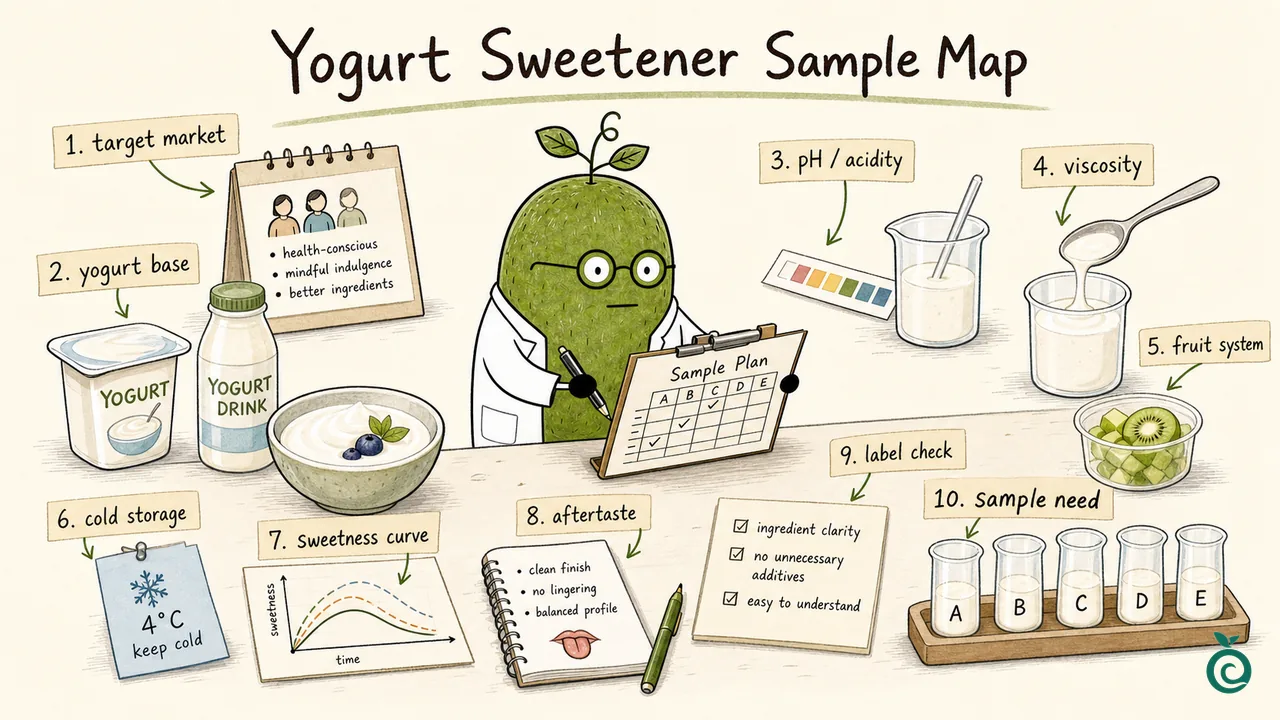
Test the fruit preparation separately
Fruit type, acid, soluble solids and processing can change the taste balance. Compare the fruit prep with and without the selected stevia in the same fruit system, then combine it with the yogurt base at the intended ratio. A good fruit prep alone may still taste unbalanced after stirring into cultured dairy. Cargill's published Greek-style fruited-yogurt prototype places its fermentation-derived EverSweet stevia sweetener and SimPure waxy corn starch in the fruit preparation. It is a supplier application example, not a controlled base-versus-fruit trial or evidence for Hengliyuan ingredients, production routes or outcomes. Our reason for screening the components separately is to locate which part of the actual product needs adjustment.
Keep the component dose and final-pack dose distinct
Record the actual commercial material, composition, carrier and amount entering each component, including any stock concentration and dilution. Keep the final base-to-fruit mass ratio and all sugar changes visible. For the same commercial material, calculated input contribution in g/kg finished product is its dose in g/kg component multiplied by that component's mass fraction in the finished product. Use a consistent final-product basis and report different materials separately; this accounting does not select a dose or prove material recovery after processing.
| Comparison route | Keep identified | Question for the final product |
|---|---|---|
| Current product control | Actual base and fruit recipes, their final mass ratio, preparation and serving conditions | What is the reference taste, texture and visible whey separation? |
| Change the base direction | Selected material and dose in the base; record sugar changes and retain the stated fruit preparation | Does the base change resolve the gap after the same fruit addition? |
| Change the fruit direction | Selected material and dose in the fruit preparation; retain the stated base and final ratio | Does the fruit change still work after it is combined with the cultured base? |
| Change both components | Each material and component dose, full changed recipes and final combination ratio | Does the combination meet the target, and which earlier comparison explains any remaining defect? |
These routes organise a comparison, not a prescribed four-sample recipe or an assumption that the current control contains no stevia. State whether additions are fixed or adjusted to matched sweetness, and record the adjustment. A change in fruit ratio or structure is another formulation change; keep it visible when interpreting the result.
Check the product as packed and stored
Taste a fresh pack and repeat through the intended shelf-life study. Record the fruit-to-yogurt distribution, sweetness finish, acid balance, viscosity and visible whey separation. Do not infer shelf life from a bench cup. If the product is a drinkable yogurt, run a separate process and texture check rather than borrowing the spoonable-yogurt result. Record whether the pack is stirred, layered or fruit-on-the-bottom and how the portion was prepared for tasting. A sample of one layer and a fully mixed serving answer different questions. Record the actual sample unit, preparation and storage history, method and checkpoint for physical measurements; keep those readings separate from sweetness intensity and liking. Use the existing sensory scorecard for panel records and the gel guide for the separate physical checks.
Start with the yogurt and the component you want to change
Tell Hengliyuan the intended market, dairy or plant base, fruit type and the taste or texture gap you want the next sample to address. Share the current sugar direction, addition stage, final base-to-fruit ratio and process details you know; measurements, quantities and a completed record can follow. Ask for the exact preparation, ingredient list, specification and available sample documents. Clarify whether the request is for an ingredient, a blend or a different finished-product/packing project before the quotation scope is set. Review the complete formula and destination-market label before making a reduced-sugar claim.
Common questions
Should stevia be added to the base, the fruit preparation or both?
Choose a trial route from the component that needs adjustment. Screen the base and fruit preparation separately, then compare the final yogurt at the stated ratio. The same material can behave differently after the components are combined.
Discuss the yogurt sample projectIs the fruit-preparation dose also the dose in the final yogurt?
Not automatically. State its units and the amount of fruit preparation in the finished product. For the same material, calculate component contributions on a consistent final-product mass basis; keep different materials separate and check actual processing losses.
Discuss the yogurt sample projectDoes the current product control have to contain no stevia?
No. Record the actual current recipe and preparation as the reference. Explain what changes in each candidate, including sugar and fruit ratio, rather than assuming that a control is an unsweetened plain yogurt.
Discuss the yogurt sample projectIf the fruit preparation tastes right on its own, is the trial finished?
No. Combine it with the intended base at the actual ratio, prepare the serving as the product will be eaten and compare the final pack. Layered and fully stirred samples need their preparation recorded.
Discuss the yogurt sample projectDoes stevia replace the body of the sugar removed?
It supplies sweetness at low use levels, not the missing sugar mass. Keep changes in body, texture or whey separation as separate formulation and physical observations instead of treating them as a sweetness score.
Discuss the yogurt sample projectCan I copy a serving or storage temperature from the illustration?
No. The drawing is a sample-planning aid. Use the actual product's stated conditions and study plan; its 4 degrees C note, spoon, pH strip and curves are not validated targets or measurements.
Discuss the yogurt sample projectDoes Cargill's prototype prove a result for our stevia sample?
No. It describes that supplier's sweetener and starch in a fruit preparation. It does not establish the identity, production route, dose or performance of a Hengliyuan sample, or document a controlled base-versus-fruit comparison.
Discuss the yogurt sample projectMust I finish the sensory and storage study before contacting you?
No. Start with the yogurt type, intended market and which component or defect you want to address. Share what you know; the selected material, documents, sample quantity, form and quotation scope can be clarified next.
Discuss the yogurt sample project