
Read this guide in
CHOCOLATE BULK AND LABEL GUIDE
Sugar-Free Chocolate Sweetener Systems: Bulk, Texture and Label Checks
Sugar-free chocolate sweetener systems: bulk routes, texture, naming and label checks, plus a sample matrix template.
In chocolate, sugar does more than sweeten. It provides bulk, particle structure, solids, process behavior and part of the eating texture.
For sugar-free or reduced-sugar chocolate, buyers should first decide what replaces sugar's bulk role, then use monk fruit, stevia or other sweetness tools to adjust the final curve.
Split the job into bulk and sweetness
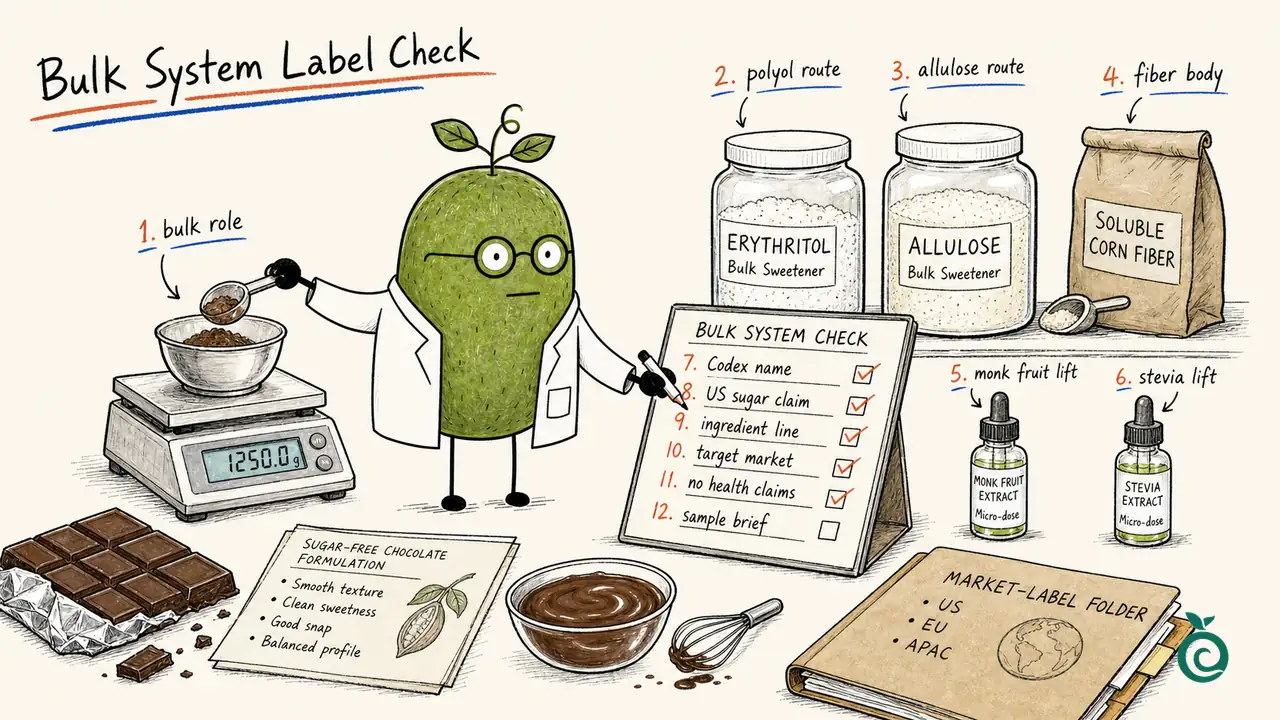
Our starting point is the physical chocolate system. A high-intensity sweetener can supply sweetness at a low use level, but it does not replace the mass and particle structure removed with sugar. Choose a suitable bulk route, then adjust sweetness and aftertaste in that base. Monk fruit or stevia may provide the main sweetness or an additional lift, depending on the selected ingredient and formulation. Either way, account for the remaining solids, fat and moisture. A sweetener approved in water has not yet passed a chocolate trial.
Choose a bulk route for the actual chocolate
Possible development routes include polyols, allulose where permitted, fructooligosaccharides, inulin, polydextrose, soluble fibers or carrier-supported systems. This is a list of formulation candidates, not a statement that Hengliyuan supplies every named material. Identify the commercial grade and its full composition before comparing samples.
| Candidate route | What the trial must resolve |
|---|---|
| Polyol-based bulk | Particle feel, cooling, moisture, melt and ingredient-specific label requirements in the intended market |
| Allulose-supported bulk, where permitted | Category and market eligibility, bulk balance, particle behaviour and separate label-claim review |
| Fiber or fiber-supported bulk | Actual composition, sweetness contribution, dispersion, moisture and finished-product texture; do not treat all fibers as equivalent |
| A combined bulk system | The purpose of each component, total mass and solids balance, sweetness finish and process compatibility |
Compare ingredient cost at the actual commercial use level for the same amount of finished product and in the same currency. A price per kilogram of sweetener alone does not establish the lower-cost chocolate.
Test monk fruit and stevia in the finished base
Cocoa intensity, fat, milk ingredients, the bulk system and serving temperature all belong in the sweetness comparison. Record onset, peak sweetness, bitterness, cooling and the finish after swallowing. Use the identified commercial monk fruit or stevia ingredient; an extract grade and a carrier-containing blend are not interchangeable by weight. Keep the base and processing comparable when changing the sweetness component. If the change also alters solids or moisture, document it and rebalance the formula rather than attributing the whole result to the high-intensity sweetener.
Check the chocolate name before artwork
Product naming, ingredient permission and nutrition claims are separate checks. The Codex Standard for Chocolate and Chocolate Products, CXS 87-1981, section 5.1.1, calls for an appropriate declaration near the sales designation mentioning sweeteners when they wholly or partly replace sugars. Its product categories also have compositional requirements. Use Codex as an international reference, then check the applicable law for the intended market and actual chocolate, compound coating or filling. A naming statement under Codex does not approve an ingredient in every country, establish a sugar-free claim or guarantee that a proposed product may legally be called chocolate.
U.S. sugar claims and allulose Facts treatment are separate
For an ordinary chocolate food, the U.S. sugar-free rule includes less than 0.5 g sugars per reference amount customarily consumed and per labeled serving. Passing that number alone is insufficient: the ingredient conditions and calorie-related labeling conditions in 21 CFR 101.60(c)(1) also apply. Do not use a low sugar-panel number as packaging clearance.
- Current 21 CFR 101.60: sugar-related claim conditions
- FDA October 2020 allulose labeling guidance: original PDF
| U.S. question | Check before approving the wording |
|---|---|
| Sugar free or zero sugar? | Review 21 CFR 101.60(c)(1) as a whole: both quantity bases, sugar-containing ingredient conditions and the required calorie claim or accompanying statement. |
| No added sugar? | Review the separate conditions in 101.60(c)(2): additions and functional substitutes, ingredients containing added sugars, processing, the reference food and applicable calorie/nutrition statements. It is not a synonym for sugar free. |
| How is allulose declared in the Facts panel? | FDA’s October 2020 guidance describes enforcement discretion to exclude allulose from Total Sugars and Added Sugars and use 0.4 kcal/g for allulose. Allulose remains in Total Carbohydrate and the ingredient statement. |
The allulose document is nonbinding U.S. guidance on specified label declarations, not a global ingredient authorization or automatic approval of a front-of-pack claim. Have the complete formula, serving size, panel and proposed wording reviewed together.
For a new U.S. allulose project, include the main sales states
For new U.S. allulose and allulose-blend projects, Hengliyuan asks for the primary sales states, separately from the buyer’s address and the shipping destination. Include the product category, channel, formula and serving size for the label review as they become available. Our current workflow keeps zero-sugar wording out of new packaging drafts pending qualified U.S. review. Sugar free and no added sugar are not automatic replacement phrases. Ingredient specifications, a COA, a sensory result or a Nutrition Facts calculation do not by themselves approve advertising claims. This is our project-review practice; it is not a statement that allulose is prohibited.
Use a small, recorded sample matrix
Start with a control and the changes needed to answer your specific question. The four rows below are optional trial directions, not a requirement to make four samples or a recommended formula. Assign sample IDs and record actual commercial ingredients, amounts and process conditions.
| Trial direction | Change and comparison to record |
|---|---|
| Control | Keep the current reference formula, material grades, batch mass, refining and fat-processing route. Record the fresh result and the same storage checkpoints as candidates. |
| Bulk-system change | Identify the replacement and its mass/solids contribution. Account for any sweetness difference; keep other variables matched where possible and disclose unavoidable changes. |
| Sweetness-component change | Use the same bulk base where possible. Record the monk fruit or stevia material and amount, rebalance to the same finished mass, and note any carrier or moisture change. |
| Combined change | Record both changes and the full mass balance. Compare with the control and relevant single-change samples; do not assign the result to one ingredient alone. |
For every sample, record particle method and preparation, flow-test temperature and method, refining/conching, fat crystallization or cooling, melt, snap, sweetness finish, package and storage conditions. Compare the fresh and stored samples under the same conditions. Set criteria for the actual product; a stress screen does not establish retail shelf life. Use the existing coating scorecard for the detailed observation record.
Start the sample discussion with the market and product
Tell us whether you are developing a bar, coating, filling or another chocolate format, the intended sales market and what you want to improve. You can contact Hengliyuan before a full formula or completed scorecard is ready. Add the known bulk direction, ingredient restrictions, processing, packaging, estimated quantity and whether you need samples. For the selected material, request the specification, COA and any required allergen, halal, non-GMO or ingredient-statement support. We can check which documents are available for that request; the exact file set depends on the material and market.
References and scope
The Codex reference was checked in its official 2026 publication of CXS 87-1981, amended in 2025, including the 2026 numbering corrigendum. The U.S. claim reference was checked against the current eCFR text, up to date through October 15, 2026; the FDA allulose source is its October 2020 guidance. Recheck the applicable requirements before final artwork. For particle data and the limits of published FOS/allulose chocolate experiments, use the linked texture-and-bloom guide. Those studies describe specific formulations and processing, not Hengliyuan product tests or a general formula. This article provides a development and procurement framework; finished-product decisions still depend on the actual material, process and sales market.
Common questions
Can monk fruit or stevia replace all the sugar in chocolate?
They can provide sweetness at low use levels, including the main sweetness in a suitable system. They do not replace all of sugar’s mass, particles and process contribution. The formula needs an appropriate bulk system as well as a sweetness decision.
Discuss this requestWhy test sweetness in chocolate rather than water?
Water does not reproduce the cocoa, fat, bulk system, serving temperature or melt of the finished product. Compare onset, bitterness, cooling and finish in the actual base, with the commercial ingredient identified.
Discuss this requestIs sugar free the same as no added sugar?
No. In the United States, 21 CFR 101.60 gives them separate conditions. Sugar free includes a quantity threshold on two bases plus ingredient and calorie-related conditions; no added sugar has separate addition, ingredient, processing, reference-food and labeling conditions.
Discuss this requestDoes FDA’s allulose guidance automatically allow a zero-sugar chocolate claim?
No. The guidance addresses specified Facts-panel declarations and calorie calculation under U.S. enforcement discretion. It does not automatically approve a front-of-pack claim. Allulose remains in Total Carbohydrate and the ingredient statement.
Discuss this requestDoes a Codex naming provision authorize allulose globally?
No. Codex naming provisions, national product standards, ingredient permission and claim rules are distinct. Check the intended country and product category before selecting the ingredient and approving the name.
Discuss this requestMust we make all four samples in the matrix?
No. Select the control and candidates needed for the question. Record all material and process changes, maintain the intended finished mass, and disclose differences in solids or moisture rather than calling an unmatched comparison a sweetener-only result.
Discuss this requestWhich information is needed to start a sample request?
Start with the chocolate format, intended market and the problem or target. Add known ingredient restrictions, process, packaging, quantity and document needs. A full formula or completed scorecard is not required for the first conversation.
Discuss this requestWhat should a new U.S. allulose packaging brief include?
Include the primary sales states separately from the buyer and shipping addresses, along with product category, channel, formula, serving size and proposed wording as available. Hengliyuan holds zero-sugar wording out of new packaging drafts pending qualified U.S. review; sugar free and no added sugar are not automatic substitutes.
Discuss this request